FREQUENTLY ASKED QUESTIONS
Content moderators are trained using structured onboarding assessments that combine the client's community guidelines with simulated exercises based on real case studies.
In most cases, the policy decision is already known, allowing new moderators to practice evaluating content safely before moderating active queues.
How Moderators Stay Aligned with Platform Policies
Subject Matter Experts (SMEs) translate compliance policies into actionable guidelines for moderators on a regular basis. As platforms grow and new content trends or edge cases emerge, SMEs update the internal knowledge base and training material immediately and conduct daily standup briefings to keep the entire team aligned.
To maintain accuracy over time, moderation teams attend regular calibration sessions to discuss policy nuances and shifting cultural contexts. Quality Assurance (QA) specialists assess moderation decisions in real-time using scorecards to make sure that individual analyst decisions remain consistent and compliant as content platforms scale.
To enforce community guidelines consistently, we implement a centralized training framework and structured hierarchy within our managed services model.
Moderators undergo intensive training built around clear positive and negative examples, alongside specific protocols for handling complex edge cases.
How Consistency is Maintained
To ensure compliance, BUNCH integrates directly into your existing content management system and workflows, using your documented policies as the single source of truth for all moderation decisions. Every moderator is trained on your specific brand guidelines, instead of relying on individual interpretation.
This setup is overseen by Service Delivery Managers (SDMs) who manage teams across global hubs in the Philippines and Vietnam, maintaining operational consistency across shift rotations on a 24/7 basis.
Each moderation team also includes Quality Assurance specialists who oversee moderator decisions and flag deviations in real time. This allows our teams to identify alignment gaps early, refine training modules, and maintain consistent rule enforcement as online communities grow.
Yes, BUNCH provides 24/7 content moderation services to ensure platforms remain safe and compliant across all time zones, every day of the year.
As a managed services provider, we handle the entire content moderation workflow process, including recruitment, training and shift rotations to deliver uninterrupted platform protection.
The 24/7 Content Moderation Model
- Expert moderation teams integrate directly into your existing workflows or third-party software to review text, images, livestreams and videos in real time.
- Moderators are trained using your specific guidelines to ensure alignment with your brand voice and internal policies.
- Team leads and Quality Assurance (QA) analysts maintain data quality by auditing moderation decisions and assigning quality scores to moderators, teams and projects on a regular basis.
- Backup moderators are trained and ready to step in as soon as traffic spikes or content goes viral.
A 24/7 managed model allows organizations to scale online communities safely without expanding internal teams or increasing management overheads.
Community Management Social Media: The 2026 Operations


At 2:14 a.m. on a Saturday, a coordinated spam attack floods a Discord server while a complaint thread on X starts spreading. The only moderator scheduled for the night is asleep, support hasn't been alerted, and the marketing calendar still shows tomorrow's product announcement as the top priority. By the time someone responds, members are asking whether the company has lost control of its own community.
That's the point where community management social media stops looking like content marketing. At scale, it becomes an operating system for conversation, safety, support, escalation, and trust. The teams that hold up under pressure define ownership, coverage, response standards, and measurement before the next incident arrives.
Why Community Management Social Media Is an Operations Problem
Community management grew out of early online communities, chatrooms, forums, and message boards in the 1980s. By the 2010s, it had become a distinct professional discipline, with dedicated people responsible for conversation, moderation, norms, and long-term participation. This history matters because it explains why the role is broader than publishing posts. Persistent communities need people who can protect the space, answer questions, identify patterns, and keep members engaged over time, as outlined in this retrospective history of community management.
A social media manager may own the publishing calendar. A community operations team owns what happens after publication. That includes comments, direct messages, support questions, user-generated content, reports, harassment, scams, feedback, and the handoffs between marketing, support, legal, product, and trust and safety.
The failure pattern is predictable. A small team relies on individual judgment, informal Slack messages, and the assumption that someone will notice a problem. Volume rises, platforms multiply, and the team responds by asking moderators to “keep an eye on things.” That isn't a staffing model. It's an invitation to missed alerts, inconsistent enforcement, and exhausted people making high-risk decisions alone.
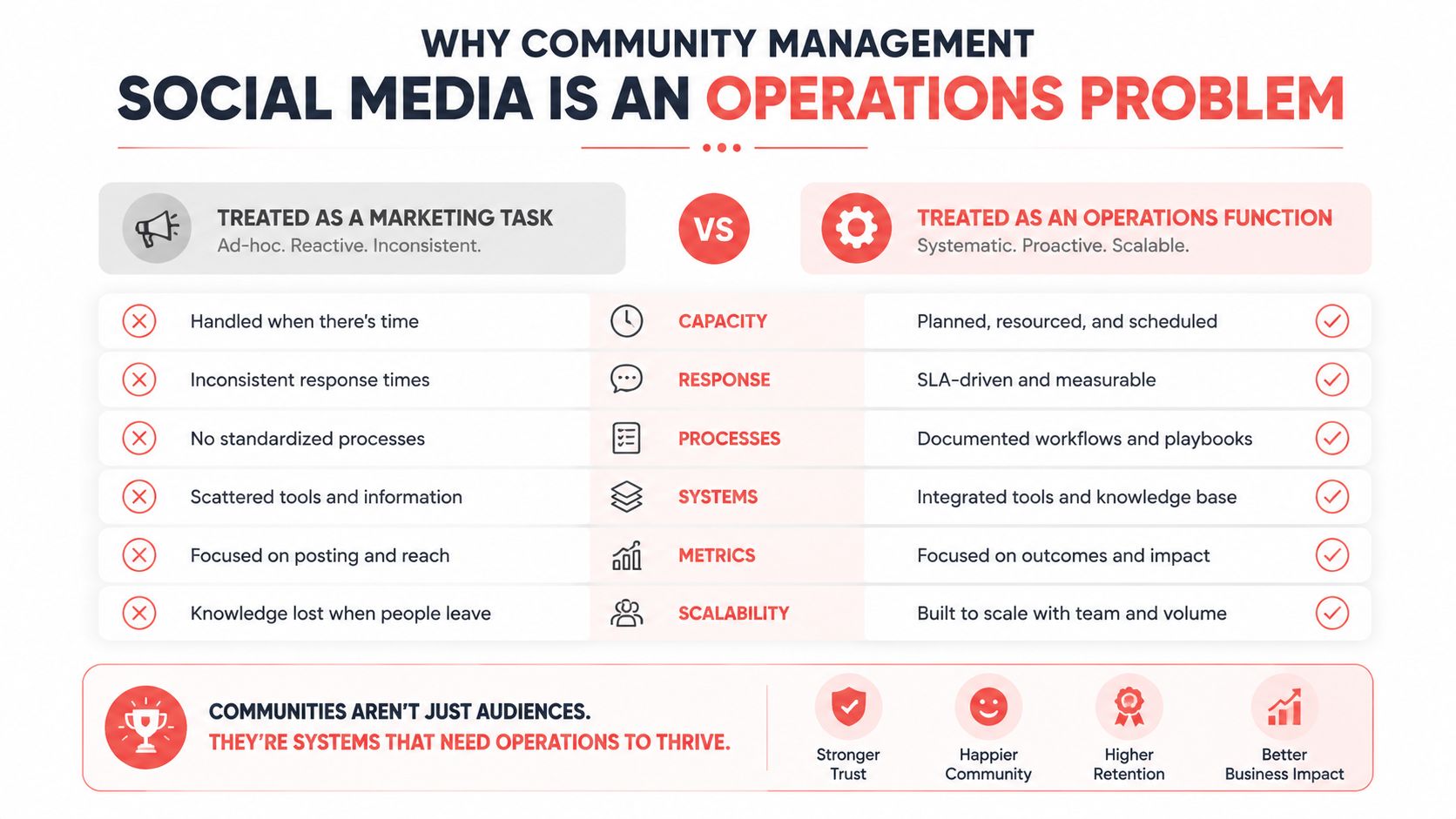
The operating model that survives volume
Start with four layers:
- Coverage: Assign named shifts, including overnight and weekend ownership. “The team monitors continuously” means nothing unless a person owns the queue at a specific time.
- Routing: Define which messages stay with community, which become support tickets, and which go to legal, security, product, or communications.
- Service levels: Set response and resolution expectations by channel and severity. A public safety incident shouldn't sit in the same queue as a routine product question.
- Incident control: Maintain alert rules, war-room procedures, approved templates, and a single decision-maker for high-risk events.
Platform concentration makes this more urgent. Facebook represented 52.06% of posts distributed through Agorapulse in 2023, according to Agorapulse's community management report. A multi-platform strategy doesn't mean workload is evenly distributed, so staffing should follow actual interaction volume rather than executive assumptions about which channels look strategically important.
Teams scaling SaaS, crypto, or UGC communities should also document the overnight path in plain language. The moderator needs to know what to lock, whom to page, what evidence to preserve, and what message can be published without approval. A practical Mava Discord management guide is useful for thinking through Discord-specific roles, rules, and workflows. For a broader example of how continuous operations can be structured, review this account of BUNCH's 24/7 operations model.
Practical rule: If a moderator has to ask who owns an incident, the ownership model failed before the incident began.
Building Moderation Policies That Scale
“Be respectful” is a value statement, not an enforceable rule. A scalable policy tells moderators what behavior violates the standard, what action to take, and when the decision requires escalation.
Write rules around observable behavior. In a SaaS forum, “don't post another member's account details” is enforceable. In a crypto Discord, “don't impersonate an administrator, request a wallet transfer, or share an unapproved token link” gives moderators a clear basis for action. On a UGC platform, “don't upload sexual exploitation, violent threats, doxxing, or content that targets a protected group” creates a review category that can be routed consistently.
Build the policy in five layers
- Purpose and scope: State who the rules cover, which channels they apply to, and whether direct messages, replies, livestream chats, and linked spaces are included.
- Prohibited conduct: Describe spam, fraud, impersonation, harassment, threats, privacy violations, illegal content, and attempts to evade enforcement.
- Allowed disagreement: Protect criticism, product complaints, satire, and strong opinions unless they cross a defined line. A member saying “this release broke my workflow” needs a different response from a member threatening an employee.
- Enforcement ladder: Use consequences that match severity. A low-risk first violation might receive education or removal, while fraud, threats, or targeted abuse may require immediate restriction and escalation.
- Appeals and changes: Explain how members can challenge a decision, then publish a changelog when rules or enforcement standards change.
A three-stage ladder can work well when it's documented precisely:
- First action: Remove the content, explain the rule, and record the event.
- Second action: Restrict participation or place the account under closer review.
- Third action: Suspend or remove the account, subject to appeal and any legal or safety escalation.
Don't force every case into the ladder. Credible threats, child-safety concerns, coordinated scams, and exposed personal data should bypass routine warnings. Automation can detect terms, links, repeated posting, and known spam patterns, but it shouldn't make the final call on sarcasm, reclaimed language, political discussion, or ambiguous harassment without human review.
Treat the policy as operational documentation
A moderator working at 3 a.m. needs examples, not philosophy. Add screenshots or anonymized examples of borderline behavior, the correct action, the reason behind it, and the escalation owner. Keep a decision log so new hires can learn from prior judgments instead of reopening the same debate.
Policy maintenance also affects safety. Ofcom's review cites evidence that only 30% of online communities regularly update their guidelines, making outdated rules a material operational weakness. The same review reports that 52% of harmful-content reports are moderated within one hour, while the average removal time after reporting is 2.3 hours, showing why teams should track both speed and the quality of the response rather than treating “reviewed” as equivalent to “resolved” (Ofcom's content moderation report).
Your onboarding test should ask a new moderator to classify realistic examples, select an enforcement action, and identify the escalation route. If they can't complete that exercise confidently, the policy isn't ready. Teams designing larger review queues can also examine scalable content moderation services for social platforms for workflow ideas.
Designing a Content and Engagement Calendar
A calendar fails at 2 a.m. if it records only posts and launch dates. Build it around audience behavior and operational capacity: where members ask questions, which requests need a moderator, how quickly each queue requires attention, and how much time remains for unscheduled work. Heavy LinkedIn publishing will not compensate for unanswered support threads in Discord.
Agorapulse's 2023 distribution data shows how activity can concentrate on one channel, with Facebook accounting for 52.06% of distributed posts (Agorapulse). Treat that figure as context, not a target. Review your own last twelve months by platform, content type, audience segment, objective, response demand, and moderation load before changing the schedule.
Allocate work by community job
New users need onboarding prompts, setup guidance, and answers to recurring questions. Experienced members need beta discussions, product feedback, recognition, and peer conversation. Moderators need protected capacity for reports, DMs, escalations, and incident response. These jobs can share a platform, but they should not compete for the same unallocated hour.
Reserve reactive capacity instead of filling every block with planned content. A weekly template may include onboarding threads, product education, an office-hours discussion, a feedback prompt, member recognition, and scheduled monitoring blocks. For a small product community, a focused office-hours thread may create more value than another broadcast post. The mix should follow queue volume and member behavior.
The blank quantitative fields are deliberate. Do not assign a percentage split until the team has measured actual workload. Compare the same platform, audience, and objective over time, then review the allocation quarterly. A content calendar should expose trade-offs, such as reducing promotional posts to protect support coverage, rather than conceal them behind precise-looking targets.
Protect the team from permanent interruption
Block engagement hours for proactive work and assign separate queue coverage for reactive work. Without that separation, moderators switch constantly between planning, support, and enforcement. They remain occupied, while response quality drops and system improvement never receives uninterrupted time.
Keep a weekly operations review for unanswered questions, repeated complaints, moderation reversals, and posts that produced useful member-to-member discussion. Feed those findings into product, support, and creative planning. The calendar earns its place when it captures community intelligence and staffing requirements, not when every slot is full.
Running Daily Engagement and Response Workflows
A reliable day starts with queue control. The on-duty operator reviews overnight reports, unresolved support threads, restricted accounts, scheduled posts, platform alerts, and messages awaiting another team. They should leave the review with a short priority list, not an open-ended instruction to “engage.”
Create separate queues for routine questions, product problems, abuse and safety reports, high-value opportunities, and incidents. A common FAQ question can receive a templated answer with a personalization token. A billing or account problem should move into a support ticket with the original context attached. A thoughtful customer post about a successful outcome may deserve amplification, provided the member's privacy and consent are respected.
Use service levels without sacrificing judgment
Response targets must reflect channel expectations and team capacity. The most useful targets are the ones your team can staff consistently, then refine using actual response-time and resolution data. Speed matters because silence creates uncertainty, but a fast incorrect answer can create more work and damage trust.
Use severity-based routing:
- Routine: Answer from the approved knowledge base, personalize the response, and close the loop.
- Product issue: Capture the account or product context, open a support case, and confirm the handoff publicly when appropriate.
- Safety concern: Preserve evidence, restrict immediate harm where authorized, and alert the designated trust-and-safety owner.
- High-sentiment opportunity: Respond in the brand voice, invite constructive discussion, and route useful feedback to the relevant team.
- Potential incident: Stop normal engagement, activate the incident channel, and wait for the assigned spokesperson.
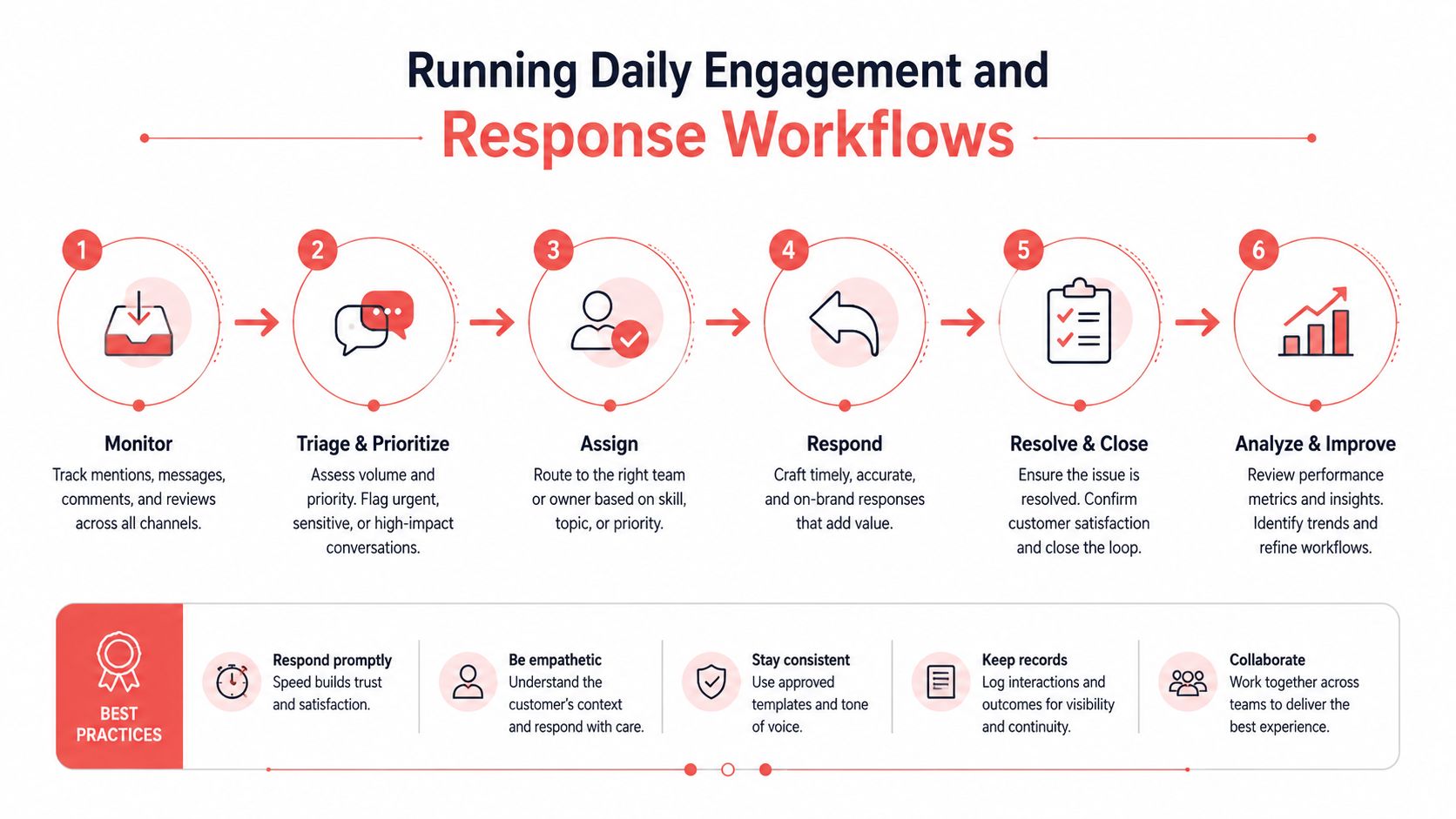
Keep humans in the decision loop
Automation works well for deduplication, language detection, spam scoring, known malicious links, and routing based on tags. It works poorly when the central question is intent. Sarcasm, criticism, self-harm language, allegations, and cultural context require human review, especially when the decision affects access or reputation.
The operator should record four things for every escalated item: what happened, what action was taken, why it was taken, and who owns the next step. That record protects the member from repeating their story and gives managers material for quality review.
Coverage can come from internal shifts, regional teams, or a managed service. Whatever the model, publish a handoff note at the end of each shift with unresolved cases, emerging themes, policy questions, and accounts requiring observation. A follow-the-sun system only works when the next person receives context, not just an empty queue.
Handoff standard: The next shift should know what changed, what remains risky, and what action is due next.
Handling Crises Without Losing Community Trust
A crisis often arrives as several connected problems. A complaint starts on X, members repost it in Discord, and scammers use the confusion to send fraudulent direct messages. Treating each post as a separate ticket creates fragmented responses. Treating the event as one incident gives the team a shared timeline and a clear command structure.
At T+0, the first moderator records the alert, captures relevant links, identifies affected channels, and classifies the immediate risks. They don't debate the entire narrative in public. They contain what they can, alert the incident owner, and post a short warning if members face an active scam or safety threat.
At T+15, the incident lead confirms roles. One person owns moderation actions, another coordinates support and affected users, another tracks evidence and decisions, and communications or legal receives a concise situation report. If the complaint involves security, privacy, financial loss, or regulated activity, those teams should join early rather than after the public response is drafted.
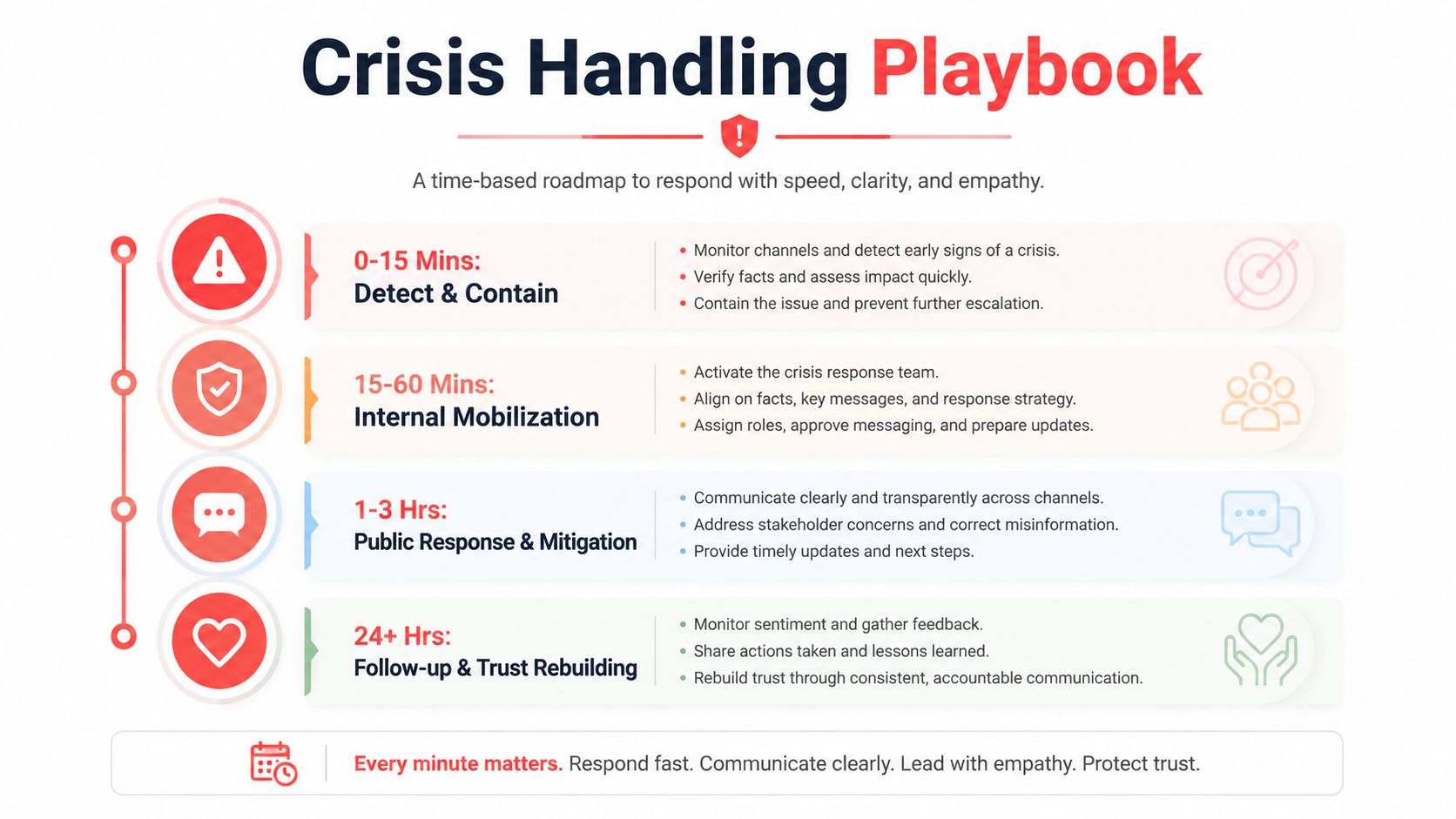
Control the message and the environment
By T+30, lock or slow affected channels if members are being targeted, remove impersonation accounts under the policy, pin a verified warning, and route reports through one intake path. The public statement should acknowledge what the company knows, explain what members should do now, and avoid claims the team hasn't verified.
By T+60, publish a holding statement through the approved spokesperson. Multiple employees replying independently often create contradictions, expose private details, or imply commitments the company can't keep. A single voice doesn't mean silence from everyone else. It means every public response follows the same verified facts and next update time.
Over the following hours, the team should resolve the immediate harm, answer affected members individually, and update the community when facts change. A useful crisis communication guide can help communications teams prepare message principles before a live incident.
Recovery is part of the incident
A crisis isn't finished when the posts slow down. Publish a post-mortem that explains the trigger, the actions taken, what remains unresolved, and which controls will change. Don't expose member data or turn the report into a defense of every decision. Explain the operational lesson in terms users can understand.
Run tabletop exercises so moderators practice locking channels, escalating sensitive cases, and using templates under pressure. Maintain platform trust-and-safety contacts before an emergency, not while an attack is underway. The community remembers whether the company disappeared, blamed users, or stayed present with useful information.
Measuring Community Health Beyond Vanity Metrics
Follower count and raw engagement show exposure. They cannot tell an operations leader whether members receive timely help, harmful content is controlled, or community input improves retention and product decisions. A useful dashboard connects participation, service performance, risk, and business impact.
Start with the last twelve months of internal data. Compare results by platform, content type, audience segment, and campaign goal, then review the same cuts on a regular schedule. Internal baselines are more defensible than industry averages drawn from a different audience, platform, or operating model.
Build four measurement tiers
Track daily, weekly, and monthly active users, growth, retention, comments, shares, and response time alongside operational measures. Add posts per active user, replies per thread, time to respond to new posts, and time to resolve customer issues. These measures show whether a small moderation team is keeping pace as volume rises.
Make the report useful to executives
Lead the monthly report with the business question. For support efficiency, connect community answers with ticket volume and resolution. For product learning, show recurring feedback themes, accountable owners, and resulting decisions. For trust, report handled cases, policy changes, and unresolved risks.
Then add health and growth context. A rise in comments requires context. Many comments may be unresolved complaints rather than healthy engagement. A decline in raw engagement may be acceptable when active members, satisfaction, and useful peer-to-peer answers are improving.
Use a lightweight dashboard that joins platform exports, helpdesk records, moderation tags, social listening, product events, and CRM fields. Define ownership for each field and record the refresh schedule, so a missing overnight feed does not look like zero activity.
Where data is incomplete, label the gap clearly. False precision can send staffing, escalation, or product decisions in the wrong direction. Review the KPI stack with moderators as well as executives, because the people working the queue can identify measures that look healthy while unresolved cases accumulate.
Your 90-Day Community Operations Rollout Plan
A practical rollout starts small enough to finish and rigorous enough to expose weak points. Don't launch a new dashboard while moderators still lack an escalation owner. Don't promise continuous coverage until overnight responsibility is assigned and tested.
Days 1 through 30 establish control
Document the moderation policy, enforcement ladder, appeal route, and incident definitions. Inventory every platform, inbox, private group, and support channel. Assign owners for community, support, product, security, legal, communications, and executive escalation.
Baseline the last twelve months of internal performance by platform, audience segment, content type, and objective. Record active participation, retention, engagement, response time, resolution time, satisfaction, reports, and recurring issues where data exists.
The checkpoint is simple: can a moderator classify a message, take the correct first action, and identify the next owner without asking a manager?
Days 31 through 60 test capacity
Assign shifts or source additional operational coverage. Run shadow shifts before giving new moderators independent authority. Test the queues during real volume spikes, then adjust routing rules, templates, permissions, and escalation thresholds.
Use automation for repetitive classification and routing, but sample false positives and false negatives every week. Review whether moderators are spending time on low-value alerts while serious issues wait. Track handoff quality, not just queue speed.
This is also the point to protect moderator wellbeing. Rotate exposure to disturbing content, provide clear stop conditions, and make escalation a supported behavior rather than a sign of weakness.
Days 61 through 90 institutionalize learning
Launch weekly operational reviews and a monthly executive report. Connect community themes to product, support, and revenue dashboards where the data supports that connection. Store incident timelines, post-mortems, policy decisions, and training examples in one controlled knowledge base.
Teams that need additional capacity can evaluate community management outsourcing from BUNCH alongside internal hiring, regional staffing, or other managed-service options. The relevant comparison is not just hourly cost. Assess coverage, training, QA, escalation control, tool integration, and the organization's ability to handle sensitive edge cases.
The final go or no-go test asks whether the operation can absorb a sudden spike without abandoning routine support, whether every serious issue has a named owner, and whether leadership can read the KPI report and make a decision. If the answer is no, keep calibrating before expanding the community.
BUNCH provides managed human-in-the-loop teams for community management, social moderation, customer support, and 24/7 operational coverage across technology platforms. If your team needs structured escalation, policy-aligned review, and reliable round-the-clock support, talk to a BUNCH expert and book a call to discuss the workflow you need to scale.
About the Author
Stay in the Loop!
Related Content

Online Community Moderation: How Communities Handle Content Moderation
A community without a moderation system is like a dinner party without a host. Most people are there to have fun, but with no one watching, some get carried away.

Scalable Content Moderation Services for Social Platforms: Best Practices
Scalable content moderation services help social platforms review, filter, and manage user-generated content as content volume grows.

How BUNCH Became a 24/7 Operations Powerhouse
Our 24/7 outsourcing services ensure seamless, efficient operations for businesses worldwide. From shift scheduling to cultural sensitivity, we guarantee continuous support in all time zones.