Data Labeling Company Guide for AI Teams


You need a data labeling company when data work starts slowing down your AI team. Raw images, video, text, audio, or LiDAR may look manageable at first. Then volume grows. Edge cases pile up. Your taxonomy changes. Quality slips. Your ML team ends up doing project management, QA, and rework instead of building models.
A strong provider does more than label data. It gives you a full team that prepares data, writes and maintains guidelines, trains annotators, reviews output, handles edge cases, and keeps quality high over time.
For growing AI and tech companies, that matters. Model quality depends on data quality. If labels are inconsistent, unclear, or poorly reviewed, model performance suffers.
BUNCH was founded in 2017 and operates as a boutique managed services firm, with offices in Metro Manila and Cavite in the Philippines. Its clients are mostly in the US and Europe, and BUNCH states that the average client relationship is over four years. Its model is a managed team of human specialists working alongside AI, not a staffing marketplace or a labeling platform.
What a Data Labeling Company Actually Does
A data labeling company turns raw data into training data for machine learning. That can include:
- drawing bounding boxes on images
- creating segmentation masks
- labeling keypoints
- tagging entities in text
- tracking objects in video
- transcribing audio
- labeling spatial features in LiDAR
But good data labeling is not just annotation.
Mordor Intelligence estimates the AI data labeling market at USD 2.32 billion in 2026.
The real work includes:
- preparing and organizing files
- writing clear instructions
- training annotators
- reviewing labels
- resolving disagreements
- updating rules when edge cases appear
This is where many AI teams get stuck. They do not just need extra hands. They need a team that can run the workflow and take ownership of quality.
Practical rule: If your team is spending too much time fixing labels, answering the same questions, or reviewing inconsistent work, you likely need managed data operations, not one-off labor.
How Raw Data Becomes Training Data You Can Trust
Raw data is messy. Files may be duplicated, blurry, incomplete, or inconsistent. Text may be vague or contain several valid interpretations. Audio may be noisy. Video may include hard-to-label moments.
The workflow needs structure before annotation starts.
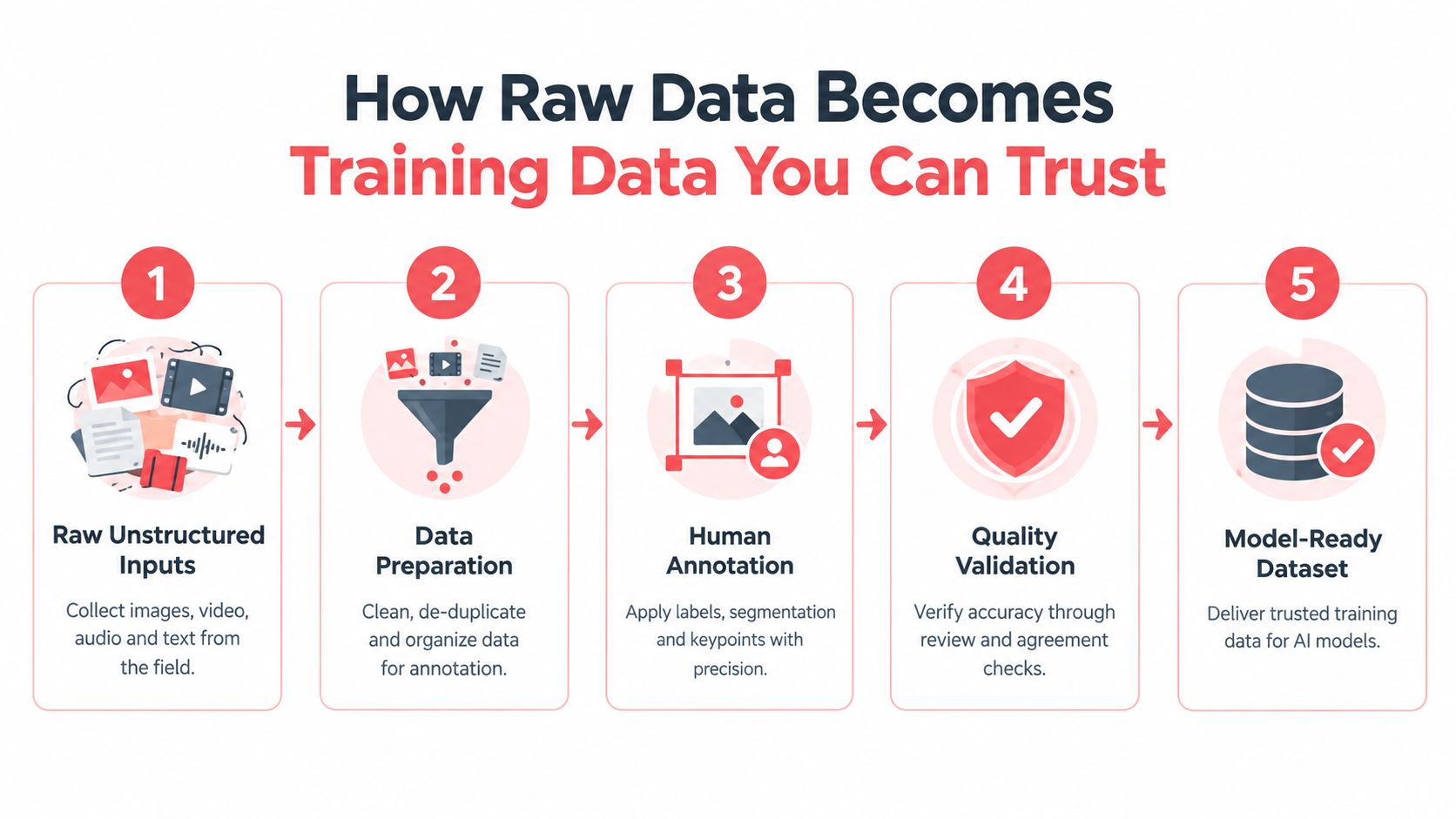
A strong process usually looks like this:
- Prepare the data
Clean files, organize inputs, confirm formats, and apply access controls. - Set the rules
Create clear guidelines so annotators know exactly how to label each case. - Annotate the data
Label images, video, text, audio, or LiDAR based on the project rules. - Review the work
Check labels, catch mistakes, and resolve unclear cases. - Improve the guidelines
Update instructions when new edge cases show up.
This last step is important. Good teams do not treat guidelines as fixed. They improve them as the dataset evolves.
That is a key part of BUNCH's approach. Its teams do not just label data. They help build the operating system around the work. That includes QA, escalation, and ongoing guideline ownership so quality stays consistent as projects grow.
Service Offerings Across Media Types
The right annotation method depends on your model.
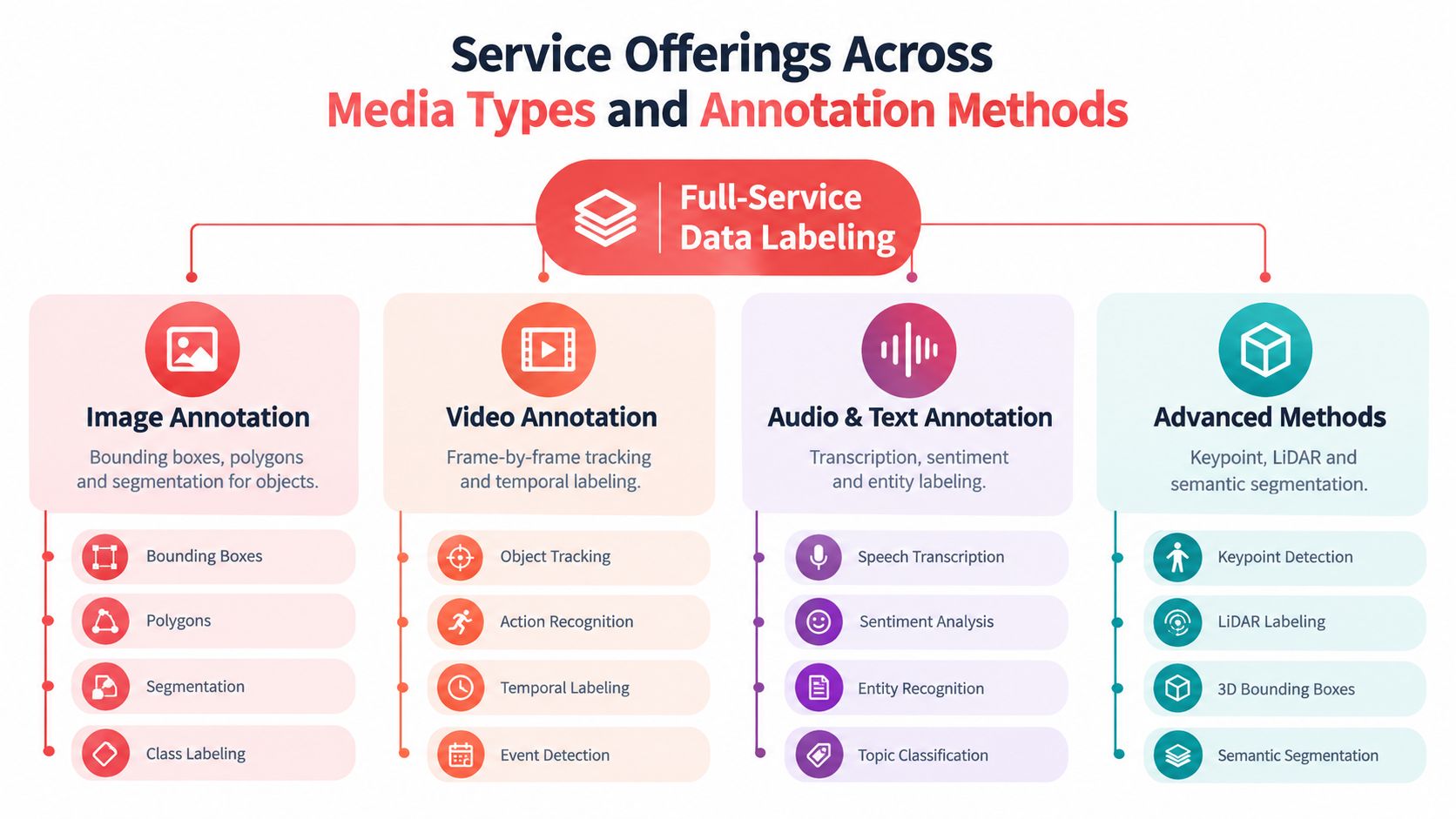
Common types of annotation
- Image annotation can include classification, bounding boxes, polygons, segmentation, and keypoints.
- Video annotation adds time and sequence. Teams may track objects, label events, or mark behavior across frames.
- Text annotation can cover sentiment, intent, named entities, policy categories, and relevance.
- Audio annotation often includes transcription, speaker labels, timestamps, and sound events.
- LiDAR annotation supports spatial and multimodal AI systems with point clouds and 3D object labeling.
BUNCH provides data annotation services across image, video, text, audio, LiDAR, segmentation, bounding boxes, and keypoints. Its adjacent operations include content moderation, trust and safety, KYC verification, community management, customer support, and AI safety work such as model evaluation and validation.
The better question is not just whether a company can label your data. Ask whether it can manage ambiguity, improve rules, and maintain quality when the work gets harder.
Why Quality Assurance Matters So Much
Quality is the foundation of successful AI models. If your labels are wrong, inconsistent, or poorly reviewed, your model learns the wrong patterns.
That is why annotation alone is not enough. You need a quality system.
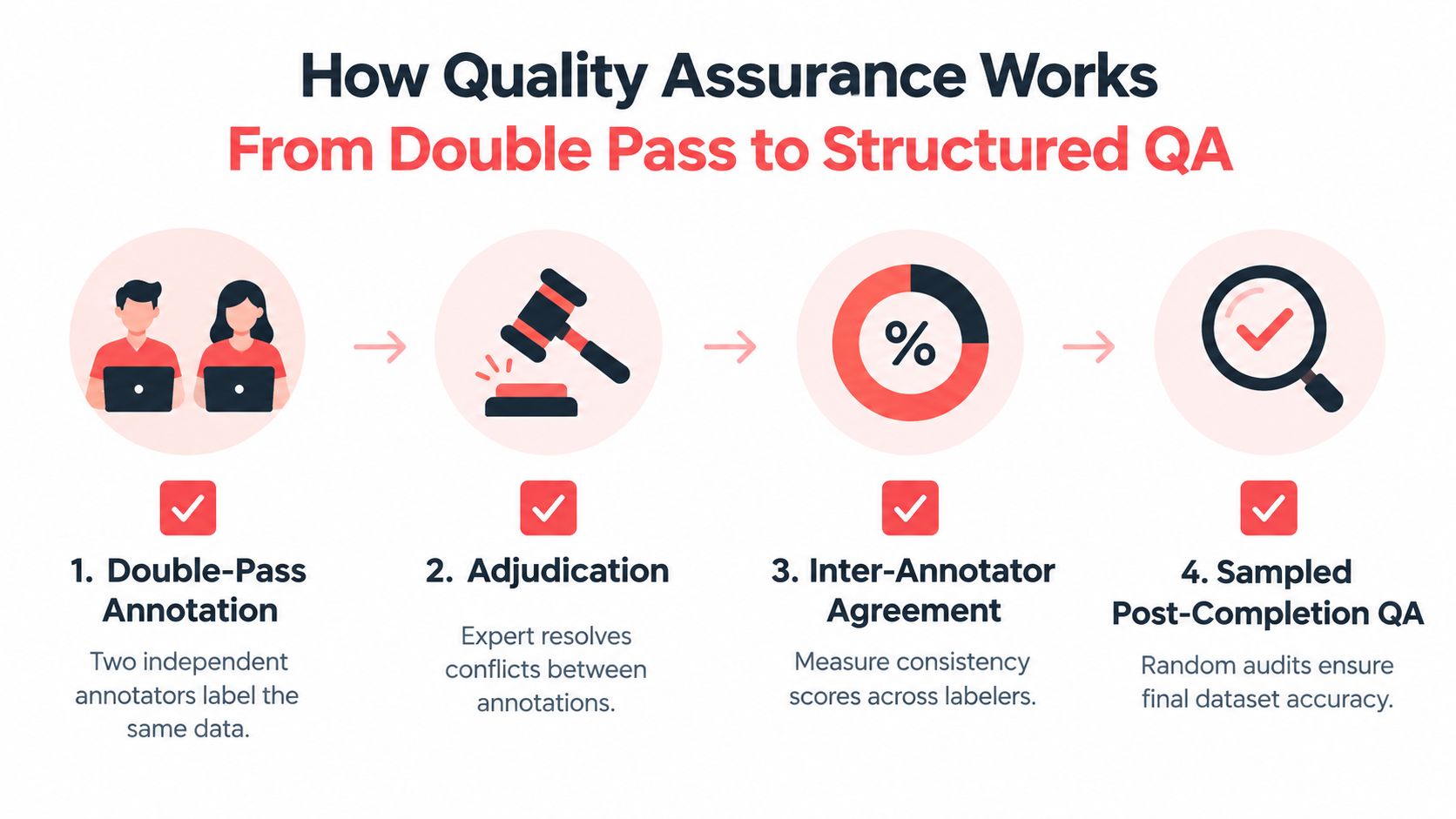
A strong QA process often includes:
- first-pass annotation
- second review by another person
- adjudication for unclear cases
- audits to catch repeat errors
- updates to the guidelines
Adjudication means a senior reviewer breaks the tie when two annotators disagree, and that decision gets folded back into the next version of the guideline, not just applied once.
That is why BUNCH emphasizes double-pass annotation and structured QA. Its FAQ on data labeling accuracy explains how review and consistency checks fit into the workflow.
Straits Research projects the data collection and labeling market at USD 2.26 billion in 2026.
The real value is not just catching mistakes. It is building a repeatable system that keeps improving.
Forage reports outsourced services accounted for 84.6% of revenue in 2024
Why Managed Teams Work Better Than Simple Vendors
Some providers only deliver labels. Your internal team still has to answer questions, retrain people, fix errors, and update instructions. A managed team works differently.
A managed partner can:
- train annotators
- write and maintain guidelines
- handle QA
- route difficult cases to senior reviewers
- keep coverage steady as volume changes
- improve the process over time
That is the difference BUNCH is built around. I've watched this play out directly on one healthcare client, our operations team scaled from 30 labelers to 150 over the course of the engagement, and the thing that made it work wasn't headcount. It was that the guidelines, QA checkpoints, and escalation paths scaled with the team, so a labeler joining in month six was producing work as consistent as someone who'd been on the project since week one.
That's what a full human-in-the-loop team actually does beyond basic annotation: it owns the workflow, the quality bar, and the documentation needed to keep outputs consistent even as the team behind it looks nothing like it did at the start.
BUNCH describes its model as modern outsourcing for high-growth technology companies, with managed human teams working alongside AI. That operating model covers data labeling as well as content moderation, customer support, KYC verification, community management, and AI safety workflows.
How to Choose the Right Data Labeling Company
Start with one question: who owns quality?
Not "who does the labeling", every vendor can answer that. Who is responsible when an edge case breaks the taxonomy, when two annotators disagree, when a client's model performance drops and the cause traces back to a batch of inconsistent labels? If the honest answer is "your team, eventually," you haven't actually outsourced the hard part. You've outsourced the easy part and kept the expensive part.
This is the same logic behind most vendor management best practices: a vendor relationship works when accountability is explicit, not assumed.
A low per-label price can be misleading if your team still has to catch errors, retrain annotators, and rewrite guidelines yourselves. What matters is whether the provider can produce usable data at scale, without pulling your ML team back into project management.
BUNCH is one option for teams that want more than annotation labor. It builds outsourced teams for high-growth technology companies and supports data labeling, trust and safety, customer experience, KYC verification, community management, and AI safety work.
Outsourcing is not always the right fit. If your volume is small or only your internal team can interpret the work safely, keeping the process in-house may make more sense. But if your team needs capacity, stronger QA, and a partner that can own and improve the workflow, a managed model can be a better choice.
Common Questions About Working With a Data Labeling Company
What does a data labeling company actually provide?
The best providers offer more than annotators. They provide project setup, guidelines, training, QA, escalation, and ongoing support.
Why do guidelines matter so much?
Without clear guidelines, different people label the same case in different ways. That creates noisy data. Strong guidelines make labels more consistent and easier to trust.
Why is managed QA important?
QA catches errors before they reach your training set. It also helps teams spot confusion, improve instructions, and reduce repeat mistakes.
When should I use a managed team?
Use a managed team when data work is taking too much time from your internal AI team, when quality matters a lot, or when the workflow needs constant oversight.
If you are comparing the cost of in-house management against a fully supported external team, BUNCH is worth considering.
BUNCH builds managed human-in-the-loop teams for data labeling, content moderation, KYC verification, customer support, and AI safety workflows. If you need a partner that can annotate, QA, write guidelines, and keep improving the process, book a call with BUNCH to start a conversation about your operating requirements.
About the Author
Stay in the Loop!
Related Content

Scalable Data Labeling Solutions: Growing Teams Without Compromising Quality
Learn how to scale data labeling for ML without sacrificing quality through double-pass annotation, AI integration, dedicated teams, continuous training, and strong project management.

A Brutal Disruption in Image Annotation Services in 2025
AI data labeling just got disrupted. Generalist models are out, and expert-driven, specialized data is in. Here’s how the landscape is evolving faster than anyone expected.

How We Are Obsessed About Data Quality and Why
We understand the importance of reliable data quality for training datasets and precision in moderating user-generated content. Learn how we apply rigorous QA in all our processes.