How to Ask for Reviews Using "If You Are Satisfied With Our Services"


74% of customers now require 24/7 service availability, and 62% of phone calls to small businesses go unanswered. If you are satisfied with our services works best when it leads to one clear next action, not a vague compliment request.
Use it after the customer has had time to judge the service, then make it easy to say yes, no, or not yet. The phrase should point to a review, feedback request, expansion conversation, or a simple continuation step, because satisfaction only matters when it changes what happens next.
Ask for Satisfaction Without Sounding Scripted
The phrase if you are satisfied with our services is useful when it connects a real service moment to one specific action. Used alone, it feels canned. Used after a resolved ticket, a completed labeling batch, or a clean moderation cycle, it gives the customer a fast way to move forward.
That matters in always-on operations. Customers do not want a generic check-in before they have seen the result, and they do not want a hard sell while they are still waiting on fixes. For teams handling support, moderation, labeling, or KYC, the best version is short, concrete, and tied to the handoff point.
BUNCH's customer satisfaction terms page is a good reminder that this kind of language belongs in a process, not in a vacuum. The wording should match the stage of the relationship, the evidence available, and the next action you want the customer to take.
Practical rule: Ask after the customer has experienced the service, then give them one obvious path forward.
A good version of the phrase does three things. It confirms the outcome, it respects timing, and it gives the customer a choice. That is why the same wording can work in an email, a support closeout, or a follow-up from a managed team.
1. The Satisfaction Check-In with Next Step
Treat the satisfaction question as a decision point. Confirm the outcome, then move the customer to one clear next action. That keeps the message useful instead of decorative.
A support team can ask, “Did we resolve your issue, and if you're satisfied, would you like to open the next queue?” A data operations lead can say, “Are your annotations meeting the current requirements, and if so, should we prepare the next dataset?” The goal is not praise. It is to turn a clean finish into a concrete follow-on step.
This works best 24 to 48 hours after the service moment, not the minute the ticket closes. Customers need time to test the result. Ask too soon, and you get reflex answers, not real feedback.
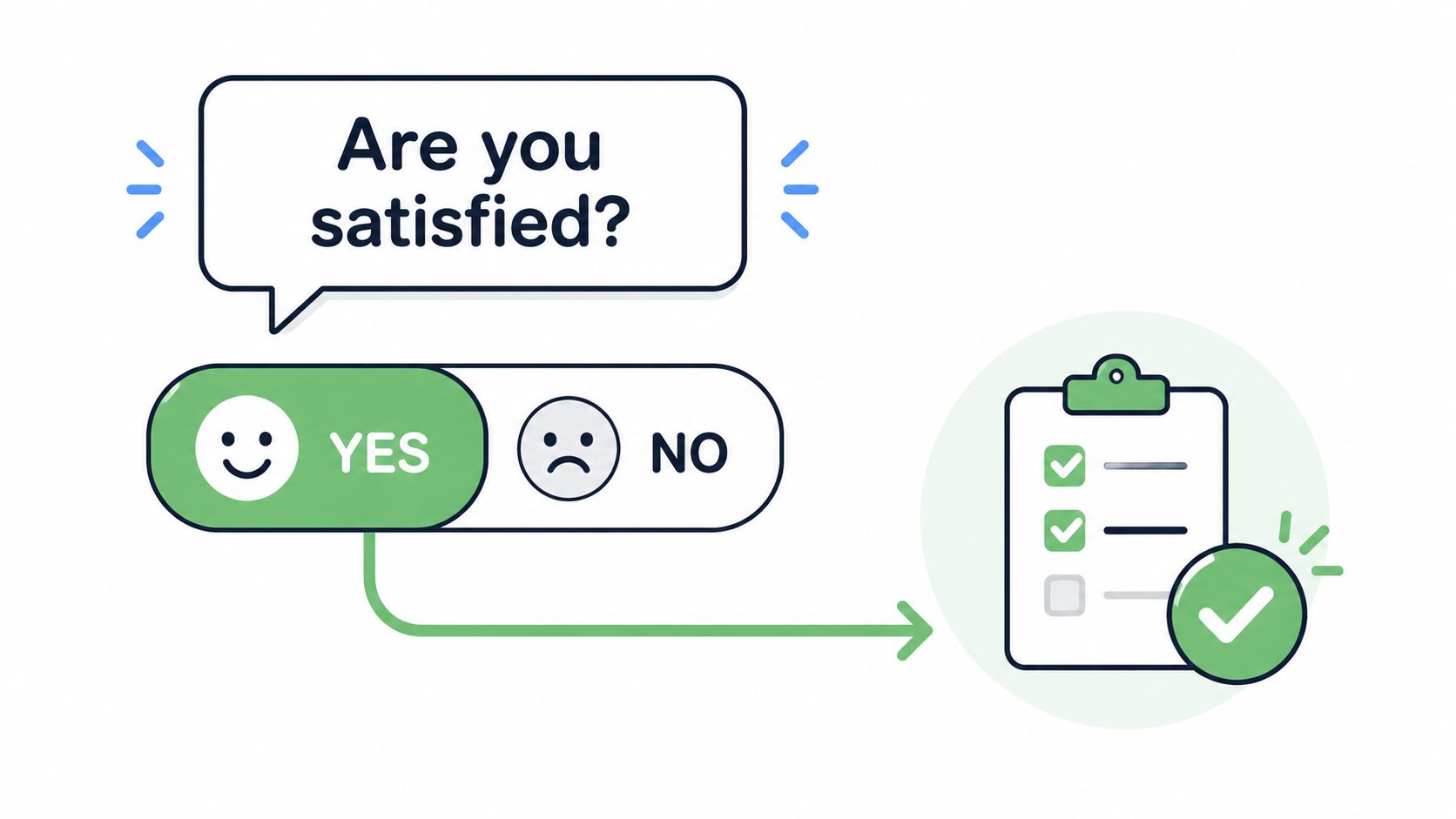
Use this when the next step is obvious. A resolved support issue can lead to a new batch of cases. A moderation cleanup can lead to ongoing queue coverage. The wording should fit the process, not force a new one. BUNCH's customer satisfaction terms page is a useful reminder that this language belongs inside a working flow.
2. The Specific Improvement Proposal
Don't ask, “How can we do better?” Ask about one concrete change. Technical buyers respond better when you give them a lever, not a blank box.
For example, after KYC verification work, you can ask whether a faster turnaround would help their compliance pipeline. After a moderation cycle, you can ask whether stricter pre-filtering would reduce edge cases without harming accuracy. That keeps the conversation grounded in operations, not sentiment.
Make the proposal about workload, not feelings
The best improvement requests point to a real bottleneck the customer already sees. If the queue is too noisy, talk about triage. If reviewers are wasting time on repetitive edge cases, talk about pre-classification. If handoff is slow, talk about routing or escalation paths.
Use the customer's operational language. If they talk about queue depth, resolution time, false positives, or manual review load, mirror those terms back. They will trust the conversation more because it sounds like a working session, not a survey.
Give them one change to react to, not five things to rank.
If they agree to the improvement, follow up with a concrete implementation path within two weeks. If they don't, you still learn which part of the workflow is stable enough to leave alone.
3. The Scope Expansion Trigger
When one service is working, ask whether the next problem is ready to be solved. That is the cleanest way to expand an account without sounding pushy.
A team that has stable annotation work may also need moderation, AI validation, or data maintenance. A support deployment that is holding up well may lead into community management or 24/7 coverage. The phrase should sound like a natural continuation, not a sales pitch.
Research the customer's setup first. If they already run support in-house but outsource moderation, ask about moderation. If they have a product launch coming, ask what user-facing process will strain first. The better your read on their structure, the better the question.
- Match the ask to the proven service: Don't propose a new line until the current one has shown it can work
- Keep the tone observational: “I noticed” lands better than “we noticed”
- Offer a small pilot: Expansion feels safer when it starts narrow
If the customer is satisfied, the question is not whether they like you. It is whether they have the next problem you can solve. That framing keeps the relationship useful.
4. The Performance Metrics Recap
Lead with the work, then the result. Operators trust a recap that shows what was handled, what moved, and what outcome followed.
Use a short, plain summary. Say the team reviewed the workload, processed the queue, and stayed within the original goal. Then ask whether those numbers match what they need. Satisfaction becomes a decision based on evidence, not a vague reaction.
If the metrics miss the target, say so first. State the gap before you ask for the next step. That makes the follow-up credible because you are naming the problem instead of dressing it up.
Keep the format tight. A short dashboard or one-pager beats a dense report. Put the customer's language first, then the metric that matters to them. If turnaround was the target, show turnaround. If policy alignment was the target, show policy alignment. For tools to measure this, see Supatool free NPS tools 2025. Then ask whether the service matched the original goal.
5. The Problem-Solved Transition
Use the original problem statement as the bridge. This version works because it reminds the customer what was broken, confirms that the friction is gone, and then asks what constraint is left.
If they came in with a support backlog, name the backlog. If they came in with a labeling block, name the block. If they came in with a moderation surge, name the surge. Then ask what is now slowing them down. That keeps the discussion tied to actual operations.
This is strongest once the customer has lived with the fix long enough to feel the impact. A few weeks is usually enough for a service team to show whether the issue stayed solved or just looked solved at the handoff.
If the first pain point is gone, don't ask whether they are happy. Ask what the next bottleneck is.
This approach works especially well for founders and heads of operations because they think in constraints. They do not want praise. They want the next thing blocking growth removed. If your service solved the original constraint, say so plainly and move on.
6. The Commitment Consolidation Ask
When the service is steady, ask for a longer commitment. Do this only after the work has proved itself over time, because premature commitment talk sounds like lock-in.
For ongoing functions like support, moderation, and labeling, a monthly project mindset often creates churn in staffing and planning. A longer framework can make sense when the work is recurring and the operating model has stabilized. The ask should be about continuity, not pressure.
Frame the benefit as operational stability. A longer commitment lets the team plan coverage, keep process knowledge in place, and avoid repeated ramp-up. If the customer is worried about flexibility, offer an exit clause or an agreed review point.
This is the place to be clear about the trade-off. A shorter term gives the customer more freedom. A longer term gives them steadier execution. If they need a permanent function, the second option usually fits better.
You should not ask for this after one good week. Wait until the pattern is clear and the service has held up. Then make the case that the work is no longer a project, it is part of how the business runs.
7. The Success Milestone Celebration with Forward Motion
Mark the milestone, then use it to open the next phase. This works because success feels more real when it is tied to a measurable checkpoint.
If a labeling team reached a major volume threshold, say so in the customer's terms. If a verification workflow cleared a backlog, say that. Then ask what the next operational target is. The message says, in effect, the current goal is done, so what comes next?

Use the customer's own definition of success, not your internal one. If they care about compliance readiness, use that. If they care about training data quality, use that. Then connect the milestone to the business result they said mattered at the start.
BUNCH's client testimonials page shows why this matters in managed work. When the service is handled well, the right next step is rarely another compliment. It is usually a new phase of the same operating relationship.
7-Point Satisfaction & Next-Step Comparison
Turn a Positive Reply Into Useful Momentum
Use one clear ask. Tie it to a real service moment. Make the response easy, and don't ask for a review before the customer has had a fair chance to judge the result. That is the difference between a useful follow-up and noise.
A stronger version of if you are satisfied with our services points to an action. It can lead to feedback, a review, a scope change, or a longer relationship, but it should never sit by itself. If you want a reply that means something, give the customer one decision to make.
Is the phrase grammatically correct? Yes. It reads naturally when you use it as part of a longer sentence or follow-up message.
When should you use it in email or SMS? Use it after the service moment, once the customer has had time to assess the outcome. Keep the message short in SMS and slightly fuller in email.
How do you ask for feedback without pressuring the customer? Give them a choice. Ask for feedback, a review, or a next step, then make it easy to decline or defer.
If you need help turning satisfaction checks into managed support, moderation, data labeling, or AI safety workflows, BUNCH has operating teams built for that kind of work. Its customer support, content moderation, data labeling, and AI safety services are set up for ongoing human-in-the-loop operations.
BUNCH builds and manages human-in-the-loop teams for customer support, moderation, labeling, and AI safety. If you're trying to turn a satisfied customer touchpoint into a better operating workflow, visit BUNCH and see how managed teams can fit the next step.
About the Author
Stay in the Loop!
Related Content

How We Are Obsessed About Data Quality and Why
We understand the importance of reliable data quality for training datasets and precision in moderating user-generated content. Learn how we apply rigorous QA in all our processes.

How BUNCH Became a 24/7 Operations Powerhouse
Our 24/7 outsourcing services ensure seamless, efficient operations for businesses worldwide. From shift scheduling to cultural sensitivity, we guarantee continuous support in all time zones.

Our Managed Services Model
Learn how our managed services are designed to shoulder all operational responsibilities, offering clients streamlined, process-based operations under a flat monthly fee, allowing them to focus on growth.