10 Machine Vision Applications Across Industries

Machine vision applications are most valuable when they turn visual inspection, recognition, or monitoring into a repeatable decision process. The global market was valued at USD 15.83 billion in 2025 and is projected to reach USD 23.63 billion by 2030, but reliable deployment still depends on representative labeled data, clear escalation rules, and ongoing validation.
That distinction matters to an operations lead or ML team. A camera can capture an image, but it can't decide whether a scratch is a defect, whether a document field is trustworthy, or whether an object in a restricted area needs immediate action without a defined workflow around it.
Machine vision is used to inspect products, interpret documents and medical images, recognize objects, monitor environments, and guide automated decisions. The strongest use cases aren't defined by cameras alone. They depend on the cost of errors, the range of real-world conditions, the quality of training data, and the people who review uncertain results.
BUNCH works with companies across many industries to support these systems with high quality training data, annotation operations, and human review workflows. That cross-industry experience matters because defect detection, document extraction, medical imaging, retail recognition, and surveillance all require different labeling standards, escalation rules, and validation practices.
The ten applications below span manufacturing, automotive, healthcare, retail, security, agriculture, identity, transportation, and equipment maintenance. Each solves a different operational problem, and each has different limits.
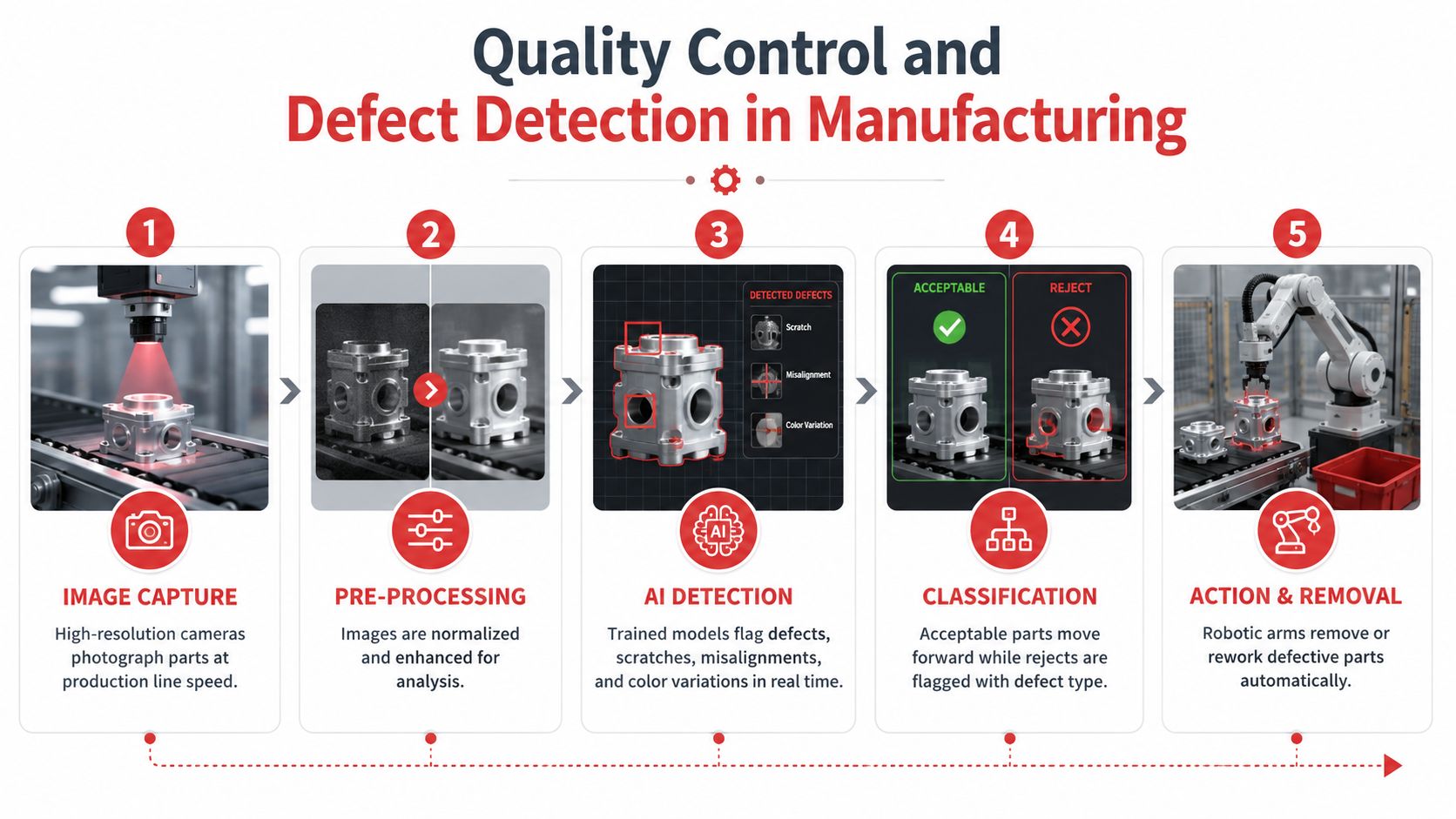
1. Quality Control and Defect Detection in Manufacturing
Manufacturers use machine vision to catch defects before products leave the line. Cameras inspect painted parts, welds, printed circuit boards, pharmaceutical packaging, bottles, containers, and food packages at production speed.
The difficult part is rarely capturing an image. It's defining the boundary between an acceptable variation and a real defect. A model needs labeled examples of scratches, misalignment, missing components, color variation, damaged packaging, poor solder joints, and inconsistent fill levels. Those labels must reflect the quality team's actual acceptance criteria, not an abstract annotation standard.
A practical starting point is to focus on defects that create the highest cost or occur most often. That keeps the first dataset tied to a measurable production problem instead of attempting to label every possible visual variation.
Practical rule: Fix lighting, camera position, and defect definitions before expanding the model. More data won't correct inconsistent capture conditions or unclear labels.
What the workflow needs
Collect images across shifts, materials, angles, and normal production variation. Borderline examples deserve extra review because two trained inspectors may disagree about whether a mark is cosmetic or unacceptable.
For complex shapes, teams may need semantic image segmentation services rather than simple image-level labels. Segmentation identifies the precise region of a defect, which helps when defect size, shape, or location affects the decision.
Human review remains useful after deployment. Inspectors should review low-confidence cases, confirm new failure patterns, and feed corrected examples back into the dataset. A vision system that works only under one light level or for one batch of materials isn't production-ready.
2. Autonomous Vehicle Perception and Object Detection
An autonomous vehicle doesn't need to know that an image contains “traffic.” It needs to locate a pedestrian, classify a truck, follow a lane boundary, identify a sign, and estimate how those objects relate to the vehicle's path.
That makes annotation unusually demanding. Teams may combine bounding boxes, keypoints, semantic segmentation, and LiDAR annotation. A pedestrian may need a box for detection, keypoints for pose, and depth information to support spatial reasoning.
Rare conditions deserve deliberate sampling. Rain, darkness, roadwork, glare, partially blocked signs, unusual vehicles, and unpredictable pedestrian movement can expose gaps that a large collection of ordinary road scenes won't reveal.
The operational chain also matters. Annotators need a policy for ambiguous objects, such as a plastic bag near the road or a person partly hidden behind a vehicle. Consensus review is more appropriate for safety-critical cases than allowing one uncertain label to become ground truth.
The dataset should preserve context, not just objects. A box around a car is less useful when the model also needs lane position, occlusion status, road surface, and nearby hazards.
Version control is essential as the perception model changes. When performance shifts, the team needs to know which dataset, guidelines, and annotation revision produced the result. For projects that combine cameras with depth sensors, LiDAR annotation outsourcing can support the point-cloud side of the workflow while internal engineers focus on model behavior and safety validation.
3. Medical Image Analysis and Diagnostic Imaging
Medical imaging systems help specialists find tumors, fractures, lesions, and other abnormalities in X-rays, CT scans, MRIs, pathology slides, and retinal images. The useful output is usually not an autonomous diagnosis. It's a prioritized worklist, an image highlight, or a second review signal for a qualified clinician.
That distinction changes the data requirements. A clinical annotator may need to mark lesion boundaries, classify severity, identify anatomical structures, and distinguish disease from artifacts. A CT scan contains many cross-sectional images, so a labeling program must define whether the target appears in one slice, across a sequence, or in a three-dimensional volume.
Clinical staff should own the annotation guidelines. A general-purpose labeling team can follow a well-defined protocol, but it shouldn't invent diagnostic criteria. Multiple expert reviews and documented disagreement are more valuable than forcing false certainty into high-stakes labels.
.jpeg)
Where people stay responsible
Human review remains necessary for flagged findings, unusual presentations, and cases outside the training distribution. Teams also need governance around access, de-identification, audit trails, and retention. Privacy and medical device requirements can't be treated as a final documentation step.
Training data should reflect relevant patient demographics and disease severity. If the dataset represents only easy cases, the model may appear effective during development but fail when clinicians encounter subtle or atypical findings.
4. Retail and E-Commerce Product Recognition
Retail vision solves a recognition problem: identify the product in a customer photo, match it to inventory, or verify that a shelf contains the expected item. The same capability supports visual search, shelf monitoring, product picking, and counterfeit detection.
Catalog images aren't enough. Customers submit photos with cluttered backgrounds, poor lighting, partial views, reflections, rotated packaging, and older product designs. A useful dataset includes those conditions, along with attributes such as brand, category, color, size, and package variant.
Product identity also changes over time. New packaging can look almost identical to an older version, while discontinued items may remain in user-generated photos. The system needs a process for adding products, retiring labels, and reviewing confusing matches.
A workable feedback loop
Route uncertain matches to a human reviewer who can select the correct product or mark the image as unknown. That unknown category matters. Without it, the model may force every unfamiliar image into the nearest existing product class.
Retail teams should also separate recognition from business rules. A model can identify a bottle correctly, but inventory systems still need to decide whether that item is available, eligible for delivery, or associated with the right listing. Machine vision supplies evidence. The surrounding workflow makes the operational decision.
5. Document and Receipt Processing
Fintech, accounting, insurance, and expense platforms use OCR and layout analysis to turn receipts, invoices, contracts, claim forms, and identity documents into structured fields. The system may need to find an invoice number, vendor, date, amount, line item, or document type before another service processes it.
A single “read the document” label is too vague for reliable extraction. Annotators often need to mark both the field boundary and the text value. They also need examples of skewed photos, folded paper, handwriting, unusual fonts, low contrast, cropped edges, and overlapping stamps.
Separate models or routing rules for major document types can be easier to maintain than one universal extractor. A receipt, a passport, and an invoice have different layouts and different risks when a field is misread.
Human review should be part of the design, not an exception added after launch. Send low-confidence fields and conflicting values to a reviewer before they trigger payment, account approval, or a compliance decision.
The review interface should show the source image beside the extracted values. Reviewers need to correct the field, record why it was wrong, and create a usable example for future validation. For KYC and regulated workflows, teams also need controlled access, retention rules, and an audit trail of changes.
6. Video Surveillance and Security Monitoring
Security teams use machine vision to monitor restricted areas, detect intrusion, identify abandoned objects, flag prohibited items, and recognize events that need attention. The system's job is usually to reduce the amount of footage a person must review, not to replace security judgment.
Training data needs temporal context. A single frame may show a person near a doorway, but the event depends on movement, zone boundaries, duration, and authorization. Annotators may label people and objects frame by frame, mark restricted regions, and identify the start and end of an event.
False alerts create a direct operational cost. If every shadow, reflection, or authorized entry triggers an escalation, operators will ignore the system. Teams should define normal activity with security staff and sample ordinary footage as carefully as they label rare events.
Privacy changes the architecture
Some deployments can process footage locally and transmit only relevant events. Others require storage for investigation, which increases governance and access requirements. Face blurring, skeleton-based representations, restricted retention, and role-based access can reduce exposure where full-resolution storage isn't necessary.
7. Agricultural Crop and Pest Monitoring
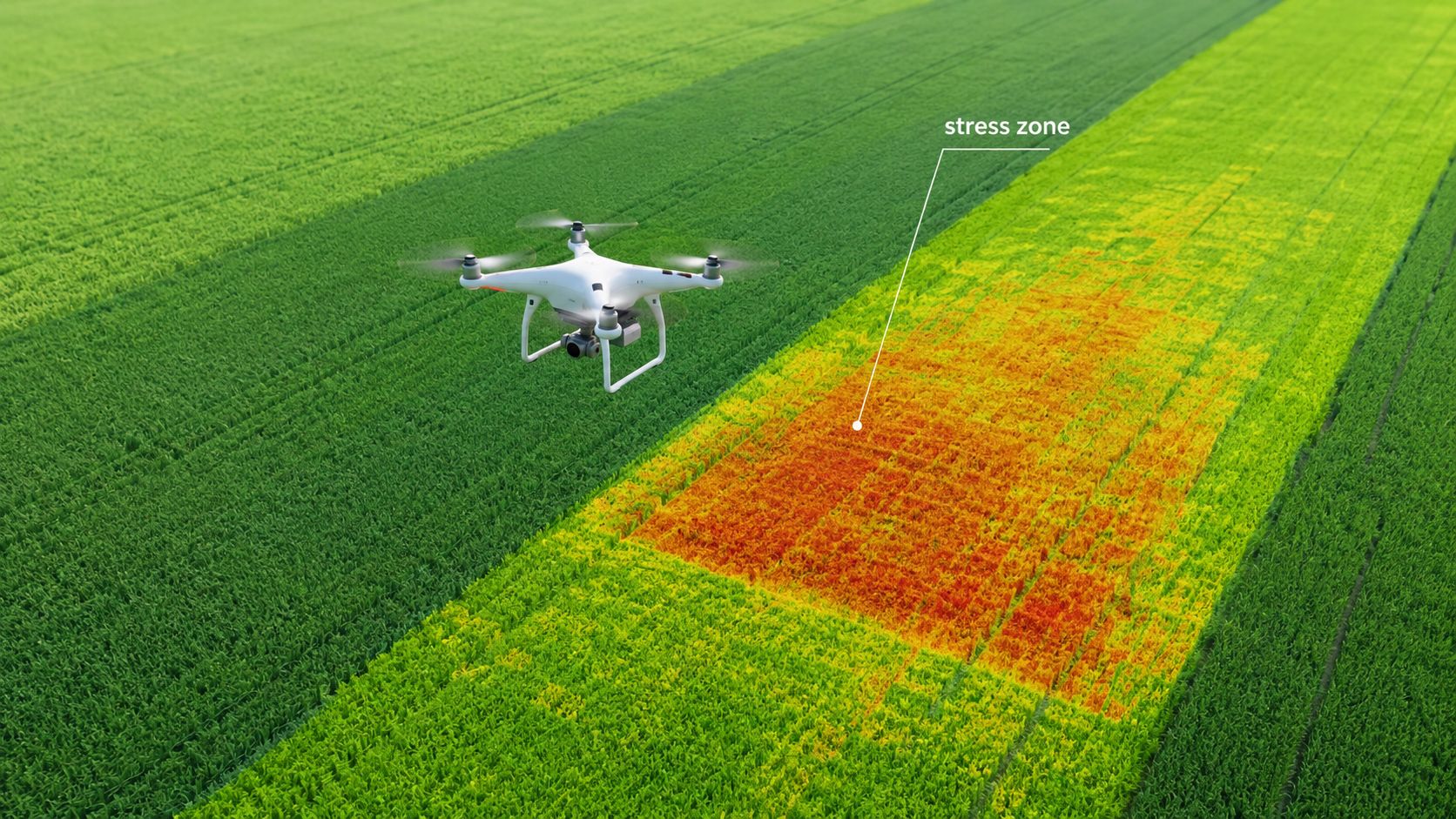
Agricultural teams use drone, satellite, and field imagery to identify crop stress, disease, pests, weeds, and irrigation problems. The output may guide an agronomist toward a field area that needs inspection, rather than directly controlling treatment.
Labels must reflect biological and geographic variation. Annotators may mark infected leaves, pest damage, weed coverage, or stressed zones, while agronomists define which categories are meaningful to growers. A model trained on one crop variety or region may not generalize to another because soil, climate, growth stage, and management practices change the visual signal.
Build for seasonal variation
Collect examples across growing seasons and crop stages. Include healthy plants, ambiguous symptoms, shadows, soil exposure, overlapping leaves, and images captured under different weather conditions.
Vegetation indices such as NDVI can provide a secondary signal, but they don't replace field validation. A spectral anomaly may indicate stress without explaining whether the cause is disease, drought, nutrient deficiency, or damage.
The review path should connect predictions to agronomist observations and eventual field outcomes. That feedback helps the team separate useful alerts from visually unusual but harmless conditions. It also prevents the model from turning a regional shortcut into a false diagnosis.
Some operators also need to evaluate equipment and field conditions specific to their region, including solutions discussed in this overview of the Xag P150 Max for Australian farms. The broader point is practical: deployment conditions matter as much as the model architecture.
8. Facial Recognition and Biometric Verification
Facial recognition can authenticate a user, support identity verification, control access, or search recorded footage. In banking and KYC, the task is often verification, comparing a live capture with an identity document or an enrolled identity. That is different from identifying an unknown person in a public scene.
The dataset needs variation in pose, lighting, expression, camera quality, age, and relevant demographic groups. It also needs attack examples, such as printed photos, screen replays, masks, and manipulated media, if the workflow is exposed to fraud attempts.
Consent and purpose must be explicit. Teams should document why facial data is collected, how long it is retained, who can access it, and what happens when the system is uncertain. Raw images and derived embeddings require careful protection.
Verification needs a human fallback
A failed match shouldn't automatically mean fraud. Poor lighting, camera angle, disability-related differences, document quality, or a genuine change in appearance can produce a false negative. Route uncertain results to trained reviewers who can follow a defined process without seeing unnecessary personal data.
Liveness checks, encrypted storage, demographic testing, and periodic validation belong in the operating model. Accuracy in a controlled demonstration doesn't establish that a biometric workflow is suitable for a live population.
9. Traffic Flow and Smart City Infrastructure
Transportation agencies use machine vision to count vehicles, classify cars, trucks, buses, and motorcycles, detect incidents, monitor parking occupancy, and support signal management. These systems operate in conditions that change by time of day, weather, roadworks, camera angle, and traffic density.
Annotation typically includes vehicle boxes, lane boundaries, vehicle classes, traffic states, and event labels. A counting model can perform well on a clear straight road and fail when vehicles overlap at an intersection.
Classification errors also affect downstream decisions, especially when policy depends on vehicle type.
Start with a corridor or intersection where the agency has a clear operational metric. That metric might concern congestion, incident response, safety, parking occupancy, or emissions. Without an agreed measure, the team may optimize model accuracy while failing to improve transportation operations.
Edge processing reduces unnecessary transfer
Local inference can reduce bandwidth and latency by sending event data rather than continuous footage. Archived video still needs privacy controls, including blurring faces and license plates where appropriate. Transportation agencies should decide what must be retained before cameras go live, not after a storage system fills with sensitive footage.
Human review is useful for disputed violations, unusual incidents, and model changes after road redesign. Automated counts can support decisions, but an operator should be able to inspect the evidence behind a consequential alert.
10. Industrial Equipment Inspection and Predictive Maintenance
Maintenance teams use visual and thermal inspection to find corrosion, cracks, leaks, overheating components, and other signs of deterioration. Images become more useful when combined with vibration, temperature, operating state, and maintenance records.
The central labeling problem is often not “defect” versus “no defect.” Equipment changes gradually. Annotators and maintenance specialists need to distinguish healthy variation, normal wear, early deterioration, and conditions that require immediate intervention.
A baseline of healthy equipment is valuable because anomaly detection depends on understanding normal operation. Historical maintenance records can connect an image pattern to an actual failure, repair, or inspection outcome. Without that connection, the model may flag visually unusual equipment that never causes a problem.
Combine signals, then validate outcomes
A thermal image may identify a hotspot, but maintenance staff still need to determine whether the cause is electrical load, a loose connection, ambient conditions, or sensor error. Multimodal models can help prioritize inspections, but they don't remove the need for qualified technicians.
Use feedback loops that record what happened after each alert. The system should learn from confirmed failures, harmless anomalies, missed defects, and changes in equipment configuration. Human review protects the model from drifting away from plant reality.
10 Machine Vision Applications Comparison
Choose the Use Case Before You Scale the Data
The right machine vision application starts with the decision, not the annotation tool. Before a team collects a large dataset, it should define what action follows a detection, who owns the decision, and what evidence that person needs.
Three checks expose most deployment risks.
First, assess the cost of a missed detection. A missed cosmetic defect may lead to rework. A missed medical finding, security event, or vehicle hazard has a different escalation path and requires a more conservative review design.
Second, map the conditions the model must handle. Lighting, camera angle, occlusion, weather, document quality, crop stage, equipment type, and demographic variation all affect generalization. Representative data is usually more valuable than a large collection of clean examples.
Third, define the uncertain-result workflow. A confidence score isn't a process. Someone must review the case, correct the label when needed, record the outcome, and decide whether the example belongs in a future validation set.
Machine vision adoption is broadening beyond traditional inspection. Gitnux reported that 31% of manufacturers had computer vision deployed on production lines by 2023, 18% were using deep-learning-based vision for quality inspection, and 70% of machine vision systems were integrated with robotics. Those figures reinforce a practical trend, vision increasingly supports automated action rather than operating as a standalone camera system. Gitnux industry statistics provides the cited industry context.
For teams that need structured image, video, text, audio, or LiDAR labeling, BUNCH data labeling outsourcing provides a managed human workflow. BUNCH was founded in 2017, operates from offices in Metro Manila and Cavite in the Philippines, serves mostly US and European clients, and also supports AI safety services such as model evaluation, AI validation, red teaming, LLM fine-tuning, and RLHF.
A machine vision project doesn't need a larger dataset by default. It needs the right examples, clear review ownership, and a way to learn from production errors.
BUNCH builds managed teams for image, video, text, audio, and LiDAR annotation, along with AI validation and human-in-the-loop operations. If your team is deciding how to handle defect labels, edge cases, or ongoing review volume, book a call to discuss a workflow suited to the application.
About the Author
Stay in the Loop!
Related Content

Scalable Data Labeling Solutions: Growing Teams Without Compromising Quality
Learn how to scale data labeling for ML without sacrificing quality through double-pass annotation, AI integration, dedicated teams, continuous training, and strong project management.

A Brutal Disruption in Image Annotation Services in 2025
AI data labeling just got disrupted. Generalist models are out, and expert-driven, specialized data is in. Here’s how the landscape is evolving faster than anyone expected.

How We Are Obsessed About Data Quality and Why
We understand the importance of reliable data quality for training datasets and precision in moderating user-generated content. Learn how we apply rigorous QA in all our processes.