Audio Annotation Service How to Choose and Scale Quality


You can collect thousands of hours of customer calls, voice commands, or field recordings and still end up with unusable training data. A transcript gives you the words. A strong audio annotation service tells you who spoke, when they spoke, what else happened in the audio, and which segments are too unclear to trust.
That is the real decision point. Not human versus AI, but whether your workflow can handle overlapping speakers, noisy clips, accents, code-switching, and changing data without feeding hidden errors into your models.
What an Audio Annotation Service Actually Does
An audio annotation service converts recordings into labeled training data. That can include transcripts, speaker turns, timestamps, sound events, intent labels, segmentation, and notes about unclear audio.
A transcription shop answers one question, what was said. A managed annotation operation answers several more:
- Who spoke: Speaker diarization separates turns between participants
- When it happened: Timestamps mark the start and end of speech or events
- What else occurred: Labels can identify laughter, alarms, music, coughing, or other sounds
- How certain the label is: Rules can route unclear segments for review instead of forcing a guess
That distinction matters because downstream systems need different signals. A meeting model may need accurate words and speaker turns. A call quality model may need intent, sentiment, interruptions, and silence. A smart-device model may care more about sound events than complete sentences.
A marketplace gives you access to workers. A platform gives you software for assigning and reviewing tasks. A managed service adds operational ownership, including recruiting, training, process management, QA, reporting, and escalation. You still need to define the target labels and acceptance criteria, but you are not left coordinating every annotator and review queue yourself.
Practical rule: If a provider cannot explain who owns guidelines, escalations, sampling, and rework, you are buying labor or software, not a managed quality system.
Here at BUNCH, its wider data annotation services covers text, images, video, audio, and 3D or sensor data. That broader capability can matter when an audio project eventually connects to video moderation, sensor fusion, or multimodal model evaluation.
Research on CrowdSpeech and VoxDIY documents 176,519 annotations across 25,217 recordings created by 4,386 workers in the published benchmark research. The useful lesson is not just scale. Large distributed workflows need consistency checks, double-pass review, and clear rules because independent judgments drift.
Core Audio Annotation Tasks Explained Simply
Start with the task your model needs, not with the labeler interface.
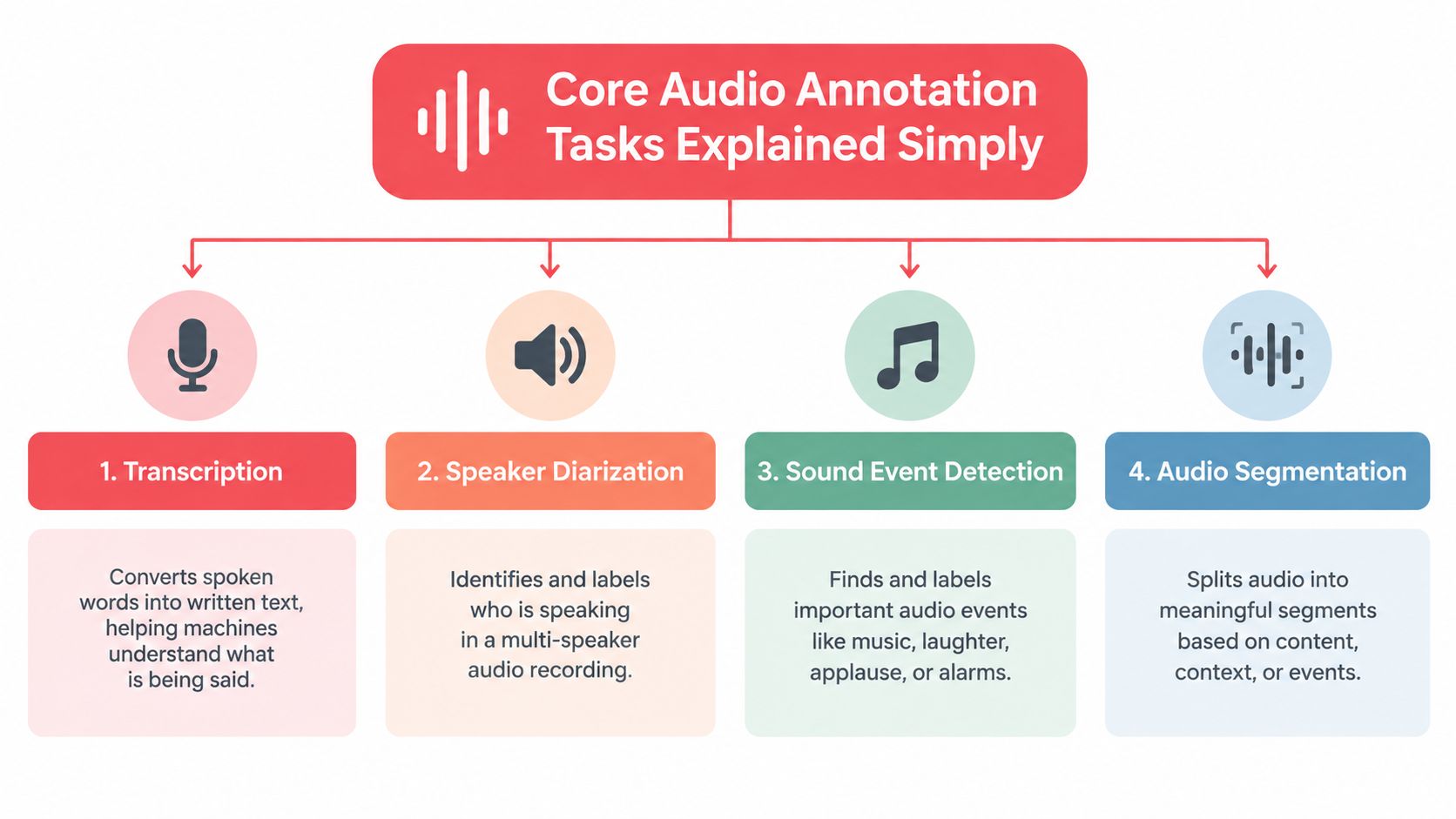
Transcription captures the words
Transcription turns speech into text. For a voice assistant, the label may preserve exact wording, filler words, and corrections. For a search feature, you may want readable text, but that version may be unsuitable for a model that must recognize disfluencies.
Set the rules before production begins. Decide how annotators handle false starts, abbreviations, profanity, names, and words that cannot be heard.
Diarization identifies speaker turns
Diarization marks who spoke when, usually with neutral labels such as Speaker 1 and Speaker 2. It is not the same as identifying a person by name.
For a support call, diarization can separate the customer from the agent. For a meeting, it can show interruptions. If your model needs turn-taking behavior, a transcript without speaker boundaries loses important information.
Sound event labeling captures non-speech audio
Sound event detection marks events such as laughter, a door closing, music, traffic, or an alarm. These labels help models distinguish speech from surrounding acoustic context.
The taxonomy needs concrete examples. A short resource on step-by-step sound design guidance can help teams describe acoustic events consistently before annotators begin.
Segmentation places boundaries around meaning
Segmentation divides an audio stream into usable units. A segment might contain one utterance, one speaker turn, or one sound event. Overlapping events may need multiple labels covering the same time range.
A customer says, “I can't log in,” while a second person speaks in the background. A single flat segment hides the overlap. A layered annotation preserves it, which gives a diarization or separation model a better training target.
Dataset examples show how wide the field has become. Indic DiarBench contains 108 hours across all 22 scheduled Indian languages, CORAA ASR contains 290 hours of manually validated Brazilian Portuguese speech, and Loquacious Set contains 25,000 hours of transcribed English speech, as documented in Mehendale et al.'s dataset research. These figures point to different needs, breadth across languages and depth within a major language.
Why Messy Audio Is the Real Challenge
Clean, single-speaker recordings are the easy case. Production audio includes crosstalk, traffic, room echo, clipped words, long pauses, laughter, code-switching, and accents that a general model may not handle well.
Overlapping speech creates a boundary problem. Should both speakers receive labels over the same time range? If annotators resolve those cases differently, the model learns inconsistent turn boundaries.
Background noise creates a confidence problem. An annotator who guesses an unclear word may produce a confident-looking label that the waveform does not support. A transcription style guide from Rev instructs annotators to mark inaudible or unclear words rather than infer them, which keeps the training target aligned with the available audio evidence in its transcription guidance.
Disfluencies and code-switching create taxonomy problems. “Uh-huh” may signal agreement, backchanneling, or an incomplete response. A bilingual speaker may switch languages mid-sentence. Accent variation can also make a technically correct word look different to annotators who lack the relevant language or regional context.
A practical service should answer these questions before you approve a pilot:
- Overlap policy: Can labels overlap, and how are speakers represented?
- Unclear audio: Are uncertain words tagged, escalated, or guessed?
- Language rules: How are code-switches, dialects, names, and borrowed words handled?
- Confidence thresholds: Which segments require a second listen or specialist review?
- Event taxonomy: What separates speech, music, noise, laughter, and environmental events?
For additional context on speech recognition in noisy environments, focus on the failure conditions your own recordings contain. Do not evaluate a service only on clean sample clips.
How Quality Control Keeps Audio Labels Reliable
Quality starts with protocol design. Skilled annotators can still produce poor data if the instructions leave edge cases open to interpretation.
Write rules that remove guessing
Create a living guide with label definitions, positive examples, negative examples, and escalation paths. Include difficult cases first, such as overlapping speakers, clipped words, filler sounds, background conversations, and language switches.
Then run a small calibration batch. Have multiple annotators label the same material, compare disagreements, and revise the guide before the main queue opens.
Research on pronunciation-error annotation found that protocol choice affected inter-annotator agreement. The study measured agreement with Cohen's kappa for expert pairs and Fleiss's kappa for crowdsourced labels, showing why task format can influence consistency in the Interspeech paper.
Use independent review
Double-pass review means one person creates the label and another checks it independently or against a defined review standard. The reviewer should inspect both obvious errors and cases the first annotator flagged as uncertain.
Track disagreement by label type. We run calibration in batches of 50 clips; if two annotators disagree on speaker-turn boundaries more than 15% of the time, we pull that batch and revise the guide before continuing, that threshold came from watching agreement plateau around week two of a project, not week one.
A project may have clean transcription but weak overlap boundaries. One overall score can hide that difference.
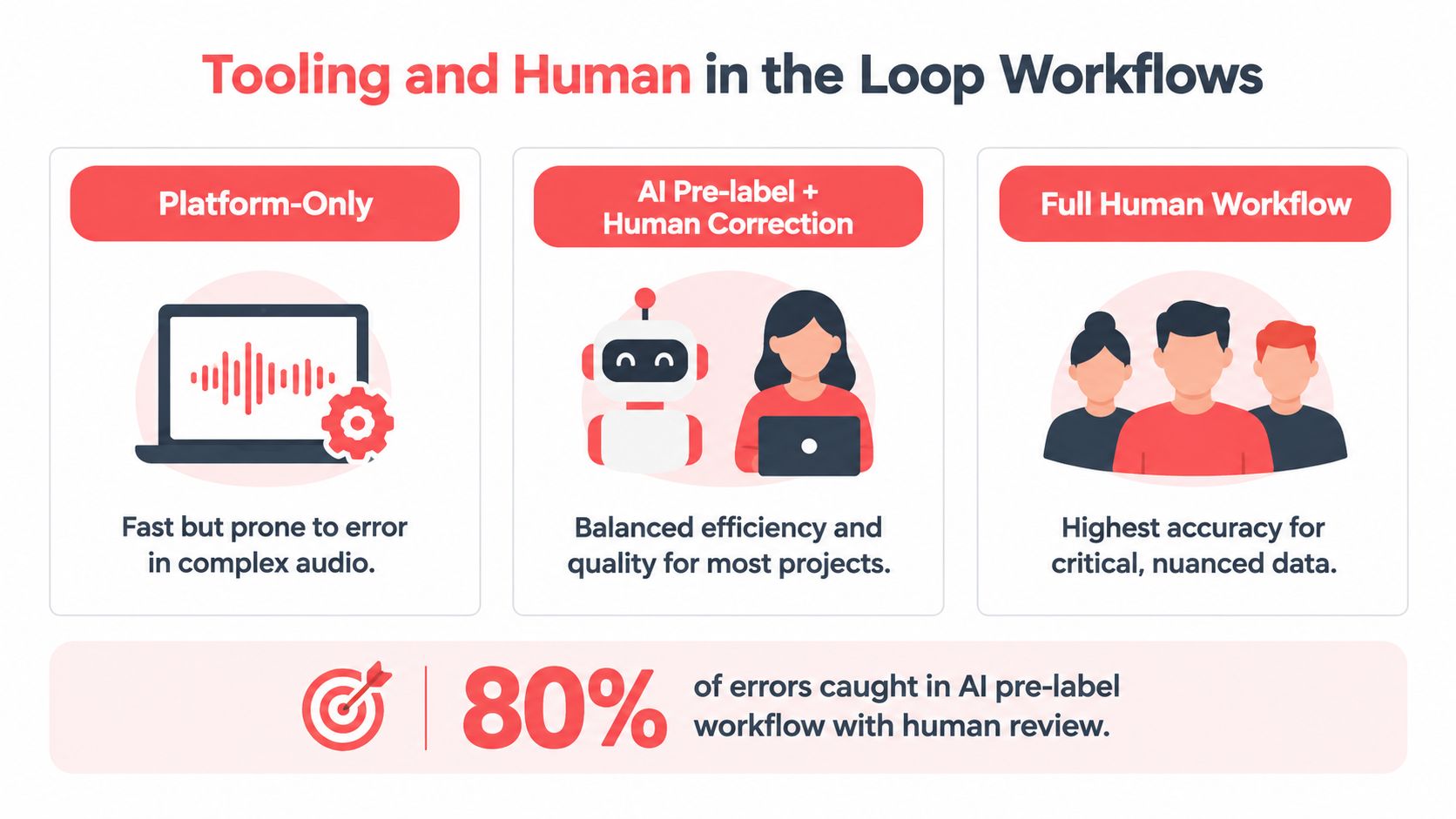
The required workflow comparison visual includes three operating models:
Make QA a feedback loop
Review findings should update examples, retrain annotators, and route similar segments back into inspection. Keep versions of the guidelines and dataset exports so your ML team can understand which rules produced a given label set.
Ask for a pilot report that shows disagreement categories, rework decisions, unresolved audio, and escalation handling. You do not need a decorative dashboard. You need evidence that the operation can detect and correct drift.
Tooling and Human in the Loop Workflows
Automation can reduce repetitive work, but it does not remove the need for judgment. Pre-trained ASR can draft a transcript, while people correct words, speaker boundaries, event tags, and ambiguous segments.
LLM-assisted annotation is useful for routing and enrichment, yet recent conference research highlights continuing gaps in bilingual, atypical, noisy, and low-resource speech in its discussion of human intervention. That makes “automation first” an incomplete policy. The right question is where automation is safe and where it needs a human gate.
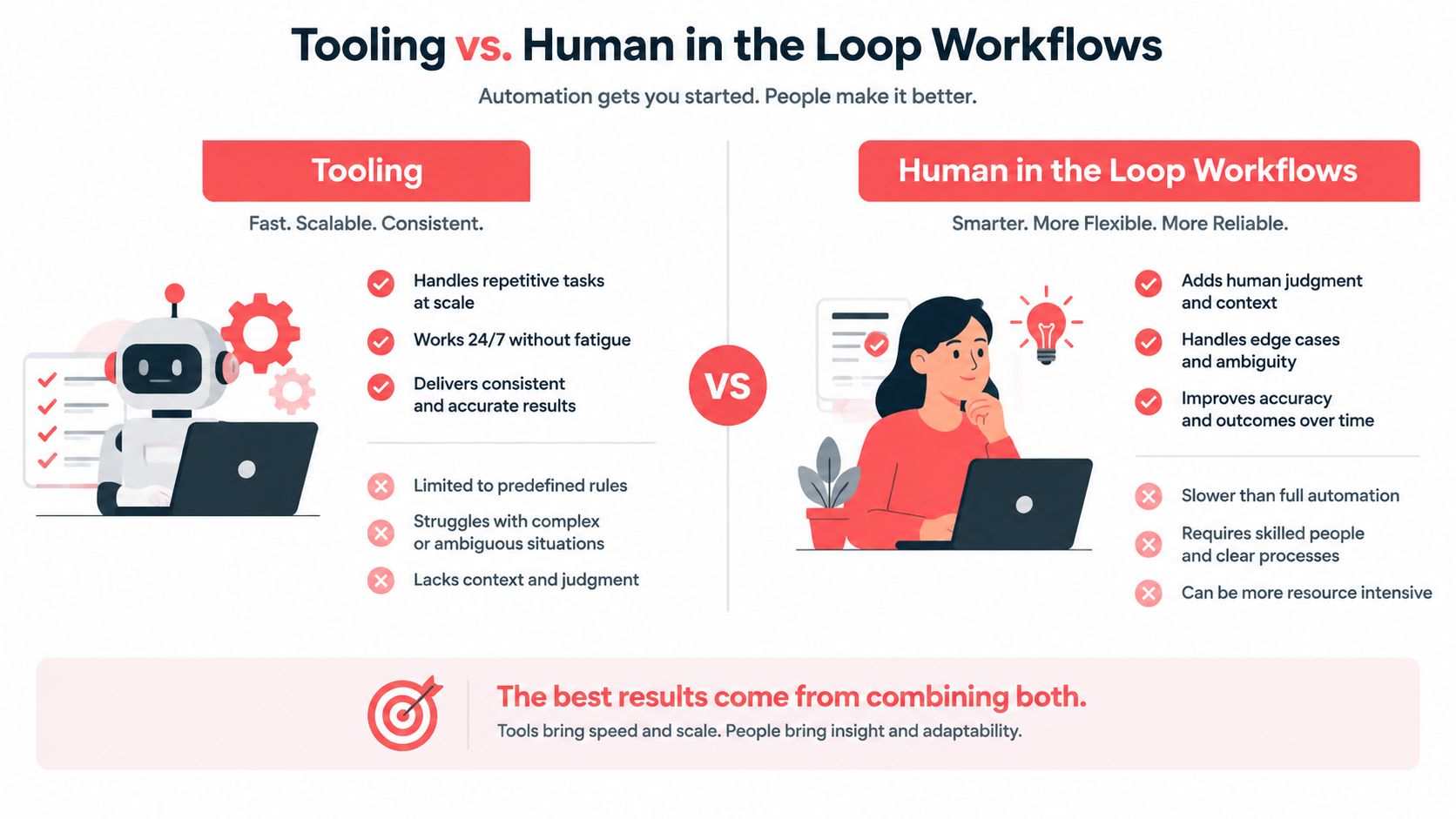
On an early project, we found reviewers were accepting ASR pre-labels for accented speech at a noticeably higher rate than for standard accents. The model's confidence score wasn't a reliable proxy for accuracy, so we removed it from the reviewer UI entirely.
Tool-agnostic integration is useful when your organization already has an annotation platform, storage system, or review environment. A service team should be able to work inside the agreed toolchain, export structured labels, and route edge cases to people with the right language or domain knowledge.
The trade-off is straightforward. Platform-only gives maximum control but adds operational work. AI correction can increase throughput but may cause reviewers to accept plausible errors. A fully managed workflow reduces coordination burden but requires strong documentation, access controls, reporting, and ownership boundaries.
How to Choose an Audio Annotation Vendor
Evaluate the operating model before you evaluate the sales deck.
Ask who trains annotators, who maintains the taxonomy, who reviews disputed segments, and who owns missed quality targets. Ask how the provider handles sensitive recordings, access permissions, retention, and exports. A vague answer usually predicts a vague process.
BUNCH was founded in late 2017, serves technology companies through a boutique managed outsourcing model, and reports an average client relationship of over four years. Most of the clients begin with 2 to 5 people before expanding into larger departments, as described on the company story page. Those facts describe its model, not a guarantee for a particular audio project.
Use a pilot to test the work, not just the interface. Give the team representative audio, including the recordings your internal annotators usually avoid.
- Specialization: Can the team handle your language, domain vocabulary, speaker structure, and event taxonomy?
- QA design: Will you receive agreement results, review outcomes, and examples of corrected labels?
- Scaling path: Can the operation move from a controlled pilot to a continuing queue without changing the rules?
- Coverage: If your workflow needs follow-the-sun operations, who manages handoffs and escalations?
- Governance: Where will files, labels, reviewer notes, and audit records live?
Outsourcing is not the right answer for every team. Keep the work internal if the dataset is small, the domain is highly confidential, or your researchers need to change labels every day while exploring a new task. A managed service fits better when volume is continuous, internal hiring is slowing delivery, or your ML team is spending too much time managing annotation operations instead of improving the model.
Putting Audio Annotation Into Practice
Start with a narrow pilot that represents your real distribution. Include clean recordings, noisy recordings, overlapping speech, accents, code-switching, and unclear segments. Define the output schema before work begins, including timestamps, speaker labels, event tags, uncertainty markers, and escalation fields.
Next, freeze a first version of the annotation guide. Have reviewers compare a shared sample, record disagreements, and revise the rules before production. Validate the labels against your downstream use case, not only against a transcript. A diarization model needs reliable speaker boundaries, while a sound event model needs consistent event timing.
Treat the dataset as an operating asset. New accents, products, policies, and recording environments will create new edge cases. Keep guideline versions, review samples, and correction notes so future batches remain compatible with earlier training data. For broader planning, see this guide to scaling data labeling teams.
Do I need a full human workflow? Not always. Use automation for predictable material, then reserve human review for ambiguous, multilingual, noisy, or high-impact segments.
What should a pilot prove? It should show that annotators understand the taxonomy, reviewers find meaningful errors, and the exported labels fit your training pipeline.
When should I avoid outsourcing? Keep annotation internal when the task is exploratory, highly confidential, or too small to justify managed coordination.
BUNCH provides managed human teams for audio annotation, including transcription, speaker labeling, segmentation, and sound event tagging, alongside wider data, trust and safety, and customer operations. Book a call with a BUNCH expert to discuss whether its managed workflow fits your audio volume, QA requirements, and internal capacity.
About the Author
Stay in the Loop!
Related Content

A Brutal Disruption in Image Annotation Services in 2025
AI data labeling just got disrupted. Generalist models are out, and expert-driven, specialized data is in. Here’s how the landscape is evolving faster than anyone expected.

Scalable Data Labeling Solutions: Growing Teams Without Compromising Quality
Learn how to scale data labeling for ML without sacrificing quality through double-pass annotation, AI integration, dedicated teams, continuous training, and strong project management.
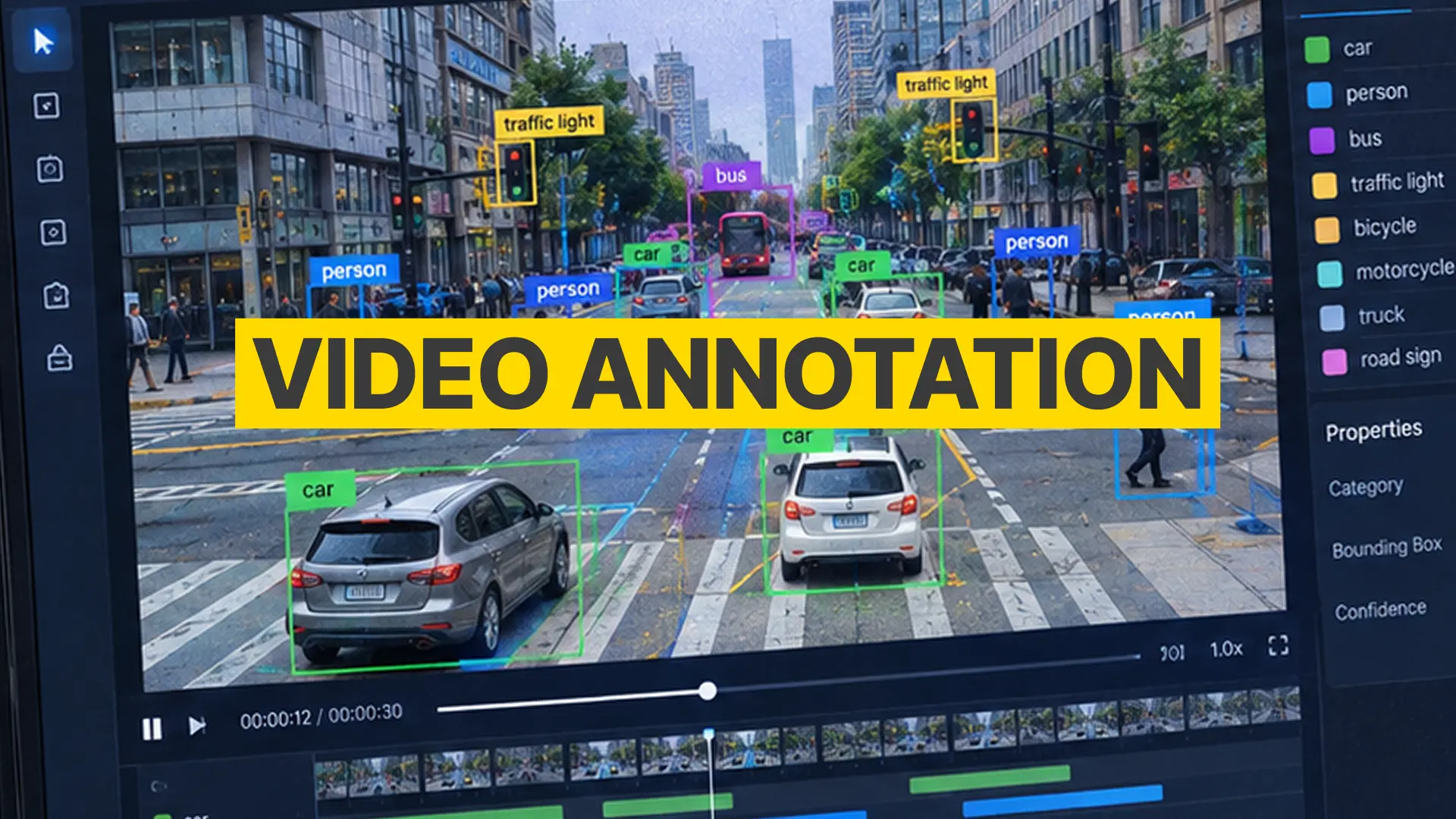
Video Annotation Services Explained and How to Choose
Learn what video annotation services do, from bounding boxes to tracking, plus workflow, QA and how to choose video annotation services for your model.