Video Annotation Services Explained and How to Choose

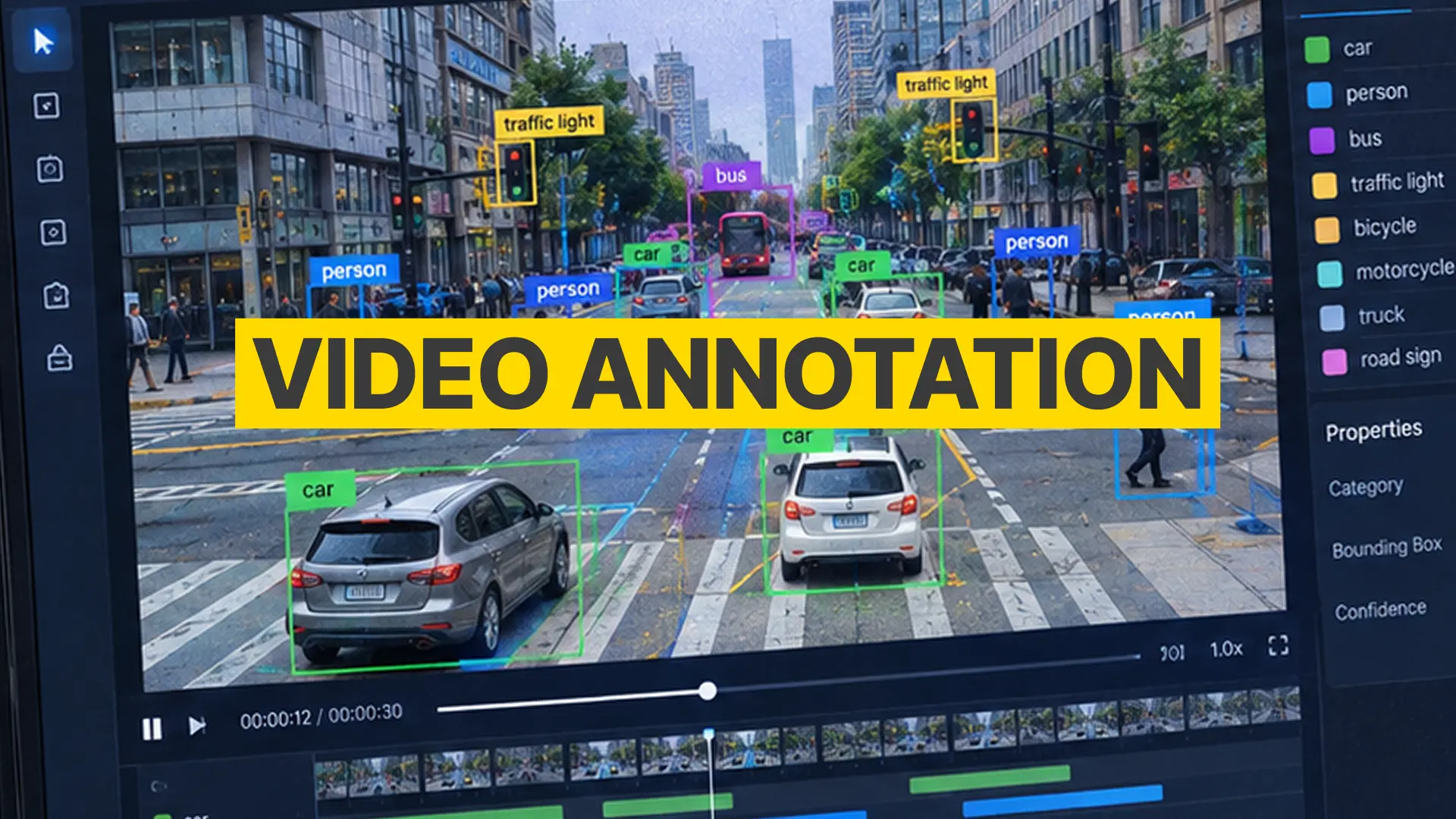
You have hours of footage, a model that needs more than raw pixels and a team that cannot afford to label every object from scratch. Video annotation services turn footage into structured training data by labeling objects, actions and events across time. The right partner does more than count frames. It manages ambiguity, temporal consistency and the rework that happens when annotators disagree.
What Video Annotation Services Actually Do
Video annotation services label objects and activity in video so a computer vision model can learn what to detect, track or classify. The output usually includes frame-level labels, coordinates, object IDs, timestamps and metadata, not just a tag on the whole file.
A still image shows one moment. Video adds motion. A car changes position, a person disappears behind an obstacle and returns, and an action has a start and end. Annotators have to preserve those relationships across the sequence.
.jpeg)
A practical workflow looks like this:
- Define the task: Decide whether the model needs detection, segmentation, tracking, pose or event labels
- Mark the footage: Annotators label relevant objects or actions on selected frames
- Preserve time: They connect labels across frames, handle occlusion and set temporal boundaries
- Review and export: A reviewer checks consistency before the dataset enters training
On a recent retail loss-prevention project, our data annotation team revealed a critical tracking vulnerability, finding that 12% of tracked customer IDs fragmented or swapped whenever individuals were blocked from view by store fixtures. To fix these identity breaks, we updated the tracking pipeline to automatically trigger a mandatory re-identification check whenever a shelf-occlusion event lasts longer than two seconds. By delaying deep feature extraction until this temporal threshold is crossed, the system avoids wasting compute on momentary tracking gaps while reliably reconciling lost visual embeddings when a customer emerges from behind a high-density shelf display.
The service layer matters because ML teams rarely need only drawing. They need guideline development, task assignment, edge-case handling, review and delivery in a format the training pipeline can use. BUNCH describes this type of work through its data annotation services, alongside other human-in-the-loop operations.
The broader annotation field became visibly data-intensive through TRECVID. The 2003 benchmark assembled about 104.5 GB of MPEG-1 video and involved 111 researchers from 23 institutes, producing 197,822 ground-truth labels across 62.2 hours of video. After hierarchy propagation, the effort contained 433,338 labels, according to Business Research Insights' account of the TRECVID history. That history shows why video labeling became an infrastructure problem, not a side task.
If you're still separating generated video from training footage, this overview of generative video tools from BlitzReels gives useful context. Generated clips may create data, but they still need labels that reflect the behavior your model must recognize.
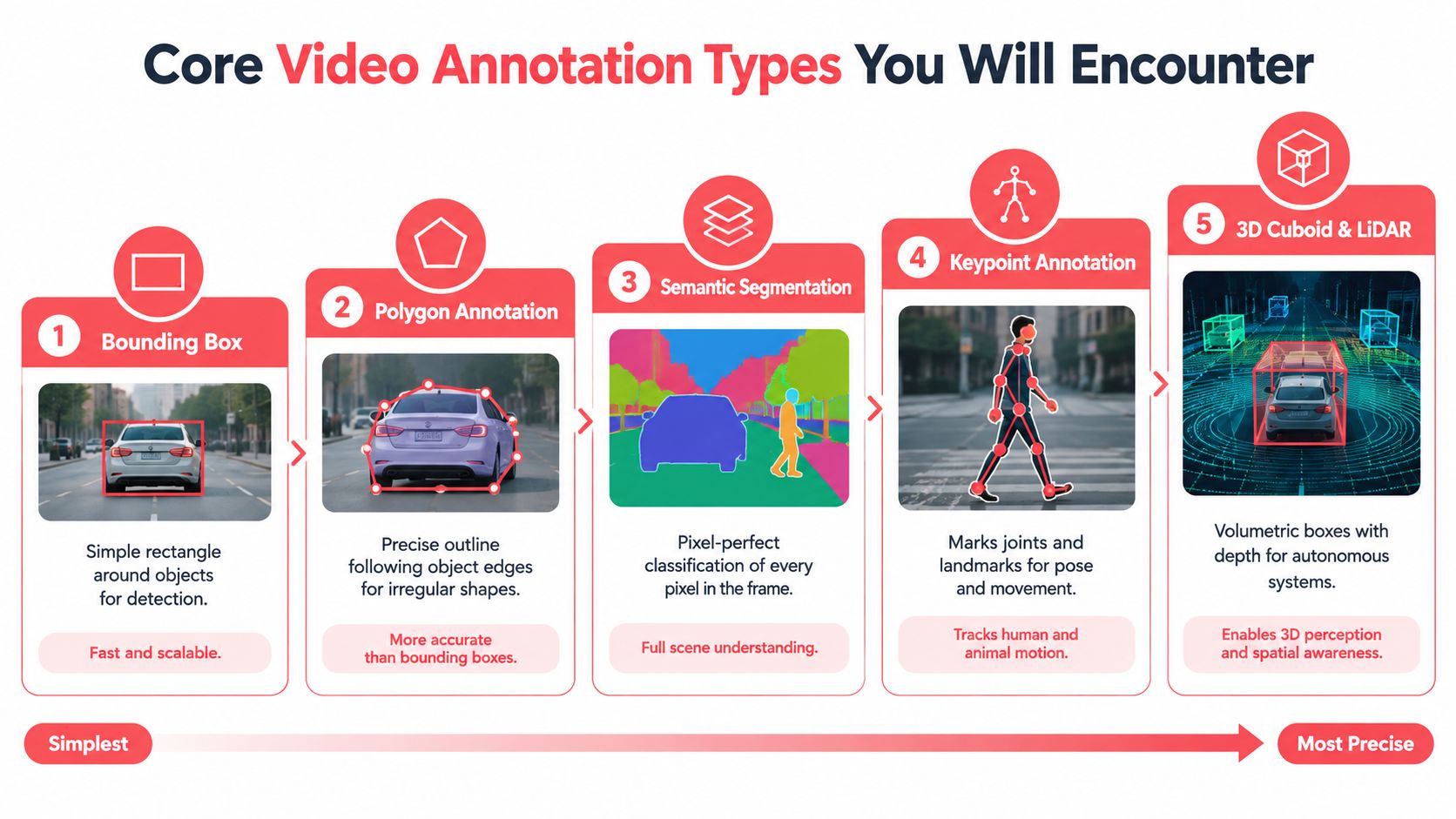
Core Video Annotation Types You Will Encounter
Choose the label format based on what the model must understand. More detail is not always better. It adds labor, review effort and more room for disagreement.
Bounding boxes
A bounding box is a rectangle around an object. It works when the model needs to locate and identify a vehicle, person, package or animal without learning the exact silhouette.
Boxes are fast to create and often fit detection systems. They are less useful when background pixels matter or objects overlap heavily.
Polygon and semantic segmentation
A polygon follows an object's outline, like tracing a leaf with a pencil. It gives the model a tighter boundary around irregular shapes.
Semantic segmentation goes further by assigning a class to pixels throughout the frame. That can make sense for road surfaces, medical regions or crop areas, but it demands more precision than a box.
Keypoints and pose
Keypoints mark landmarks such as joints, facial points or the corners of an object. Connecting those points into a skeleton lets a model reason about posture and movement.
Use this format when shape matters less than the relationship between parts. Pose estimation, gesture recognition and movement analysis are common examples. Teams evaluating this work can review keypoint annotation services for a more focused treatment.
Clip and event classification
Clip-level classification assigns a label to a segment or entire clip. It answers questions such as whether a scene contains a fall, a collision or a particular activity.
This is simpler than marking every object, but boundaries still matter when the model must learn when an event starts and stops.
3D cuboids and LiDAR
A 3D cuboid adds depth, orientation and volume. It fits autonomous systems, robotics and other applications where a model must understand an object's position in three-dimensional space.
The selection rule is straightforward:
- Use boxes when location and class are enough
- Use polygons or masks when shape and boundaries affect the prediction
- Use keypoints when pose or part relationships matter
- Use clip labels when behavior is the primary target
- Use cuboids or LiDAR labels when depth is part of the decision
Do not ask a provider for pixel-perfect masks if your model only needs detection. Conversely, do not expect loose boxes to teach a system a precise boundary.
How Tracking and Temporal Labeling Work Across Frames
The hard part of video annotation is often the boundary, not the frame. A reviewer may agree that an action happened while disagreeing about the exact frame where it began or ended.
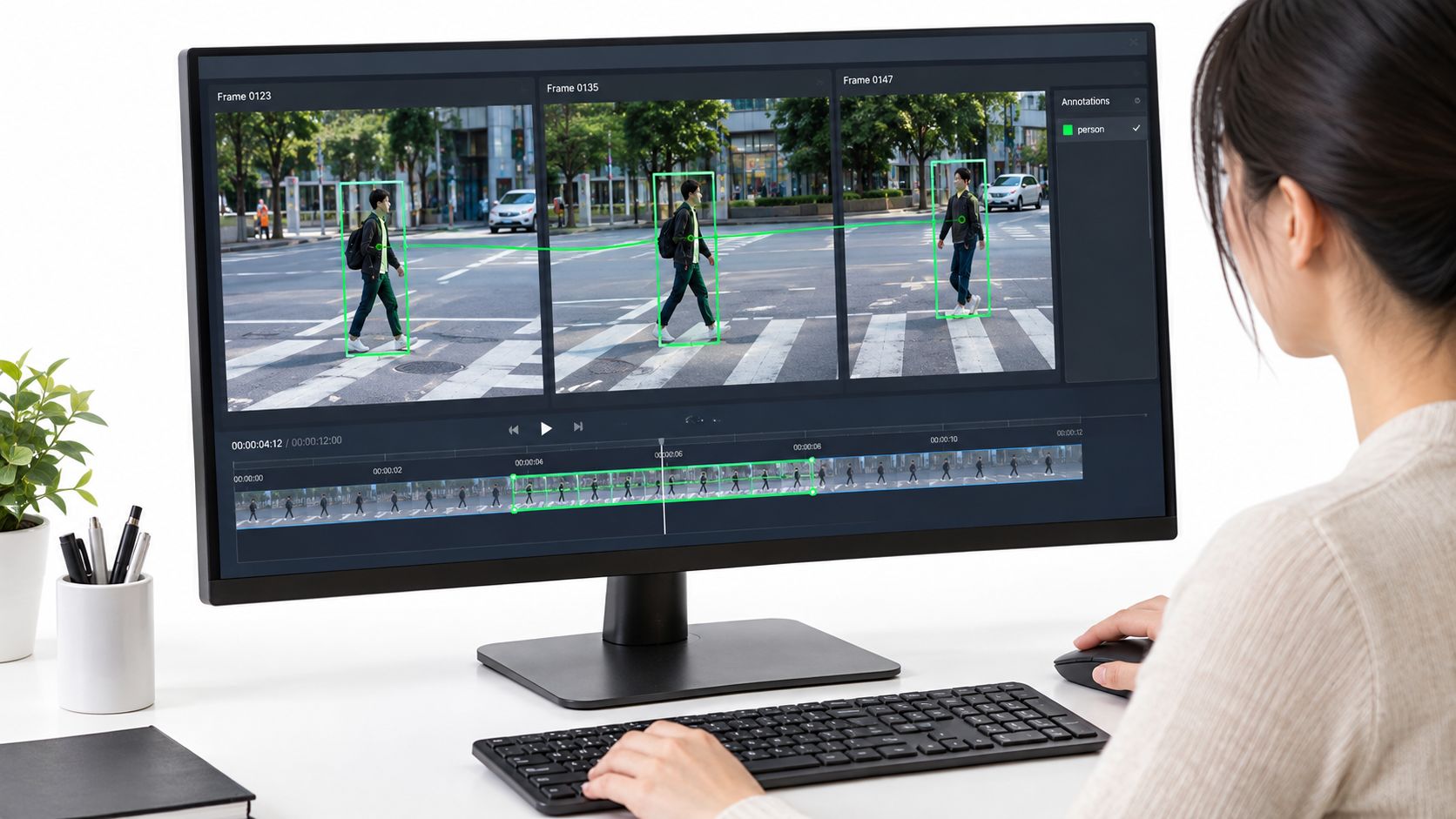
Tracking gives an object a persistent identity across a sequence. The annotator marks the object, then maintains that identity as it moves, changes scale, becomes partially hidden or reappears. A box that jumps, flickers or changes size for no visual reason creates a noisy training signal.
Keyframes reduce repetitive work
Annotators can place labels on important keyframes and use interpolation between them. Linear interpolation reported recall@0.7 of 0.73, while visual interpolation reported 0.75, according to the WACV 2021 paper on efficient video annotation.
Those figures do not mean interpolation can run unattended. It works best when motion is predictable. Direction changes, blur, occlusion and crowded scenes require more keyframes and closer review.
The same paper reports that medium-complexity videos could reach about 10% error with 0.001 clicks per frame, while difficult videos required up to 0.2 clicks per frame. The procurement lesson is more useful than the numbers themselves: labor follows motion complexity, not video duration.
Temporal boundaries need adjudication
Action labeling requires a start frame and an end frame. One annotator may mark the beginning of a hand reaching for an object. Another may wait until contact. Both may follow a reasonable reading of the guideline.
A temporal labeling thesis describes high-quality temporal labeling as an intrinsic challenge as video datasets grow. The same research context reports conflicts in about 8% of videos even after two-pass annotation, while another source notes disagreements of plus or minus 5 frames and says 32% of action segments in EPIC-KITCHENS-100 fell below a strict tIoU threshold during initial labeling, as summarized in the temporal labeling thesis.
Practical rule: Ask how a provider resolves uncertain start and end frames. The answer tells you more than a headline throughput claim.
Inside a Reliable Video Annotation Workflow
A dependable workflow starts before anyone opens an annotation tool. The operations lead first confirms what the footage contains, what data can be shared, which classes matter and how the final labels will enter the training pipeline.
Intake creates the operating boundary
The provider reviews file formats, camera views, expected conditions and privacy requirements. Faces, license plates or other sensitive content may need controlled access or anonymization before annotation begins.
Next comes the label specification. It should define classes, attributes, occlusion rules, identity rules and examples of difficult cases. If “starts walking” has no operational definition, different annotators will produce different boundaries.
Tooling supports judgment
The annotation environment should support the required shapes, tracks, keyframes and exports. Automated tracking and interpolation can handle repetitive movement, but a human still checks where the tool loses the object or carries a label through an occlusion incorrectly.
Assignment then follows the guideline. Annotators work on defined segments, raise unclear cases and receive decisions that update the shared instructions. Without that feedback loop, an early misunderstanding spreads through the dataset.
Review is part of production
A reviewer checks object continuity, label placement, class use and temporal boundaries. Below-threshold work returns for correction instead of entering the training set.
Datasets also need version control. When a class definition changes, you should know which clips were reviewed under which rule and whether earlier labels need rework. Delivery should include the agreed export structure, metadata and a clear handoff into your model pipeline.
The useful vendor question is not “How fast can you label?” Ask, “What happens when the footage does not match the guideline?”
Quality Controls That Keep Video Data Consistent
Quality control has two jobs. It catches obvious labeling errors, and it exposes rules that reasonable people interpret differently.
A common human-in-the-loop model uses first-pass labeling followed by second-pass review. Reviewers reconcile disagreements against calibration examples, then send below-threshold batches back for rework. This approach applies to boxes, segmentation, keypoints and temporal labels across video and other data types.
Calibration prevents rule drift
A calibration set gives annotators the same reference clips before production begins. It should include normal examples plus the cases most likely to cause disagreement, such as partial occlusion, reflections, crowded scenes and uncertain action boundaries.
Agreement metrics help you see whether the rule is working. Cohen's kappa, for example, can quantify agreement beyond simple matching. The metric is not a substitute for judgment, but a declining score signals that the guideline, training or review process needs attention.
Second-pass review can be efficient
A silver-standard workflow asks a second annotator to revise the first pass rather than redo the entire task. A study of this approach reduced total annotation time by 33% while maintaining near-equivalent quality. On 16.4 hours of video, agreement improved from Cohen's κ = 0.68 for a single annotator to κ = 0.77 after revision, according to the human-in-the-loop annotation study.
That changes the cost discussion. You do not necessarily need full duplicate annotation for every frame. You need a review design that concentrates expert attention where ambiguity and error risk are highest.
A newer hybrid workflow study reported a 35% reduction in annotation time for most participants while shifting the task toward verification and editing, as documented in the 2026 study of dense temporal video segmentation. For buyers, the implication is direct: assisted review may outperform pure manual production when the tool generates a useful first pass and humans correct it carefully.
How to Choose the Right Video Annotation Partner
Look for evidence that the provider can explain temporal ambiguity, not just object labeling. Ask to see how they handle a lost track, an object re-entering the frame, a disputed action boundary and a batch that fails review.
Security deserves the same attention as quality. Ask where footage is accessed, how permissions are controlled, how exports are handled and what happens to data after the project ends.
BUNCH is one managed-services option. Founded in 2017, it builds custom outsourced teams for technology companies, with offices in Metro Manila and Cavite in the Philippines. Its public seller profile reports customers served since 2017 and an average client relationship of 4+ years, with clients often expanding from small teams into departments, as shown on BUNCH's G2 seller profile. Its model covers human annotation and structured QA rather than a self-serve labeling platform.
For broader procurement research, this guide to data collection vendors for AI can help separate collection needs from annotation needs. They overlap operationally, but they are not the same buying decision.
Outsourcing is not always right. Keep the work in-house when your labels depend on confidential domain knowledge, the task changes daily or your team needs tight research feedback during model development. Outsource when the specification is stable, the volume is recurring and managing annotator capacity would distract your ML team.
Putting Video Annotation Into Practice and Next Steps
A pilot can look inexpensive until reviewers must resolve a person disappearing behind a vehicle or an action that starts between frames. Set the label specification before comparing vendors. Define objects, action boundaries, occlusion rules, identity changes and the required response when evidence is unclear.
Use ordinary and difficult footage in the pilot. Score temporal consistency alongside box or mask quality. Check whether identities persist, boundaries match, interpolation behaves as expected and reviewers can resolve disagreements without repeated rework. A low frame rate may hide boundary problems, while dense review may expose them and raise adjudication cost.
Video labeling became an infrastructure problem early, including in the 2003 TRECVID benchmark described in the market estimate cited by NIST. The practical lesson is simple: as labeled-video demand grows, a team needs repeatable review, escalation and export processes.
Decision test: Price ambiguous minutes, reviewer time and rework. Frame count alone will not show the project's real cost.
BUNCH provides managed teams for video annotation, including object tracking, detection, segmentation, classification and frame-level review. Human specialists work alongside AI-assisted workflows. Book a call with BUNCH to discuss your footage, label specification and review model.
About the Author
Stay in the Loop!
Related Content

Scalable Data Labeling Solutions: Growing Teams Without Compromising Quality
Learn how to scale data labeling for ML without sacrificing quality through double-pass annotation, AI integration, dedicated teams, continuous training, and strong project management.

A Brutal Disruption in Image Annotation Services in 2025
AI data labeling just got disrupted. Generalist models are out, and expert-driven, specialized data is in. Here’s how the landscape is evolving faster than anyone expected.

How We Are Obsessed About Data Quality and Why
We understand the importance of reliable data quality for training datasets and precision in moderating user-generated content. Learn how we apply rigorous QA in all our processes.