Community Management Services Explained Simply


Your community can look calm at sign-off, then unravel overnight. Spam appears, members argue, scam links spread, real questions go unanswered, and someone has to decide what to remove, what to escalate, and what needs a human reply.
Community management services provide the people, processes, coverage, and tools that keep an online community useful and safe. They combine moderation, engagement, reporting, policy enforcement, and escalation. Done well, they create an operating system for your community, not an ad hoc task for whoever notices a problem.
At BUNCH, we run managed community management and moderation teams around the clock. This guide covers how these services work and when they're worth it, including when they're not.
What Community Management Services Actually Do
A community manager does more than answer comments. They help members find information, encourage productive discussion, identify harmful behavior, apply rules consistently, and route complex issues to the right owner.
That matters as a company grows. A founder might manage a Discord server alone at first. Then volume rises, more moderators join, and the work becomes continuous, distributed across time zones, and too important to run on memory and goodwill.
The social media moderation market was estimated at USD 8.34 billion in 2024 and is projected to reach USD 23.89 billion by 2033, with a projected CAGR of 12.8% from 2025 to 2033, according to Research and Markets' social media moderation market insights. The main takeaway is simple. Moderation is now a recurring operational function tied to user-generated content, platform safety, and policy enforcement.
A practical service may include:
- Reviewing posts, messages, images, videos, and live chat
- Responding to member questions
- Welcoming new members and pointing them to resources
- Detecting spam, scams, harassment, and policy violations
- Recording actions and reasons in a moderation log
- Escalating threats, appeals, legal issues, and edge cases
- Producing reports for product, support, trust and safety, and leadership teams
For a clear overview of the broader discipline, PostSyncer's guide to community management strategies is useful because it separates community building from simple social posting.
The real design questions are practical. Who covers each channel? Which issues need a response within minutes? Which decisions can automation handle? Where must a trained reviewer step in?
How Online Community Moderation Works in Practice
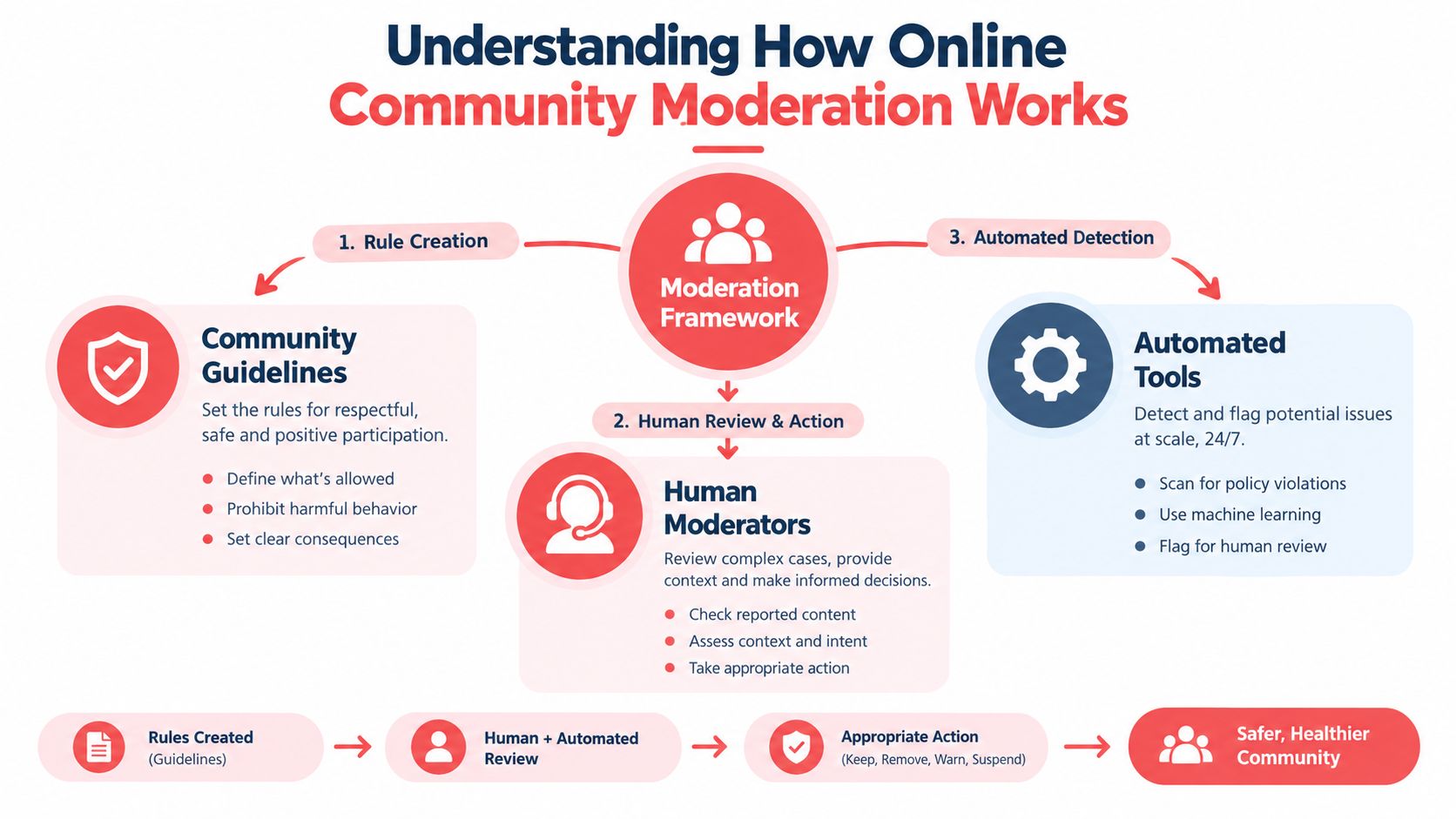
Online moderation is the operating system for community behavior. It sets expectations, gives staff a repeatable way to assess reports, and defines when cases move beyond frontline authority.
Start with rules people can apply
Guidelines should describe observable behavior. “Be respectful” states a value. “Do not target another member with threats, slurs, or repeated unwanted contact” gives moderators something they can assess.
Useful rules define scope, include examples, explain how to report problems, and state possible actions. They should cover ordinary disputes as well as spam, impersonation, fraud, sexual content, self-harm concerns, and coordinated abuse where relevant.
Build an intake and enforcement path
Reports may come from members, automated flags, moderators, or internal teams. A shared queue should assign each item an owner, priority, status, and escalation route. That record also helps managers review response times and decision consistency.
A graduated enforcement ladder can include:
- Informal guidance, when a member appears confused
- Warning, when behavior breaks a rule but does not require immediate removal
- Content removal, when a post causes harm or violates a clear policy
- Temporary restriction, when repeated behavior requires a cooling-off period
- Permanent removal, for severe or persistent violations
- Specialist escalation, for legal, safety, payment, identity, or policy questions
The queue needs service-level targets for each priority, even if channels use different targets. A low-risk disagreement can wait for routine review. A credible safety concern needs immediate ownership and a named escalation contact.
Post-moderation reviews content after publication. Reactive moderation starts after a member report or a moderator spots an issue. Both remain common. A 2025 Australia and New Zealand community management report found that 67% of communities used post-moderation and 64% used reactive moderation, while also noting movement toward AI-assisted moderation, as reported in the Grand View Research social media moderation report.
Misinformation affected 58% of communities, social conflict affected 57%, and spam affected 47% in that report. The lesson is straightforward. Written rules need queue ownership, reviewer judgment, records, and escalation coverage. Our guide to online community moderation walks through how these parts connect, from intake and triage to escalation and appeals, and includes copy-ready templates for an enforcement ladder and an escalation matrix.Our teams cover every time zone around the clock. Staff work a standard 40-hour week with consecutive rest days and more than 12 hours of rest between shifts, so night coverage doesn't depend on people running on empty. QA scores are issued weekly by default, and because audits run through late and overlapping shifts, we can shorten that cycle to a few hours when an issue needs it. Details in how we run 24/7 operations, as of September 2024.
What Community Management Services Cover Day to Day
The service usually includes three distinct jobs. They overlap during incidents, but they should not be treated as one vague task.
Moderation protects the community
Moderators review reports, automated flags, posts, replies, images, videos, and live chat. They compare each item with policy, take the allowed action, record the decision, and escalate anything outside their authority.
A moderator might remove a phishing link, warn a member for repeated abuse, or leave a political disagreement untouched because disagreement alone is not a violation. Quality depends on making those distinctions consistently.
Engagement gives members a reason to stay
Engagement is more than posting upbeat updates. It includes answering product questions, directing members to documentation, welcoming new participants, highlighting useful discussions, and prompting subject-matter experts to contribute.
A crypto community may need a clear answer about wallet compatibility. A developer community may need someone to summarize a long technical thread. A gaming group may need an event reminder that prevents repeated support questions. These actions reduce friction and make the community easier to use.
Escalation protects decision quality
Some issues should not be resolved by frontline moderators. A credible threat may go to trust and safety. A refund dispute may go to support. A suspected account takeover may go to security. A policy ambiguity may go to legal or the policy owner.
The escalation record should include the original content, member context, action already taken, reason for escalation, and required response. Without that context, specialists waste time reconstructing the incident.
On a trust and safety queue for a fintech client, the client updated its guidelines three times in a week. Moderators had to adapt continuously, and our QA and Product Knowledge Test (PKT) results showed confusion in how some updates were interpreted.
We made three changes. Before each PKT, we now run an internal knowledge review to find gaps in advance. After each policy update, we hold a discussion and a refresher rather than relying on a written notice alone. And when a rule is ambiguous, moderators go through a set line to the client's support team instead of choosing an interpretation themselves.
We kept average handle time (AHT) and QA within target throughout.
The lesson: an update isn't finished when it's published. It's finished when reviewers apply it the same way in the queue.
Practical rule: If moderators repeatedly ask the same internal question, the problem is usually a missing policy rule, an unclear owner, or weak training documentation.
A useful daily report separates volume from risk. It can show what entered the queue, what was resolved, what breached target times, which policy categories increased, and which cases need product or policy decisions. That makes community management a source of operational feedback, not just a support cost.
Engagement Models and How Teams Are Staffed
The best staffing model depends on three variables: volume, risk, and required coverage. A small professional community with sensitive product discussions may need more judgment than a larger low-risk group.
Outsourcing is not the same as using a staffing marketplace. A managed service should define the work, train people on your policies, monitor quality, maintain escalation routes, and own day-to-day delivery. You are buying an operating function, not a list of contractors.
24/7 global coverage can work when channels stay active across regions. It requires handoff notes, shared queues, consistent permissions, and a clear owner for unresolved cases. Without those controls, each shift starts from scratch and members get conflicting answers.
A managed monthly arrangement can also make planning easier than constantly adding freelancers, but it reduces direct control over individual hiring decisions. Keep policy ownership, high-risk approvals, and strategic community decisions inside your company if those areas are central to your product or reputation.
Industry Examples From Crypto and Gaming Communities
A crypto community on Telegram and Discord has a distinct operating problem. Members may be discussing token launches, wallets, governance, or market events while scammers impersonate administrators and share malicious links.
A workable team watches channels during peak activity, checks reports quickly, removes impersonation attempts, and keeps official information easy to find. Moderators should not improvise financial or technical advice. They should use approved responses and escalate account, transaction, or identity issues to the right specialists.
KYC-adjacent vigilance matters here, but community moderators should not turn a chat channel into a verification desk. A formal KYC operation commonly includes customer identification, due diligence, beneficial ownership checks, sanctions and watchlist screening, risk scoring, enhanced due diligence, ongoing monitoring, and record keeping, as outlined in Checklynx's KYC and KYB due-diligence guide.
Gaming communities create a different pattern. During a launch, update, tournament, or live event, chat volume can rise sharply. Players may report cheating, harassment, bugs, account access problems, or inappropriate user-generated content in the same stream.
The moderation team needs fast triage, but speed alone is not enough. A player reporting a bug needs a support route. A targeted harassment report needs privacy and careful evidence handling. A gameplay disagreement may need no action.
The operating model changes by channel. Live chat may need active observation. Forums can tolerate slower review if reports are prioritized. Discord may need bot-assisted filtering with human review for ambiguous cases. The core principle stays the same: match authority and response expectations to the level of risk.
Building a Sustainable 24/7 Operating Model
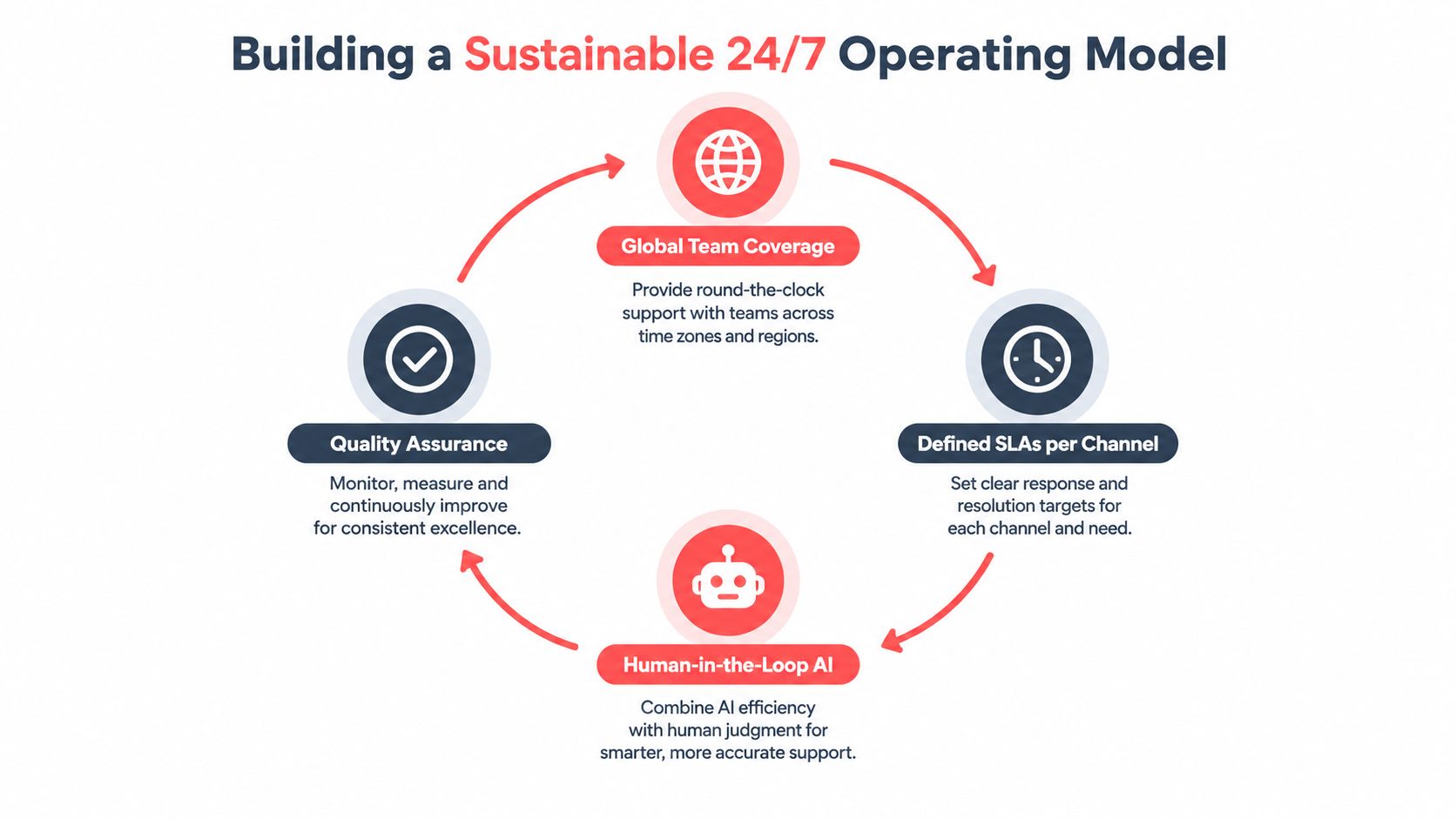
Twenty-four-hour coverage does not come from telling one person to stay available. It comes from shift design, handoffs, service targets, escalation rules, and quality review.
Independent benchmarks put response targets at under 30 minutes on X, under 1 hour on Instagram and TikTok for trending posts, under 2 hours on Facebook, under 4 hours on LinkedIn, and 24 to 48 hours for lower-urgency channels such as YouTube, according to Nerdify's community-management response benchmarks. Use these as planning references, then set targets based on your own risk and channel behavior.
Design the queue around uncertainty
A shared queue with keyword pre-filtering can surface likely scams, threats, high-risk terms, or urgent product issues. It should not decide every outcome. Confidence-based routing should send uncertain or high-risk items to human reviewers, while straightforward cases move through automation.
Human review remains necessary. OFCOM's content-moderation research describes human moderators reviewing content reported by users or flagged by automated tools. That handoff is where many quality failures happen, so teams need clear thresholds and examples.
Protect the people doing the work
Moderator load can become unsustainable as communities grow. IFTAS's 2025 Social Web Trust & Safety Needs Assessment, published in January 2026, surveyed volunteer moderators across 184 decentralized services. It found roughly one moderator per 3,500 active accounts, compared with one per 1,200 the year before. A follow-up IFTAS post, measuring against total accounts, put the average at 1:24,288, up from 1:6,167 in 2023. More than half of respondents were the only moderator or part of a very small team, and about one in five reported trauma or burnout. The sample is mostly small, volunteer-run communities, so it shows how strain builds when moderation is under-resourced, not what a company's community needs.
The practical takeaway is to plan for the people, not just the queue. Build relief coverage, rotate exposure to disturbing material, separate routine engagement from high-risk review, and give moderators a real escalation path. QA sampling, double review for edge cases, and shift handoff notes also help prevent inconsistent enforcement.
Our teams cover every time zone around the clock. Staff work a standard 40-hour week with consecutive rest days and more than 12 hours of rest between shifts, so night coverage doesn't depend on people running on empty. QA scores are issued weekly by default, and because audits run through late and overlapping shifts, we can shorten that cycle to a few hours when an issue needs it. Details in how we run 24/7 operations, as of September 2024.
How to Choose the Right Community Management Vendor
Start with the work, not the sales deck. Give a prospective provider representative policy examples, difficult edge cases, expected channels, reporting needs, and escalation scenarios. Then ask them to show how a case moves from intake to decision to QA.
Look for these controls:
- Policy alignment: Training uses your rules, examples, exceptions, and prohibited actions
- Quality assurance: Reviewers receive sampled feedback, calibration, and documented correction
- Tool agnosticism: The team can work with your existing platforms rather than forcing a replacement
- Training and ramp: The provider explains how new reviewers learn your domain before taking live work
- Escalation design: Sensitive cases have named owners, response windows, and evidence requirements
- Security practice: Access, retention, permissions, and audit records are documented
Tools can support scheduling, publishing, reporting, and approvals. For a separate view of tool selection, SMS Activate's overview of agency-focused social media management solutions can help distinguish campaign tooling from operational moderation.
Outsourcing is not right when your policies are still changing daily, your community is small enough for direct founder involvement, or the work contains decisions only an internal specialist can make. It can fit when the queue is persistent, coverage gaps create risk, and internal leaders need to focus on policy, product, and incident decisions instead of routine review.
BUNCH, founded in 2017, builds managed outsourced teams for high-growth technology companies from offices in Metro Manila and Cavite, serving clients mostly in the US and Europe. Its services include community management, content moderation, trust and safety, customer support, KYC verification, data annotation, and AI safety work, with human specialists working alongside AI.
If you're mapping coverage gaps or deciding between an in-house, hybrid, and managed model, book a call with a BUNCH expert to discuss community management teams, moderation workflows, and human-in-the-loop operations for your product.
About the Author
Stay in the Loop!
Related Content

Community Management Social Media: The 2026 Operations
Master community management social media with practical moderation policies, engagement tactics, crisis handling, and KPIs that drive real growth in 2026.

Community Management for Social Media Operations
Build a reliable social media community management operation with clear SLAs, escalation paths, moderation standards and off-hours coverage.

Online Community Moderation: How Communities Handle Content Moderation
A community without a moderation system is like a dinner party without a host. Most people are there to have fun, but with no one watching, some get carried away.