Online Community Moderation: A System That Scales


At 2 a.m., a harmful post lands in your community. The filter flags it, three reviewers see it, one removes it, another restores it, and older reports keep waiting. Online community moderation scales when policy, automation, queues, reviewers, escalation, and appeals work as one system. It does not scale when the team relies on judgment alone.
This guide breaks down what a workable moderation system actually looks like, drawing on how BUNCH builds and staffs 24/7 moderation teams for online communities. Where it's useful, we'll point to the specific mechanics, routing thresholds, escalation tiers, queue metrics, that separate a system that holds up under volume from one that just looks organized on paper.
What Online Community Moderation Actually Does
Online community moderation sits between user activity and community safety. It reviews posts, comments, images, videos, live interactions, account behavior, and member reports, then turns those signals into actions such as approval, removal, restriction, escalation, or appeal.
At scale, this looks less like reading a forum and more like running an operations queue. A classifier may flag a scam, a member may report harassment, an account-risk system may spot coordinated behavior, and a moderator may notice a pattern across several conversations. Each signal needs context. Each action needs a reason another reviewer can understand.
The Four Parts of a Workable System
Policy defines what is not allowed, what needs context, and what the community should encourage.
Detection gathers signals from automated classifiers, reports, account activity, keyword rules, and moderator observation. Account signals matter because a suspicious post from a new account may need a different path from the same words used by a trusted member.
Not all suspicious accounts are the same problem. Portreeve's account-fraud research (September 2026) identifies three populations: scripted bulk signups (a burst of registrations), single operators running multiple accounts (overlapping device or payment signals over time), and stolen-identity accounts (a mismatch between account holder and payment instrument). A system watching only for velocity spikes catches the first and misses the other two, which is why account-risk signals need their own routing, separate from content signals.
Decision-making assigns an outcome. That may be auto-approval, removal, a warning, a temporary restriction, or senior review. The action should reflect both the content and the surrounding risk.
Learning and governance capture reviewer decisions, appeals, policy changes, and recurring edge cases. Without this layer, the same ambiguous case gets debated repeatedly across shifts.
Large platforms now process moderation at huge volume, and regulators expect clearer reporting and consistency. The main challenge is no longer just writing the right rule. It is applying that rule reliably under pressure.
Practical rule: Every moderation decision should answer three questions, what happened, which rule applied, and what happens next.
Designing Community Guidelines That Hold Up Under Pressure
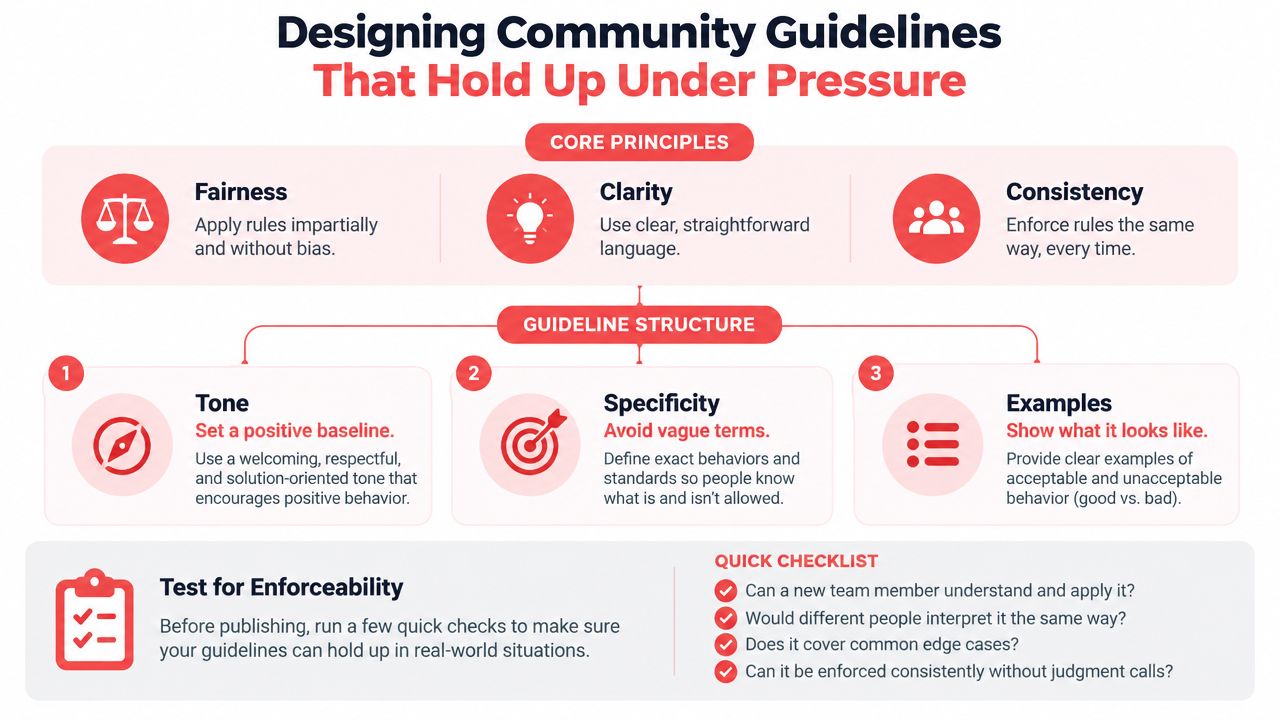
A guideline is useful only when two trained reviewers can apply it to the same case and reach a similar result. Write for the tired reviewer handling an ambiguous report, not for the executive reading a polished policy page.
Start with a short purpose statement. Explain who the community serves, what members can do there, and what behavior protects that purpose. Then define prohibited behavior using observable actions. “Be respectful” sets a tone, but it does not tell a reviewer whether to remove an insult, close a hostile thread, or allow a sharp disagreement.
Write Rules a Reviewer Can Test
Use a pattern that separates behavior from interpretation:
- Allowed disagreement: Members may challenge ideas, products, or decisions without attacking another member
- Personal attack: Remove insults directed at a person, including repeated comments meant to provoke or humiliate
- Threatening conduct: Escalate statements that express intent to harm a person, group, or property
- Commercial activity: Keep promotion inside the designated space and remove unsolicited outreach where members have not consented
- Sensitive material: Route content involving self-harm, exploitation, or credible threats to the trained escalation path
Examples do more work than abstract language. Include a permitted example, a clear violation, and an edge case. Tell reviewers what extra context to check, such as quotation, satire, reclaimed language, news reporting, or a member's prior interaction.
Use Graduated Enforcement
A workable ladder might move from education to warning, temporary restriction, suspension, and permanent removal. Do not make every violation a ban. Excessive severity creates false positives, discourages legitimate participation, and pushes reviewers to soften enforcement informally.
The opposite failure is vague leniency. If moderators have no documented response to repeated boundary testing, outcomes depend on who is working the queue. State which behaviors can skip earlier steps, especially credible threats, child sexual abuse material, account compromise, and coordinated abuse.
Language and regional context change how a phrase is understood, while the safety standard stays fixed. A CHI 2025 audit of the five largest moderation APIs, including OpenAI's and Amazon's, found they over-rely on identity terms, perform worst on implicit hate speech aimed at LGBTQIA+ people, and misclassify reclaimed slurs from Black, LGBTQIA+, Jewish, and Muslim communities as violations (Hartmann et al., Weizenbaum Institute). Local examples and reviewers fix this; translation alone doesn't.
Version every rule. Record the effective date, changed language, affected queues, and reviewer training required.
Building a Human Plus Automation Moderation Workflow
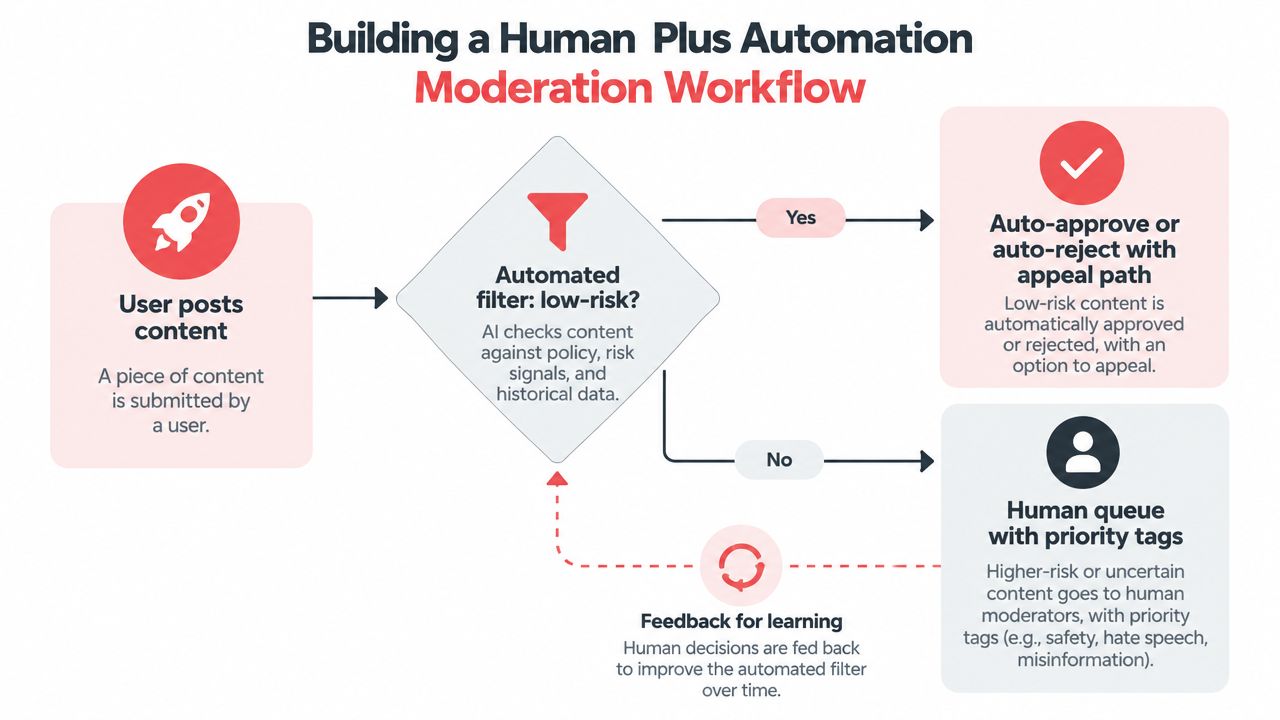
Automation should reduce repetitive review, not dump more uncertain cases onto people. The design starts with explicit routing thresholds and ends with feedback that improves the next decision.
A practical model uses three confidence bands: above the top threshold, the system auto-removes; between the two thresholds, it escalates to a human reviewer; below the bottom threshold, it auto-approves. We typically start new clients at 0.9 and 0.55 and expect to move at least one threshold within the first month, once real language and slang patterns in that community show up. Your team should tune these against policy risk, appeal outcomes, and language coverage rather than treating the starting numbers as fixed.
Route by Risk, Not Only Confidence
Confidence tells you how strongly a model matches a pattern. It does not tell you how damaging the content would be if missed. A lower-confidence credible threat may deserve faster review than a high-confidence spam message.
Prioritize the human queue by:
- Severity: Child exploitation material, credible threats, self-harm, and severe violence need the fastest protection
- Reach: High-impression or rapidly spreading content deserves earlier attention
- Queue age: Older cases must move before they become invisible backlog
The handoffs need clear boundaries. A model can recommend, a frontline reviewer can decide routine cases, and a senior reviewer can handle policy exceptions or high-risk incidents. If everyone can bypass escalation, the system loses its control points.
A 2025 study of 156 Reddit communities found that once bots were introduced, volunteer moderators did about 21% more moderation, not less, concentrated on subjective rules rather than clear-cut violations (He, Hong & Raghu, Information Systems Research, 2025). Automation redirects human attention toward the cases where escalation boundaries matter most, and the same study found bot-assisted communities retained volunteer moderators better.
Bot assistance can help with explanations and routine tasks, but it only creates value when it removes low-value work and preserves reviewer authority over difficult cases. Teams designing these systems should also account for second-generation bias in content moderation services.
Keep a feedback loop, but do not train blindly on every decision. Separate clear policy decisions from reversals, rushed approvals, and reviewer disagreements. Store the rule version, model version, language, action, and appeal result so the ML team can identify drift instead of treating all labels as truth.
Running Intake Triage Escalation and Appeals Without Losing Trust
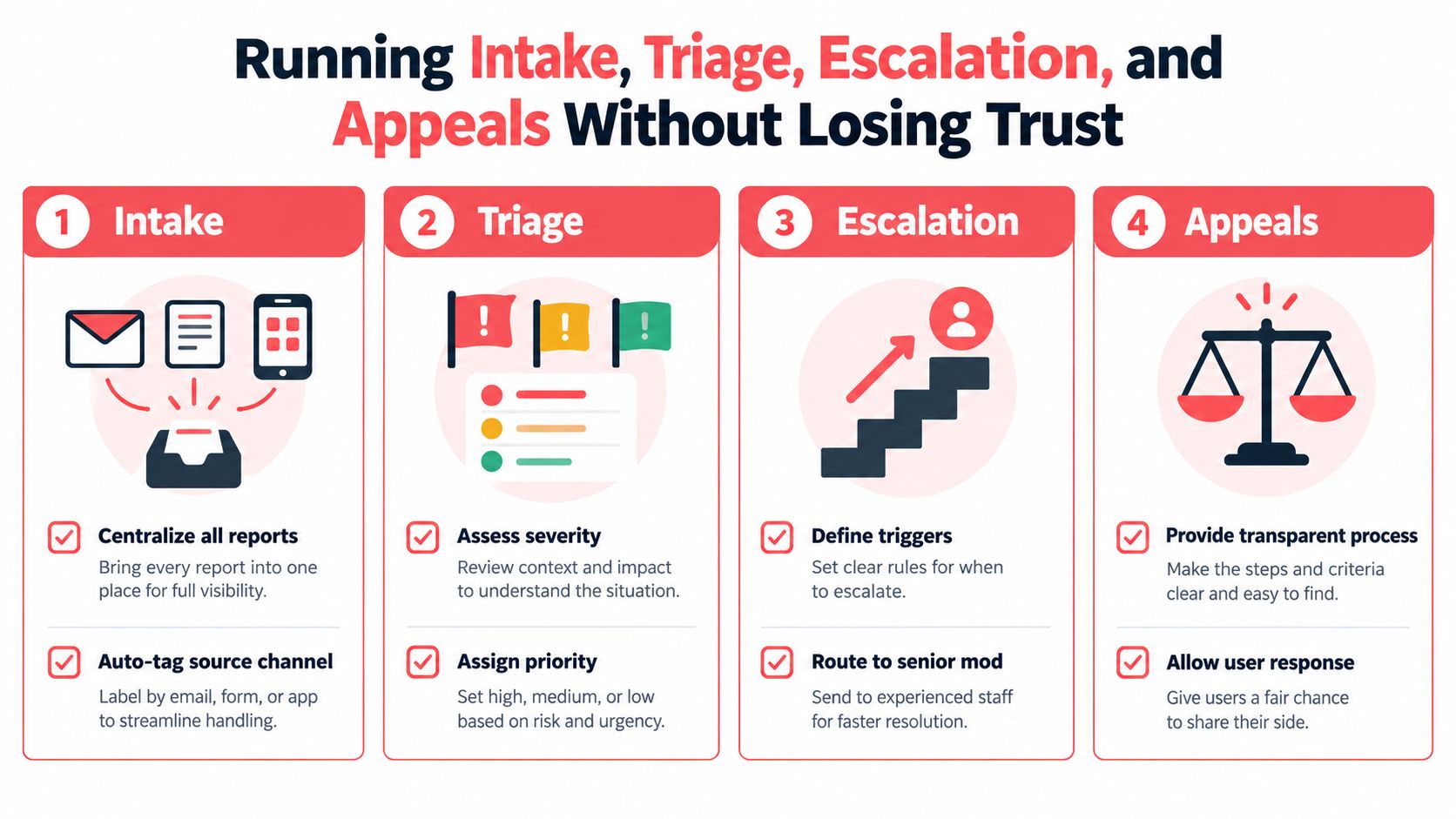
A report should enter one operational flow whether it arrives through an in-product button, email, support ticket, moderator alert, or partner notification. Normalize the source, attach the content and account context, then assign ownership. Scattered reports create duplicate work and make it harder to know whether a serious case has already been handled.
A Repeatable Operating Sequence
Intake: Capture the reported item, reporter reason, source channel, account identifier, timestamps, and linked content. Deduplicate reports without hiding how many people were affected.
Triage: Assess severity, potential reach, vulnerability, and immediacy. Attach a priority tag and route urgent cases to the right specialist instead of leaving them in the general queue.
Decision: Apply the rule version that was active when the content appeared. Record the action, rationale, and reviewer identity. If the evidence is incomplete, preserve the case and escalate instead of forcing a confident answer.
Escalation: Define triggers in advance. Examples include credible threats, suspected exploitation, coordinated harassment, legal requests, high-profile incidents, and disagreement between reviewers. Senior review should be a real tier, not a label that sends the case back to the same person.
Appeal: Give the member a clear way to respond, identify what action was taken, and explain whether the original decision changed. Appeals are not just a customer-service step. They are evidence about false positives, unclear rules, and inconsistent reviewers.
Queue telemetry prevents silent failure. Track queue depth, age distribution, and the arrival-versus-clearance rate over time. A queue can look stable while its oldest items breach the policy SLA, so the age profile matters as much as the total count. Reviewer throughput should reflect sustained items per reviewer hour under a realistic content mix, not a one-off staffing estimate, as outlined in moderation workflow reliability guidance.
At each shift handoff, name the oldest unresolved case, active incidents, policy questions, staffing gaps, and decisions waiting for senior review. Trust grows when people can see that the process has owners and that mistakes produce corrections.
Metrics That Tell You If Moderation Is Working
A low removal count does not prove a healthy community. It may mean the classifier misses abuse, reports are not reaching reviewers, or the team is avoiding difficult decisions.
Build a dashboard around a small set of operational signals. Track human-review rate, queue depth, review time, false positives, appeal rate, appeal-overturn rate, latency, and system errors. Review them by language, content type, policy category, and reviewer tier, because aggregate numbers can hide a serious local failure.
Queue modeling helps turn staffing into an operations decision. A queue-simulation paper defines reviewer utilization as the ratio of time a subset of reviewers is available for work in the system, supporting capacity planning for continuous moderation operations in queue simulation research. Track utilization alongside quality. A fully occupied team may clear work briefly while creating fatigue, rushed decisions, and weaker appeals.
Staffing for 24/7 Coverage Without Burning Out Your Team
There is no single correct coverage model. The right choice depends on risk, volume, language needs, internal expertise, and how much operational control your company must retain.
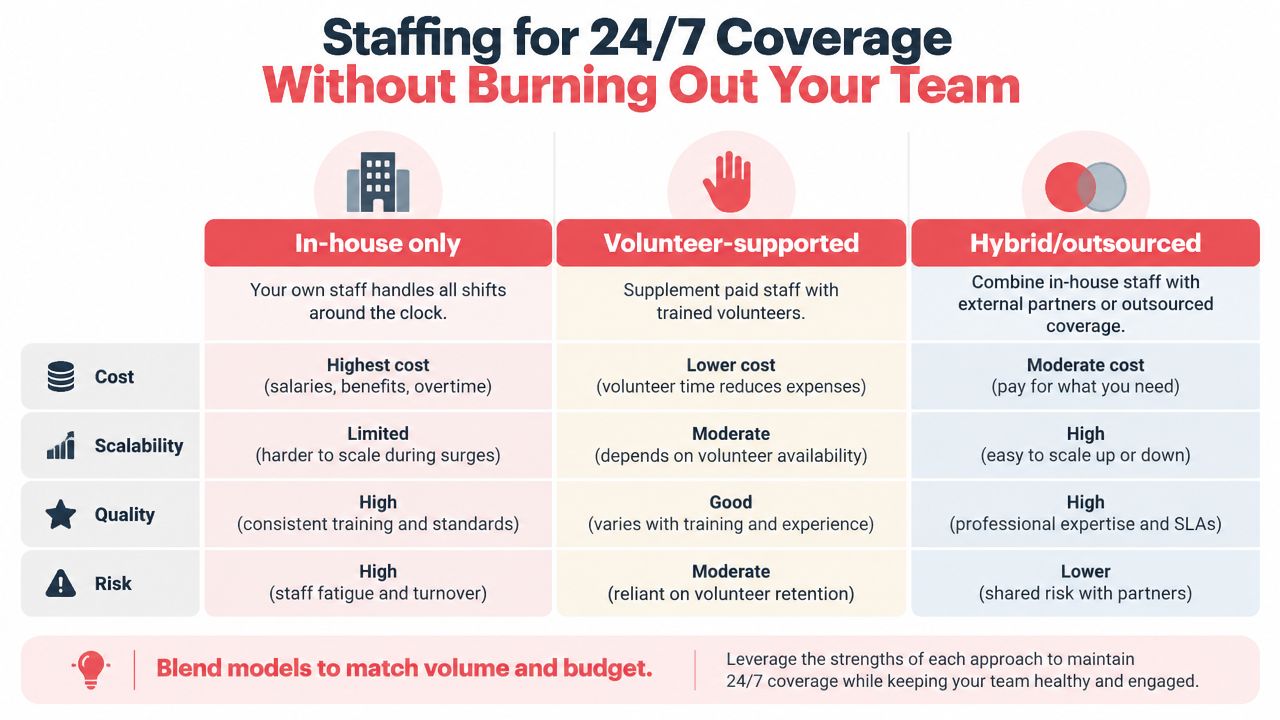
In-house teams give you direct cultural context and fast policy feedback. They can also become expensive to sustain across nights, weekends, languages, and sudden volume changes. Volunteer moderators add lived experience, but they should not carry responsibility for severe safety incidents without trained staff behind them.
A hybrid team works when responsibilities are explicit. Your internal team owns policy, risk appetite, incident command, and final decisions on exceptional cases. The managed team handles defined queues, routine actions, documentation, QA, and escalation according to that policy. Follow-the-sun scheduling can extend coverage, but only if shifts share the same rule versions, examples, and handoff records.
Outsourcing is not the right answer when your policy is unsettled, your tooling cannot expose case context, or leadership is not prepared to review quality. Adding people to a broken workflow only spreads inconsistency.
BUNCH provides managed teams for content moderation, community operations, customer support, and AI safety workflows, with human reviewers working alongside automated routing. Its 24/7 operations model is relevant when you need extended coverage without turning every internal operator into an overnight reviewer.
If your team needs structured coverage for content moderation, community management, or human-in-the-loop AI safety work, BUNCH can build and manage a team around your policies, queues, and escalation paths. Book a call with a BUNCH expert to discuss the workflow you need covered and where internal ownership should remain.
About the Author
Stay in the Loop!
Related Content

Online Community Moderation: How Communities Handle Content Moderation
A community without a moderation system is like a dinner party without a host. Most people are there to have fun, but with no one watching, some get carried away.

Community Management Social Media: The 2026 Operations
Master community management social media with practical moderation policies, engagement tactics, crisis handling, and KPIs that drive real growth in 2026.

Scalable Content Moderation Services for Social Platforms: Best Practices
Scalable content moderation services help social platforms review, filter, and manage user-generated content as content volume grows.