FREQUENTLY ASKED QUESTIONS
Industries that require ongoing AI validation include those that use AI to make high-stakes decisions and calculations that affect human health and safety, financial security, and legal compliance. As real-world data is constantly changing, continuous evaluation is required to monitor algorithms for model drift, hallucinations, accuracy, and bias.
AI benchmark scores are insufficient in evaluating AI models as they tend to be based on clean, static data rather than the unstructured, dynamic data used in real-world environments. This means that AI models are not trained to handle the edge cases, unpredictable user behaviour and context ambiguity that often arise outside of controlled test environments.
AI systems frequently fail in production due to the massive gaps between how they are tested and how they are expected to perform in real-world environments. During testing, AI systems are evaluated using structured, static data sets, whereas in production, data is dynamic and unpredictable.
How to Build an AI Evaluation Framework


A strong AI evaluation framework ties each test to a documented failure mode, sets measurable acceptance criteria, and preserves the evidence needed to compare versions and investigate failures. NIST organizes this operating model into four functions, Govern, Map, Measure, and Manage, while BetterBench shows that benchmark quality can itself be assessed against 46 best practices across the benchmark lifecycle.
Benchmark scores help, but they do not show whether a system is safe to release, why it failed, or whether it still works once real users, changing data, and connected tools are involved. A production-ready framework links risk mapping, offline tests, human review, adversarial testing, release gates, and live monitoring into one evidence system.
What an AI Evaluation Framework Should Do
A benchmark shows performance on a defined set of inputs. It does not show which important failure modes were missed. That matters in customer support, moderation, KYC, and tool use, where a rare failure can cause more harm than a lower average score.
A practical framework does five things:
- Maps failure modes: Record unwanted behavior first, then link it to a test, metric, or review queue
- Defines acceptance criteria: Replace “high accuracy” with measurable conditions and clear release consequences
- Preserves evidence: Keep prompts, outputs, configuration, timestamps, reviewer notes, and model versions
- Connects results to decisions: Assign promote, revise, block, or monitor outcomes to named owners
- Reassesses regularly: Update suites when models, policies, data, tools, or user behavior change
NIST describes the AI Risk Management Framework as voluntary and use-case agnostic, supporting the design, development, use, and evaluation of AI systems. Its four functions, Govern, Map, Measure, and Manage, are more useful than a leaderboard because they connect testing to accountability.
BetterBench makes the same point from the benchmark side. Researchers assessed 24 AI benchmarks against 46 best practices, covering benchmark design, documentation, maintenance, and interpretation in the BetterBench paper. Benchmarks need evaluation too.
Practical rule: If a score cannot trigger a documented decision, it is not yet part of an evaluation framework.
In practice, BUNCH helps many service-industry companies double check data and flag anything that falls outside defined guidelines before it reaches customers. Teams often find that a workflow performs well in staging, then breaks once real-world data, edge cases, and production variability hit the system. Based on the timeline and scope, BUNCH can validate data layers, code, reports, content, and related operational outputs before anything is shared with customers.
Teams building agent workflows can also use this guide to evaluating AI agents as a reference for extending tests beyond a single response. The key question stays the same: what evidence would justify release, revision, or stopping this version?
Core Evaluation Methods Compared
Offline, human, adversarial, and production evaluation answer different questions. Treating them as substitutes creates blind spots.
Offline evaluation is the fastest way to catch regression on a stable test set. It supports repeatable comparisons across model versions, prompts, policies, and retrieval settings. Its limit is simple, it only reflects the inputs you selected.
Human evaluation captures qualities automated metrics often miss, including factual care, tone, context, and whether a refusal is appropriate. It costs more, needs training, and reveals reviewer disagreement. That disagreement is evidence about the rubric, not noise.
Red-teaming looks for failures that normal traffic may not reveal yet. Safe RLHF uses a two-stage annotation process, first assigning a safety meta-label across 14 predefined harm categories, then ranking responses for harmlessness and helpfulness in the Safe RLHF paper. Anthropic's red-teaming work released a dataset of 38,961 attacks generated by 324 participants, showing why adversarial evaluation should be treated as a real evidence stream rather than a handful of creative prompts as documented in this study summary.
Production monitoring shows what happens after deployment, including distribution shift, edge cases, latency changes, refusal behavior, and tool failures. It provides the most realistic evidence, but sampling, privacy controls, and delayed labels make interpretation harder.
For a lighter introduction to prompt scoring and review design, this prompt evaluation guide for marketers can help non-ML stakeholders understand why prompt quality and system quality are not the same thing.
Map Evaluation to the AI Lifecycle
An evaluation framework starts before model selection and continues after release. Each stage needs an input, an output, and an accountable owner.
During problem framing, product and risk owners define intended use, prohibited use, affected users, and failure modes. During data curation, the data lead versions source material, labeling instructions, adjudication records, and validation results. For image, video, audio, and LiDAR workflows, annotation quality is part of the model evidence, not a separate operational concern.
Pre-release validation combines offline tests, human review, and red-teaming against acceptance criteria. The release owner then consolidates the evidence into a decision record. “Go” is only one outcome. “Revise” or “block” may be correct when a severe failure remains unresolved.
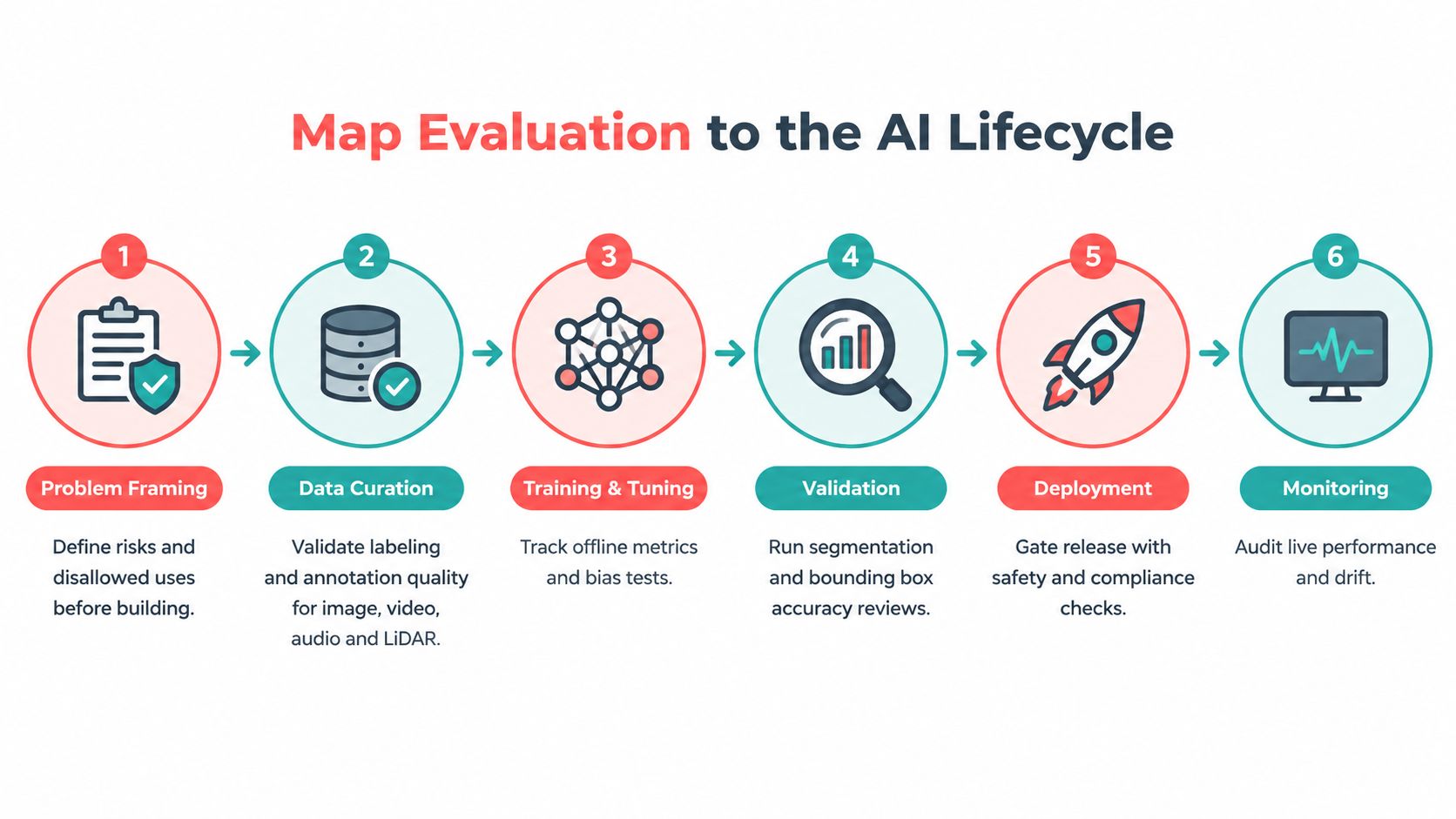
Post-release, operations teams monitor live behavior, sample outputs for review, and feed confirmed incidents into the risk register and regression suite. A prompt change, knowledge base update, moderation policy revision, or model replacement should trigger the same evidence process.
ISO/IEC 42001:2023, the first international AI management-system standard, supports this lifecycle approach by requiring an AI management system to be established, maintained, and continually improved in the ISO/IEC 42001 standard. Evaluation becomes an organizational control, not a task completed before launch.
Choose Metrics That Match Decisions
Start with the decision, not the metric library. A metric matters only when the team knows what action follows if it changes.
A customer support system may need task correctness, escalation appropriateness, factual grounding, latency, and schema conformance. A moderation system may prioritize harmful-content handling, refusal behavior, consistency across policy categories, and reviewer escalation. A tool-using agent needs tool selection, argument validity, retry behavior, and final task completion.
Aggregate metrics are summaries, not proof of acceptable behavior. Require per-slice results, raw examples, confidence intervals, and reviewer notes before making a release decision.
Safety testing also benefits from explicit definitions. A 2024 evaluation paper defines Average Safety Score as the mean safety score across attempts at a given turn and Flipping Rate as the share of attempts where a response changes from safe to unsafe in the EMNLP paper. The value is not the label itself. It is the discipline of defining exactly what the metric measures.
Avoid a composite score that lets strong performance in easy cases hide a severe failure. Severity should drive gating directly.
Build Representative Test Datasets
Treat test data like versioned code. Every case should link to a failure mode, a source or generation record, and an acceptance criterion.
Start with must-pass suites for safety, policy, and known regressions. Add monitor suites for distribution coverage, fairness slices, language variation, and production edge cases. Keep a small canary set for fast feedback during prompt or model development, but do not confuse fast feedback with broad coverage.
A customer support case bank might include these categories:
Version each dataset with a hash. Store the source, generation prompt when applicable, annotation instructions, adjudication record, and changes between versions. Do not edit a case after a model fails it, because that destroys the historical meaning of the result.
For teams that need external support for data annotation services, the operational requirement is simple: preserve provenance, QA records, and reviewer ownership so labeled data remains usable as evaluation evidence. Coverage must include failure modes that still have no test cases.
Run a Repeatable Human Evaluation
Human review matters because people can judge context, intent, and harm. It becomes weak evidence when reviewers get different instructions, know which model produced an answer, or leave no record of why they decided as they did.
Begin with a task brief. Define the user goal, the information available to the reviewer, the scoring dimensions, examples of acceptable and unacceptable behavior, and the escalation route for harmful content. Use blinded model labels where practical so reviewers are not influenced by brand or version.
A defensible protocol includes:
- Calibration set: Reviewers score known examples before rating live cases
- Independent review: At least two reviewers assess each item where disagreement matters
- Severity tiers: Critical, major, and minor outcomes have different escalation paths
- Adjudication: A named lead resolves disagreement and records the rationale
- Evidence retention: Raw ratings, notes, model version, prompt hash, and dataset version remain available
Do not hide disagreement by averaging it away. Track inter-annotator agreement, inspect the cases that split reviewers, then revise the rubric or dataset when the disagreement reflects unclear policy.
For high-risk workflows, human review should also challenge automated evaluators. A judge model can help with scale, but it needs calibration against domain reviewers and should not make the final call on severe safety findings without an escalation path.
The tradeoff is operational. More review improves evidence and exposes ambiguity, but it increases cost and queue management. A sensible design uses broad automated checks, targeted human sampling, and mandatory human escalation for severe or uncertain cases.
Design Red-Teaming as Evidence
Red-teaming should produce a finding an engineer can reproduce and an owner can act on. A creative prompt without a success condition is a story, not a test.
Scope probes around documented risks such as prompt injection, jailbreak chains, data extraction, unsafe tool calls, and policy evasion. For each probe, define the attack goal, success condition, severity rule, number of variants, and triage owner.
Severity should reflect user harm, exploitability, and reproducibility. Novelty alone is not a severity criterion. Repeat successful attacks across rephrasings and contexts so the team can distinguish a systemic weakness from a brittle artifact.
Retain the full transcript, model version, system prompt version, active safety filters, tool traces, and reviewer notes. Link every finding to a release action: block, mitigate, monitor, or accept with a written residual-risk rationale.
Teams that need dedicated support can review BUNCH red-teaming services as one operational model for human-led adversarial testing. The important part is not who runs the probe. It is whether the finding enters the same controlled evidence system as offline and human results.
Assess Fairness and Safety
Fairness and safety should not share one universal threshold. The affected group, potential harm, policy obligation, and available evidence differ by domain.
A model that summarizes customer tickets may need language and accessibility review. A moderation system may require harmful-content testing across policy categories and user groups. A KYC workflow may require checks for data leakage, inconsistent escalation, and errors that affect access to service.
Statistical checks reveal aggregate patterns. Human review exposes qualitative harms a metric may miss. Red-teaming tests how the system behaves when someone intentionally tries to exploit a weakness.
Record who signs off, what blocks a release, and what evidence can overturn an earlier approval. Version thresholds and policy definitions. A new model, data source, policy, or regulatory requirement should trigger reassessment rather than reliance on stale approval.
Evaluate AI Systems in Production
Offline scores start aging as soon as live traffic changes the input distribution. A production framework needs telemetry, sampled review, drift detection, and a route for failures back into the test suite.
Log prompts, responses, latency, refusal behavior, fallback triggers, retrieval context where permitted, and tool outcomes. Apply privacy controls and access restrictions before retaining sensitive interactions. Sample live outputs using the same review protocol used offline, otherwise pre-release and post-release evidence stop being comparable.
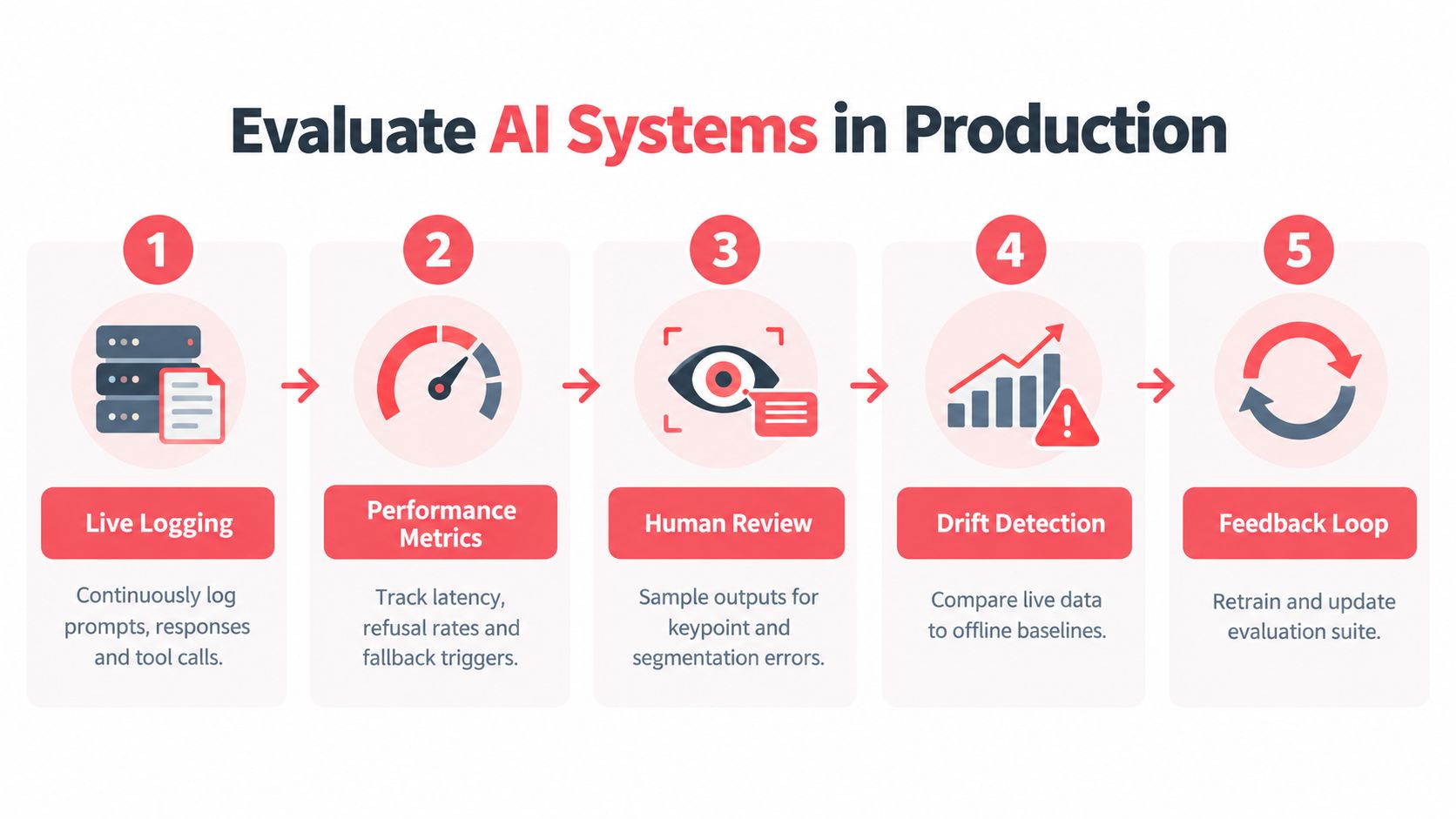
A production failure should become a regression case after sensitive information is removed. This closes the loop between expected behavior and what users actually encountered.
Production monitoring answers whether the current system is still safe to operate. Offline evaluation answers whether the next version is safe to replace it.
Track every change that can affect behavior, including model updates, prompt changes, retrieval configuration, knowledge base edits, moderation rules, and tool schema changes. Each change should rerun the relevant evaluation suite in the same evidence format.
The International AI Safety Report 2026 describes an evaluation gap because common tests may not reflect real-world performance, may be contaminated by training data, and often focus on narrow tasks in its production evaluation discussion. That is why live evidence is not an optional dashboard layer. It is part of readiness.
Use Scoring Rubrics and Release Gates
A release gate should turn different evidence streams into a decision without pretending they are interchangeable. Use a five-level rubric anchored to user impact:
The rubric does not replace thresholds. A model can score well overall and still fail a hard safety gate. Severity should drive the release decision, not the average.
A practical scorecard records:
- Metric: Name and definition
- Threshold: Required condition
- Observed value: Result for this version
- Slice: Dataset, language, risk, or workflow segment
- Owner: Person responsible for interpretation
- Status: Pass, revise, block, or monitor
- Evidence: Run ID, logs, reviewer records, and residual-risk note
Require confidence intervals where appropriate, sample descriptions, reviewer agreement, severity counts, and comparison with the approved baseline. The final readiness record should identify the model version, prompt version, dataset versions, unresolved findings, rollback conditions, and signatories.
Evaluate Multi-Agent and Tool-Using AI
A multi-agent system cannot be evaluated as one prompt followed by one answer. The unit of testing is a task graph with intermediate state, tool calls, handoffs, retries, and a final outcome.
Consider a support workflow with a planner, a retrieval agent, a billing tool, and an escalation agent. The planner can choose the wrong specialist. The retrieval agent can pass incomplete context. The billing tool can receive malformed arguments. The escalation agent can report success even though the account action failed.
Test each leg independently, then score the full trajectory:
- Tool selection: Did the agent choose the right capability?
- Argument validity: Were required fields present and correctly populated?
- Schema conformance: Did the call match the tool contract?
- Context preservation: Did handoffs retain the user's intent and constraints?
- Coordination: Did agents avoid dropped handoffs, circular delegation, and contradictory outputs?
- Outcome integrity: Did the system complete the task or falsely report success?
Planner and executor agents need separate rubrics because their failure surfaces differ. A planner may fail through poor decomposition while an executor fails through invalid tool use.
IDinsight's reporting on AI governance notes that solid multi-agent evaluation frameworks remain limited, risk mapping methods are thin, and longitudinal study is rare in its discussion of multi-agent systems. Replayable traces help close that gap. Store intermediate state, tool responses, retries, handoff messages, and final decisions so reviewers can locate the coordination failure rather than judging only the last response.
AI Evaluation Framework Quick Reference
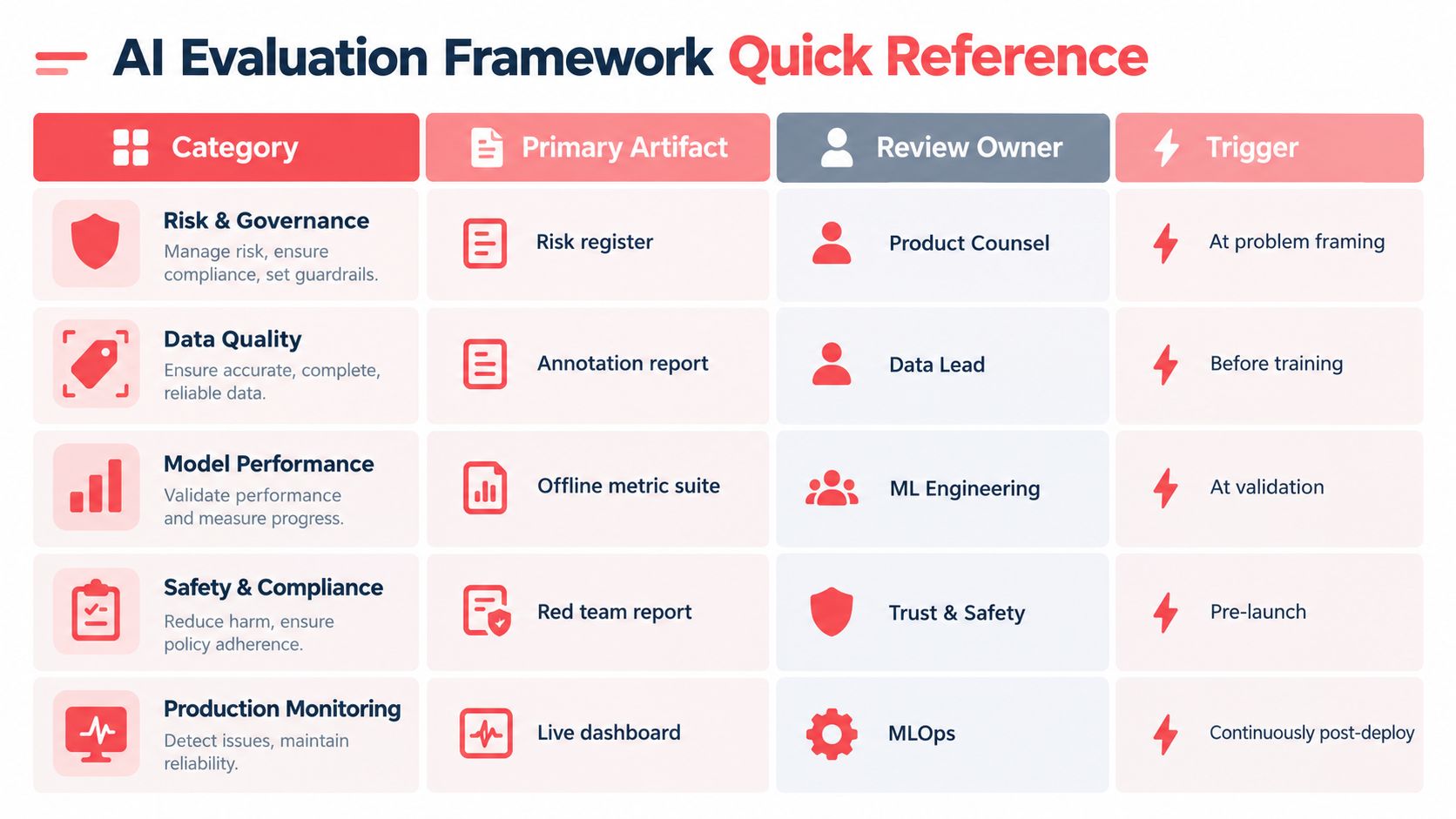
Before deployment, the team should be able to answer five questions: What changed? Who reviewed it? What evidence supported the decision? What residual risk remains? Under what condition do we roll back?
The framework is not static. Thresholds need review when policy, data, model behavior, tools, or user behavior change. Evaluation is a recurring operating discipline, not a one-time benchmark.
BUNCH, founded in 2017, builds managed teams for data labeling, content moderation, customer support, KYC verification, and AI safety work, including model evaluation and validation. Its teams operate from Metro Manila and Cavite, Philippines, serving technology companies primarily in the US and Europe. If your evaluation program needs human review, annotation, moderation, or AI validation alongside your internal ML and trust teams, visit BUNCH to discuss the workflow and evidence requirements.
About the Author
Stay in the Loop!
Related Content

Operational Frameworks for AI Evaluation Beyond Benchmark Scores
When it comes to AI model evaluation, enterprise technology leaders are fast discovering that benchmark scores alone are insufficient in predicting real-world reliability.

10 Machine Vision Applications Across Industries
Explore 10 machine vision applications in manufacturing, healthcare, retail, automotive, robotics, and quality control, with data and implementation guidance.

How We Are Obsessed About Data Quality and Why
We understand the importance of reliable data quality for training datasets and precision in moderating user-generated content. Learn how we apply rigorous QA in all our processes.