Call Center Outsourcing: How to Plan, Evaluate and Run It


Call center outsourcing works when your volume is steady enough to absorb ramp-up and the work can be specified cleanly. It's the wrong call for low-volume queues, judgment-heavy work or regulated-by-default workflows where one breach costs more than any labor savings.
The market is already large, not a side bet. One estimate puts global call center outsourcing at USD 97.31 billion in 2024 and projects USD 163.86 billion by 2030 (Mordor Intelligence market estimate). That scale is why this needs to be treated as an operating model, not a cheap headcount shortcut.
Decide if Outsourcing Is the Right Answer First
Start with the queue, not the vendor deck. If you can't describe the work in measurable steps, outsourcing will turn into a handoff problem with a monthly invoice attached.
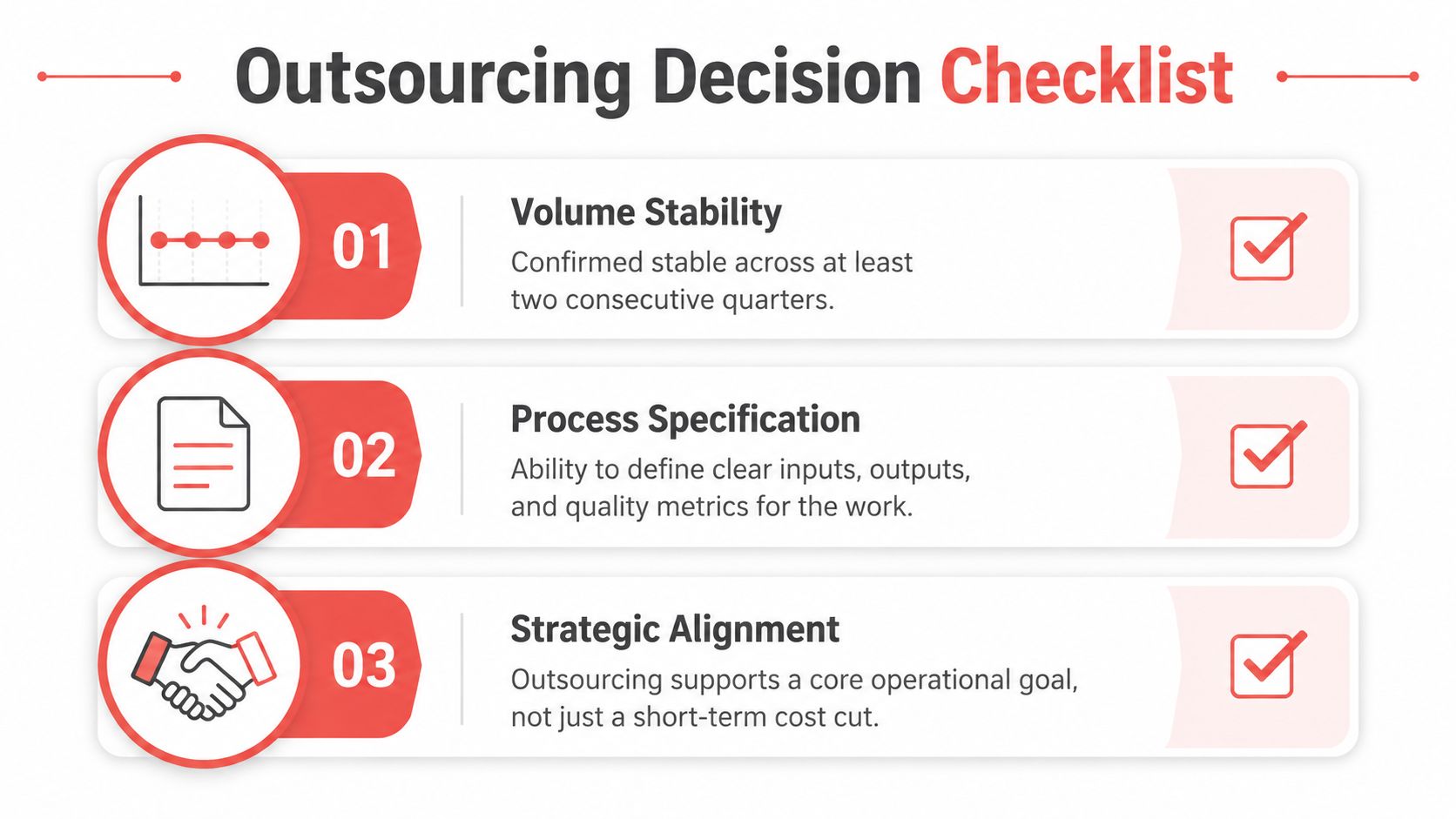
The first test is volume stability. You need enough consistent demand to justify the ramp, training and coordination overhead. When the queue is thin or lumpy, your team ends up paying for structure it can't fully use.
The second test is whether the work is spec-able. Support flows with clear inputs, outputs, and QA rules can be outsourced. Work that depends on judgment, like retention saves or enterprise escalation, belongs closer to the product team or the internal support lead.
The third test is your tolerance for drag during transition. Outsourcing is never instant. Even a well-run program needs time for training, calibration and policy alignment.
Practical rule: outsource when the work is repeatable, measurable and steady. Keep it in-house when it is scarce, sensitive or volatile.
If you want a blunt gut check, ask whether a bad external experience would damage trust faster than the vendor could save money. The failure mode is not price, it's a queue that sounds cheaper until customers start paying for the sloppiness.
Build a Vendor Shortlist That Survives Scrutiny
Forget logo slides. A usable shortlist comes from capability evidence, not polished positioning.
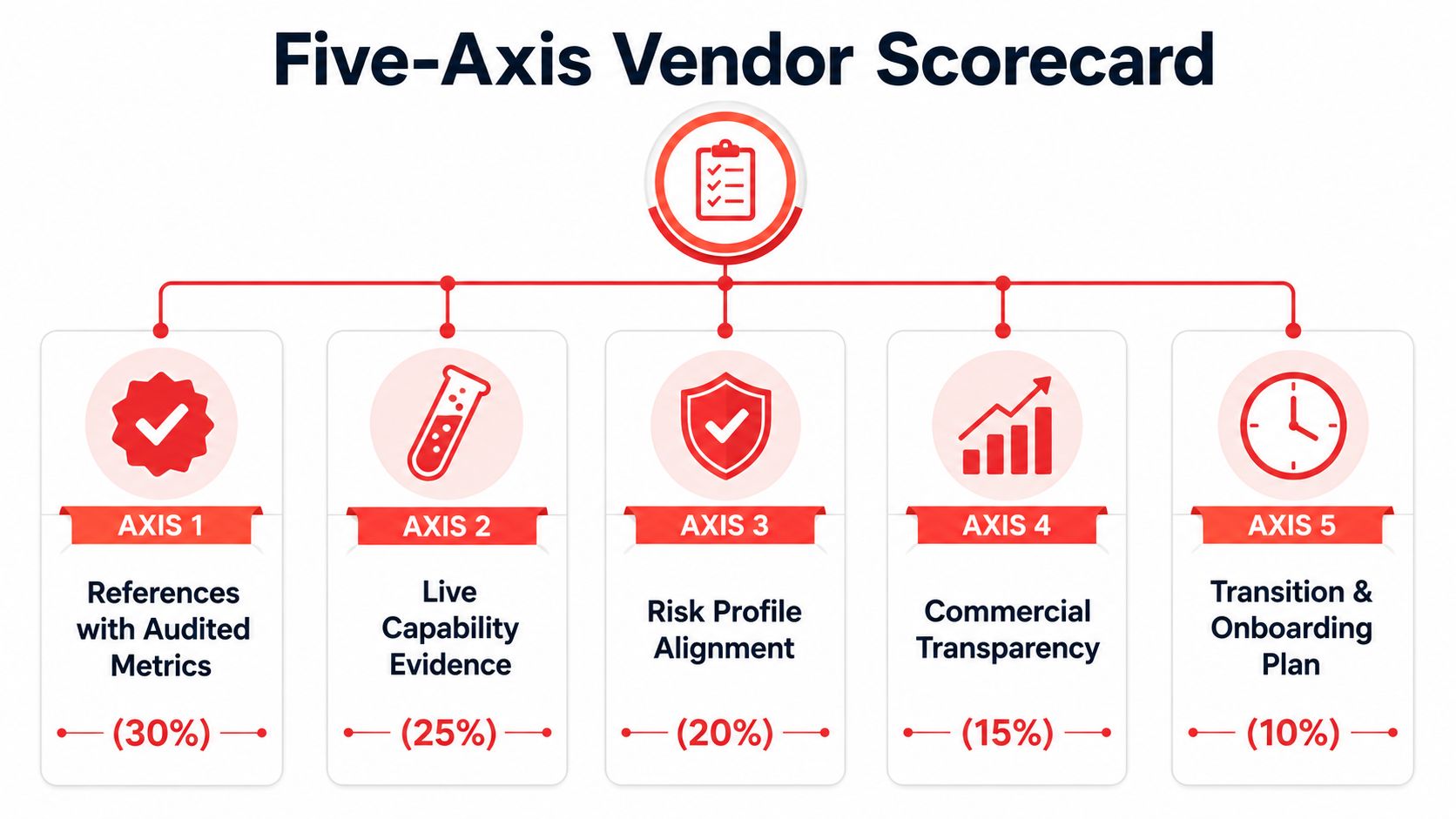
We would score vendors on five axes, then make one axis a hard fail if they can't prove it. References with audited metrics matter more than testimonials. Live data on attrition and average handle time tells you whether the program is stable. Security posture needs verification, not promises. Financial stability needs more than a quick credit check. Commercial terms need teeth.
A simple scoring model works: assign 1 to 5 on each axis, multiply by the weight, then require a minimum total score of 3.5/5. Treat anything below 3 on the security axis as an automatic fail regardless of total. Don't “watch it and see.”
Two shortcuts ruin the shortlist. First, don't take analyst quadrant names at face value. Your traffic pattern is what matters. Second, don't treat the RFP as the contract. Run a two-week scoped pilot with real tickets and a measured QA pass rate before any commercial commitment.
Refusal to share attrition, no named program manager in the proposal and references older than twelve months are enough reason to walk away.
If you're evaluating managed teams for support, moderation or KYC workflow design, a provider like BUNCH, which publishes this guide offers managed outsourcing services fits that operating model. It's not a staffing marketplace, it's a managed-services setup, which is the right frame for this kind of work. We build and manage customer support teams that own the queue end to end, voice included, with our own team leads and QA, across time zones. It is a managed service rather than a staffing marketplace.
Compare Onshore, Offshore, and Hybrid Delivery
Onshore is the cleanest option when control matters more than rate. Offshore is the right call when you need broad coverage and can tolerate more coordination. Hybrid is usually where sane operators land when they want both.
DimensionOnshoreOffshoreHybridHourly costHighestLowestSplit by queue complexityLanguage and accent fitStrongestVariableStrong where it mattersRegulatory exposureLowest frictionHighest governance burdenManaged by workflow typeTime-zone coverageLimited overnightBuilt for 24/7Broad with overlap windowsQA controlTightest loopHeavier calibration neededOne shared QA standard
Onshore wins on trust and simplicity, but you pay for it in coverage and seat economics. Offshore wins on scale, but you have to write the escalation playbook, name the handoff contacts and run weekly calibration because drift compounds quickly.
Hybrid is the practical answer when your queue is mixed. Put simple Tier 1 volume where it can be handled cleanly, then keep negotiation-heavy or sensitive Tier 2 and Tier 3 work closer to the buyer. The catch is obvious. If your knowledge base and customer history aren't unified, the two teams will contradict each other in front of customers.
There's also a control tradeoff people ignore. Geographic distance adds coordination friction, which is why some buyers repatriate sensitive work or keep a hybrid model instead of going fully offshore (Grand View Research). That's the question, not just hourly rate.
For a more detailed definition of the delivery split, see the internal guide on customer support outsourcing. Choose by where your risk and complexity concentrate, not by the headline rate.
Write an SLA You Can Actually Audit
Most SLAs fail because they measure activity the buyer can't really verify. Calls handled sounds tidy. It doesn't tell you whether the customer got the issue solved.
Anchor the contract to outcomes. Use resolution rate, first-contact resolution, CSAT, escalation accuracy and compliance-defect rate. For each one, define the measurement window, the data source and who owns the report.
That keeps arguments out of the monthly review. If the vendor uses the same ticketing system and QA rubric you do, there's less room for dashboard theater.
MetricTarget ExampleMeasurement SourceMiss PenaltyResolution rateContract-defined targetShared ticketing and QA dataService credit tied to severityFirst-contact resolutionContract-defined targetCRM and QA sampleEscalating credit scheduleCSATContract-defined targetPost-contact surveyCredit after cure periodEscalation accuracyContract-defined targetQA audit and case reviewRemediation plus creditCompliance-defect rateZero-tolerance where relevantAudit sample and recordingsImmediate review and holdback
Put the calculation method in writing. Specify sample size for QA scoring, what happens when the target is missed and how credits scale with severity. A flat penalty is lazy. A severity-based schedule is harder to argue with.
Also build a quarterly true-up. Forecasts change. Targets should reset against actual demand instead of the number that looked good in procurement.
If you can't audit raw recordings, screen captures and ticket histories, you don't really have an SLA. You have a brochure.
Add a governance block. Name the review cadence, escalation path and who on both sides can approve exceptions. That turns the SLA into an operating document instead of a PDF people stop reading after signature.
Design 24/7 Follow-the-Sun Coverage That Holds Up
Follow-the-sun works only when it behaves like one queue, not three shifts pretending to be coordinated. The handoff has to be deliberate or customers feel every break in the chain.
Start with overlap. Pick locations where the workday overlaps enough for live transfer, not just ticket dumps. Then write the handoff playbook so nobody improvises at the worst time.
Use one ticket system. Time stamp everything in UTC. Ban local-time notes that drift into ambiguity. When a case crosses regions, the next team should see the full context without reading between the lines.
The failure modes are predictable. Holidays hit one region but not another. Daylight saving changes the handoff window twice a year. A site goes down mid-shift and the queue needs to move without losing ownership.
A quarterly continuity drill is essential here. Simulate one region going offline and measure how quickly coverage is restored. If a customer can only get a callback later, you don't have 24/7 coverage.
Training is the part most buyers underbuild. The first 90 days should be phased. SMEs shadow live calls. The vendor documents the decision trees and edge cases. Then agents move into a closed-room simulation before they touch production traffic.
After that comes a controlled ramp. Start with reduced volume and heavier QA sampling, then taper to steady state once the team proves it can hold quality. Name the checkpoints, week two for knowledge checks, week four for live calibration, week eight for steady-state review.
Coverage only counts if a real customer reaches a competent person the first time.
For teams that need continuous support or moderation across time zones, BUNCH's 24/7 operations model is the right kind of reference point. It shows why handoffs, not just staffing, are what make round-the-clock service work.
Build QA and AI Workflows Around Real Outcomes
If QA still revolves around handle time, you're measuring the wrong thing. The work now is about whether the issue got resolved correctly and safely.
Use layered QA. Let automation flag all interactions for speech and text signals, then have humans calibrate a smaller monthly sample against the rubric. That's how you catch drift without burying the team in manual review. Independent guidance for outsourced support also treats first contact resolution as a strong leading indicator, with mature teams often pushing well past the industry baseline of around 70% and top programs reaching the high end of the range.
AI changes the agent's job, not the need for operations. Real-time transcription, suggested replies, knowledge retrieval and after-call summaries can help agents move faster. The trap is using AI to hide understaffing by pushing complex issues down the road instead of solving them.
The regulatory stack matters more now too. TCPA, GDPR, PCI-DSS, HIPAA and emerging state-level AI disclosure rules all affect how data is handled. Data residency, retention and model training consent belong in the MSA, not in some side letter nobody reads.
One useful pattern is monthly calibration, quarterly deep dives and a published issue-to-fix loop. QA findings should flow back into training, routing logic and, when needed, SLA changes. That keeps the program honest when the product changes faster than the queue can absorb.
Hold the Operating Principles and Move Forward
Treat outsourcing as a partnership with shared accountability, not a labor arbitrage shortcut. The buyer still owns the customer journey even when someone else staffs the queue.
Hold the essentials. You need a written scope of work, an SLA tied to auditable outcomes, named escalation paths, a documented ramp plan and a QA program both sides signed off on. If any one of those is fuzzy, the program will drift.
Use a phased ramp with checkpoints at 30, 60 and 90 days. A single cutover is how teams create avoidable fire drills. Switching vendors after launch is always more expensive than choosing carefully up front.
Map your own volume, complexity and compliance profile against this framework before you talk to a salesperson. If you want to pressure-test the plan with an ops team that works across support, moderation, AI safety and KYC workflows, we can do that with you.
If you need a support team rather than advice on how to run one, that is what we do. Tell us the queue, the volume and the coverage window and we will prepare a custom proposal.
About the Author
Stay in the Loop!
Related Content
Service Level Agreement KPI Guide for Operations Teams
Master every service level agreement KPI that matters for support, moderation, and data operations. Includes targets, formulas, and sample SLA clauses.

How to Ask for Reviews Using "If You Are Satisfied With Our Services"
Explore 7 practical ways to use “if you are satisfied with our services” in review requests, feedback emails, SMS messages, and customer follow-ups.

Ethical Supply Chain: Your Reputation Extends to Your Outsourced Teams
Explore how ethical outsourcing protects your brand through fair wages, safe working conditions, mental health support, and end-to-end compliance.