Service Level Agreement KPI Guide for Operations Teams

Monday morning, the dashboard looks clean. On-time delivery is green, SLA attainment is high, and nothing appears broken, until the escalations start landing from customers who got the right response at the wrong quality. In support, that means tickets closed before the root cause was solved. In moderation or data labeling, it means work moved fast enough to satisfy the clock, but not carefully enough to protect the product.
That gap is why a service level agreement KPI framework can't stop at speed. Modern SLA practice already treats response time, resolution time, and % of SLAs met or breached as standard operational controls, with red, yellow, and green thresholds reviewed on a daily, weekly, or monthly basis, because SLA dashboards are supposed to compare performance across departments and service lines, not just produce a cheerful status page IBM's SLA KPI overview.
The problem is that many teams still measure the easy thing, then wonder why quality keeps slipping through the cracks.
Why Most SLA Dashboards Miss the Real Problems
A clean dashboard often hides the busiest kind of failure. An operations lead can open Monday's report and see that the team hit its response-time targets all weekend, while the customer success inbox fills with complaints about mislabeled assets, bad moderation calls, or KYC exceptions that should never have passed review. The metric says the contract held. The business says the experience didn't.
That mismatch happens because most SLA dashboards are built around throughput and timelines, not decision quality. A ticket queue can look healthy if agents close cases quickly, but the team may be pushing shallow fixes to keep the line moving. A moderation queue can show solid turnaround while reviewers approve borderline content just to protect their averages. A labeling team can keep pace on volume while drifting away from the annotation guide.
The deeper issue is incentive design. If the dashboard rewards closure speed and never asks whether the work was right the first time, the team will optimize for the visible number. If the dashboard only tracks aggregate attainment, it hides channel, severity, and workflow differences that matter in human-in-the-loop operations. That's exactly where a lot of vendors and internal teams end up, because broad SLA language feels safer than precise quality gates.
Practical rule: if a KPI can go green while customers complain about defects, it's not protecting the contract, it's protecting a report.
What gets missed in support, moderation, and labeling
Failure modes are usually operational, not mystical. Routing can be wrong, review depth can be too shallow, calibration can drift, or a third-party dependency can create a bottleneck that the top-line SLA number never exposes. In managed services, those misses show up differently across functions, but the pattern is the same, the dashboard tracks the clock while the work quality erodes underneath it.
That's why the rest of this guide leans toward quality-weighted SLA KPIs. The right framework doesn't just ask whether work was completed on time. It asks whether the right work was completed, by the right process, with enough quality control to keep the contract meaningful.
What Service Level Agreement KPIs Actually Measure
A service level agreement KPI is the metric that proves whether the team fulfilled a contractual obligation. That's different from an internal performance metric, which might help with coaching, forecasting, or capacity planning but doesn't necessarily carry contract consequences. In practice, SLA KPIs sit closer to legal and financial accountability, because they're the numbers that can trigger remedies when performance slips.
A useful SLA KPI has four parts. First is the metric definition, which needs to say exactly what is being counted. Second is the measurement window, which says when the clock starts and stops. Third is the target threshold, which defines the acceptable floor or ceiling. Fourth is the breach consequence, which says what happens if the team misses the mark. When any of those pieces are vague, disputes follow during review meetings.
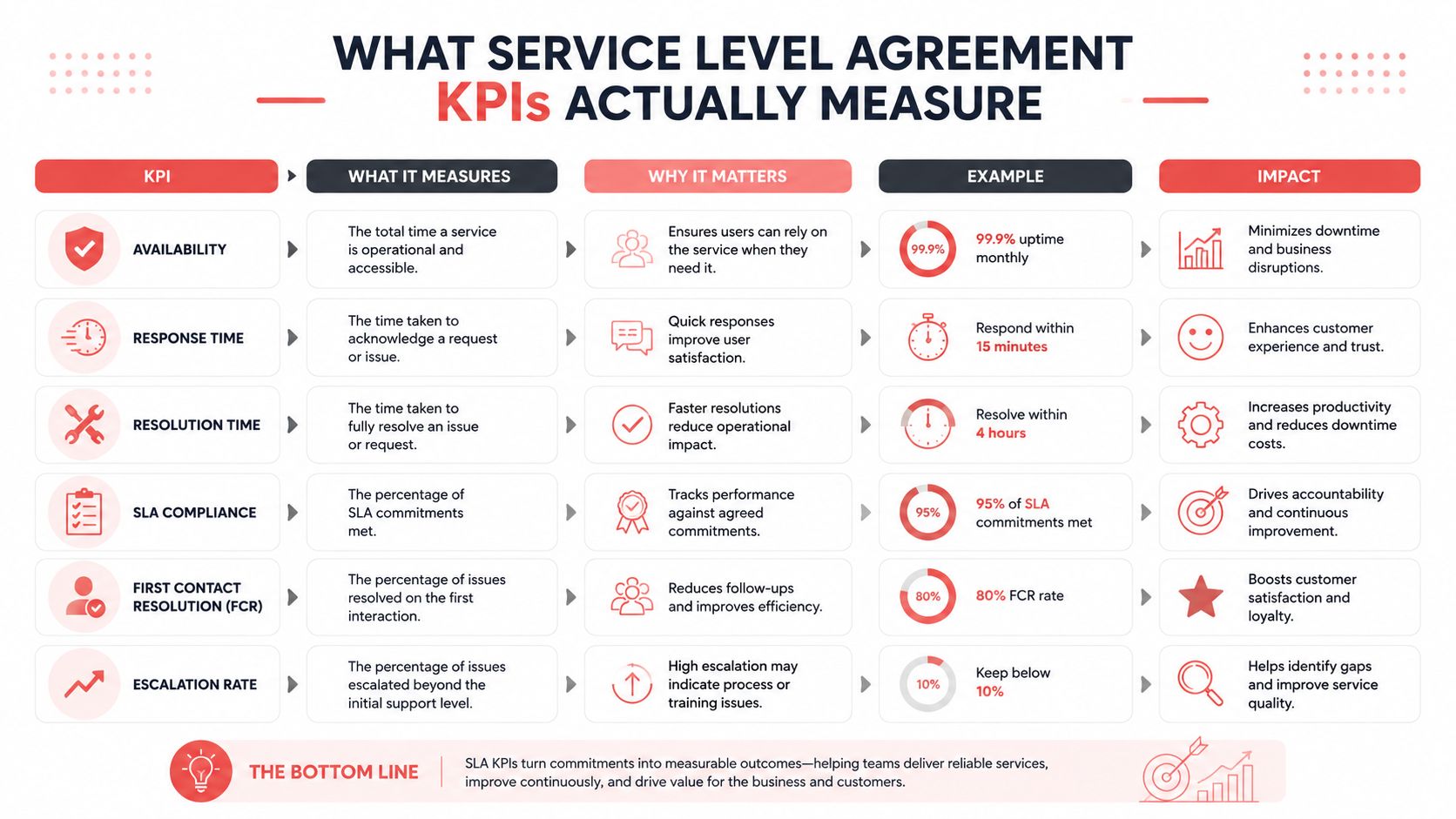
The distinction between SLA KPIs and operational KPIs matters most when teams try to negotiate around the numbers. Average handle time can be useful internally, but it isn't always a contractual commitment. First response time within a defined window is different, because it can be tied to service credits or other remedies. If the definition, window, and threshold aren't explicit, one side thinks the contract was met while the other side believes a breach occurred.
For a clean comparison of those roles, the resource on SLAs vs KPIs for support teams is useful because it separates the internal management layer from the contractual layer without collapsing them into one bucket.
The governance layer underneath the metric
The data source matters as much as the number itself. SLA reporting should use agreed calculations, agreed source systems, and agreed dispute steps, or every quarterly review turns into an argument about whose dashboard is “correct.” In enterprise operations, that alignment is the difference between governance and theater.
The key point is simple. SLA KPIs measure contract execution, not just effort. If the calculation is fuzzy, the governance is weak, and the contract becomes hard to defend.
Core SLA KPIs Every Operations Team Should Track
The strongest KPI sets are smaller than many expect. Industry guidance recommends outcome-linked measures, not long catalogs, because a short set of well-defined KPIs is easier to govern and much harder to game ITIL-oriented KPI guidance. In operations, that usually means pairing speed, quality, and capacity indicators rather than chasing every available metric.
The KPI set that actually survives review
Average Handle Time, or AHT, is still useful, but only if it's treated as a diagnostic measure, not a goal by itself. The standard formula is total talk time plus hold time plus after-call work, divided by total calls. Push AHT too hard and teams often cut corners elsewhere, which is why aggressive AHT targets can backfire on first-contact resolution.
First Response Time, or FRT, tells you how long the customer waits before the team acknowledges the issue. Channel-specific benchmarks are common in practice, and modern support guidance shows that live chat, phone, and email all need different expectations because the workflow is different modern support SLA benchmark guidance.
Resolution Time should be measured from the first contact to a confirmed close, not just a ticket timestamp. If the ticket is marked done before the customer accepts the result, the metric tells a comforting lie.
Mean Time to Resolve, or MTTR, matters most in moderation, incident response, and exception handling because it captures the average across cases, not just the best or worst one. That helps compare severity tiers, but only if the tiers are defined consistently.
Accuracy Rate and First Contact Resolution, or FCR, are the quality guardrails. They keep teams from winning on speed while losing on correctness.
A strong KPI set also makes manipulation harder. If a vendor shortens responses but creates more reopens, the quality metrics expose the trade-off. If a labeling team hits the deadline but misses annotation fidelity, the accuracy gate catches it. If a moderation team closes cases quickly but escalates edge cases poorly, MTTR by severity shows the imbalance.
Operational truth: one speed KPI without one quality KPI almost always rewards gaming.
Channel-Specific Targets for Omnichannel Support
A single target across every channel sounds tidy until real volume hits. Email, chat, phone, and social all create different customer expectations and different operational costs, so one universal response number usually ends up masking the channels that need the most attention. That's especially true in 24/7 support, where shifts, time zones, and staffing mix all change how the queue behaves.
Live chat usually needs the fastest acknowledgment because customers expect back-and-forth interaction. Phone support is different, since the meaningful metric is often average speed of answer or abandon rate rather than a written response clock. Email can tolerate longer windows, but only if the contract says so and the customer segment accepts it. Social support usually needs a separate handling path because public visibility changes the risk profile.
The most useful reporting format is tiered. High-priority channels get their own SLA lines, while lower-priority ones are tracked separately so they don't disappear inside an aggregate score. That matters because blended reporting can make the whole operation look healthy while one customer-facing channel falls behind.
The internal link at BUNCH's multi-channel support overview is a useful reference if you're building or auditing a mixed-channel operating model and need a clean way to think about coverage, escalation, and handoffs.
The practical takeaway is that channel-specific SLA KPIs protect reality better than a single average ever can. If the contract doesn't distinguish the queue, the queue will eventually distort the report.
Quality Weighted KPIs for Data and Moderation Workflows
Standard support SLAs assume the main failure mode is slowness. Data operations and trust-and-safety workflows have a different problem, the work can be on time and still be wrong. That's why quality-weighted SLAs matter so much in labeling, moderation, and KYC review.
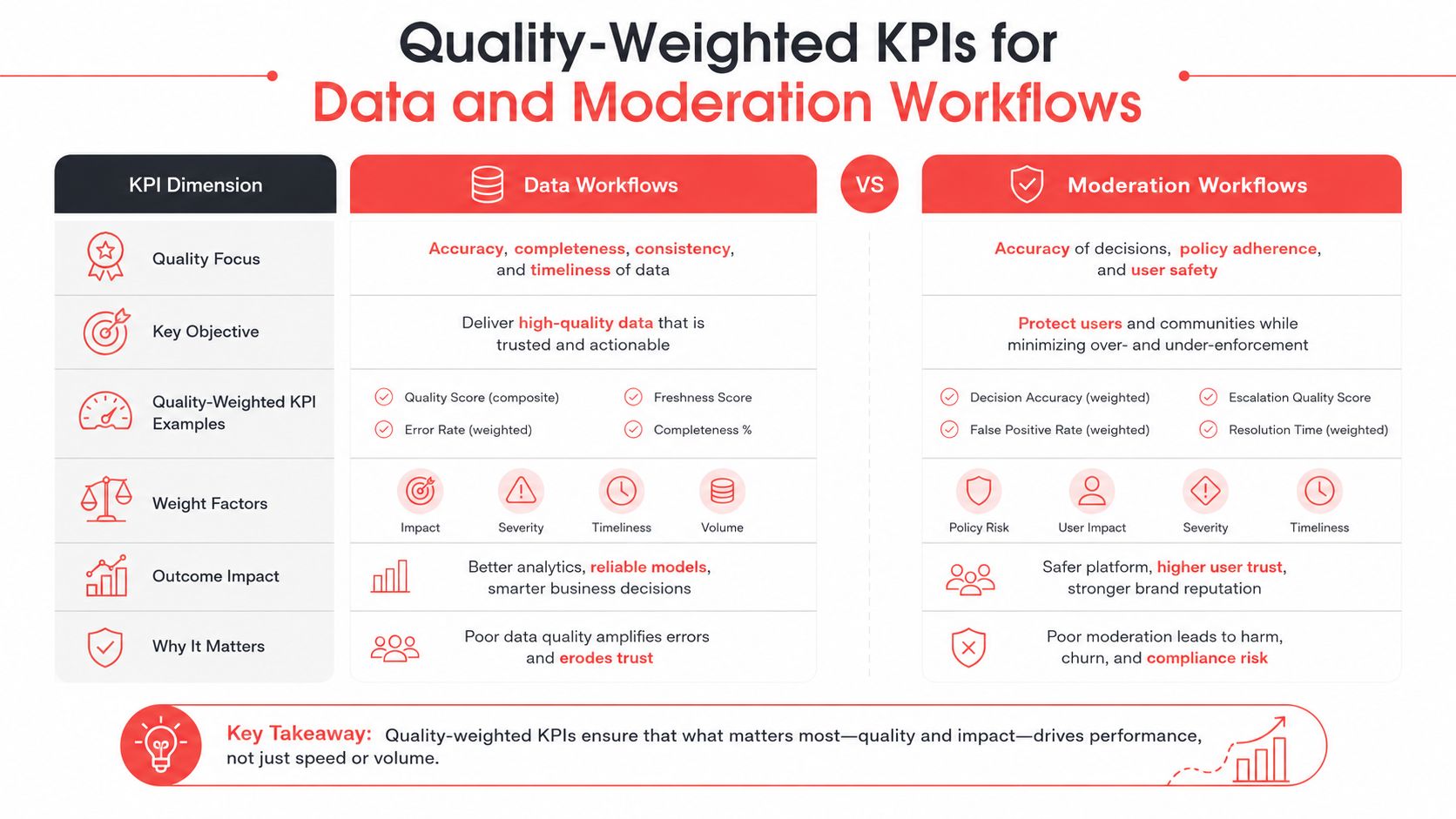
A 95% accuracy target doesn't mean much unless the team agrees on how accuracy is measured. Gold-set calibration, guideline interpretation, and edge-case handling all affect the result. If the team doesn't review against a stable reference set, the number can look precise while still drifting away from the actual business standard.
Moderation works the same way. A single turnaround average can hide the fact that the most sensitive cases are being under-reviewed or escalated too late. Segmenting MTTR by severity tier gives a much better read on whether the operation is protecting users and the platform.
What to weight and what to watch
The strongest quality-weighted SLA structures usually combine these elements:
- Accuracy or conformance: the work matches the guide or policy.
- Turnaround time: the work gets finished within the promised window.
- Double-pass or review depth: edge cases receive the extra review they need.
- Escalation handling: hard cases are routed correctly instead of forced through.
The internal process behind those KPIs matters as much as the final score. A double-pass review rate can act as a process-health signal, because it often reveals when quality is drifting before the contract threshold is breached. That's particularly valuable in KYC and AI validation work, where a fast wrong decision can create more downstream work than a slower correct one.
BUNCH is one option in this category, since it runs managed human-in-the-loop operations for data labeling, content moderation, customer support, and KYC workflows with defined scope, SLAs, and QA processes. In a setup like that, the KPI conversation usually centers on how to combine turnaround, review depth, and accuracy into one contract that a team can operate.
The FAQ on how quality audits work in data annotation is helpful if you need to see how audit checks fit into a quality-heavy workflow instead of treating accuracy as a single final score.
The point is straightforward. Speed-only SLAs fit ticket queues. Quality-weighted SLAs fit human judgment work.
How to Choose a Small Set of Outcome Linked KPIs
Too many KPI frameworks fail because they try to measure everything. Once a contract tracks a long list of metrics, teams stop treating any of them as decisive, and quarterly reviews turn into a reading exercise instead of a management tool. A smaller set of outcome-linked KPIs is easier to enforce and much harder to ignore.
Start from the outcome, not the dashboard
Begin with the customer or downstream result you're protecting. If the outcome is user trust, the supporting levers might be moderation accuracy, escalation handling, and review depth. If the outcome is service continuity, the levers might be response time, backlog age, and resolution quality. Pick one leading indicator and one lagging indicator for each lever, then stop.
That discipline also helps with the classic trade-off between speed and quality. If a contract tracks both AHT and FCR without understanding how they interact, the team can optimize one while damaging the other. If accuracy is the true outcome, then throughput metrics need a quality gate, not a separate universe.
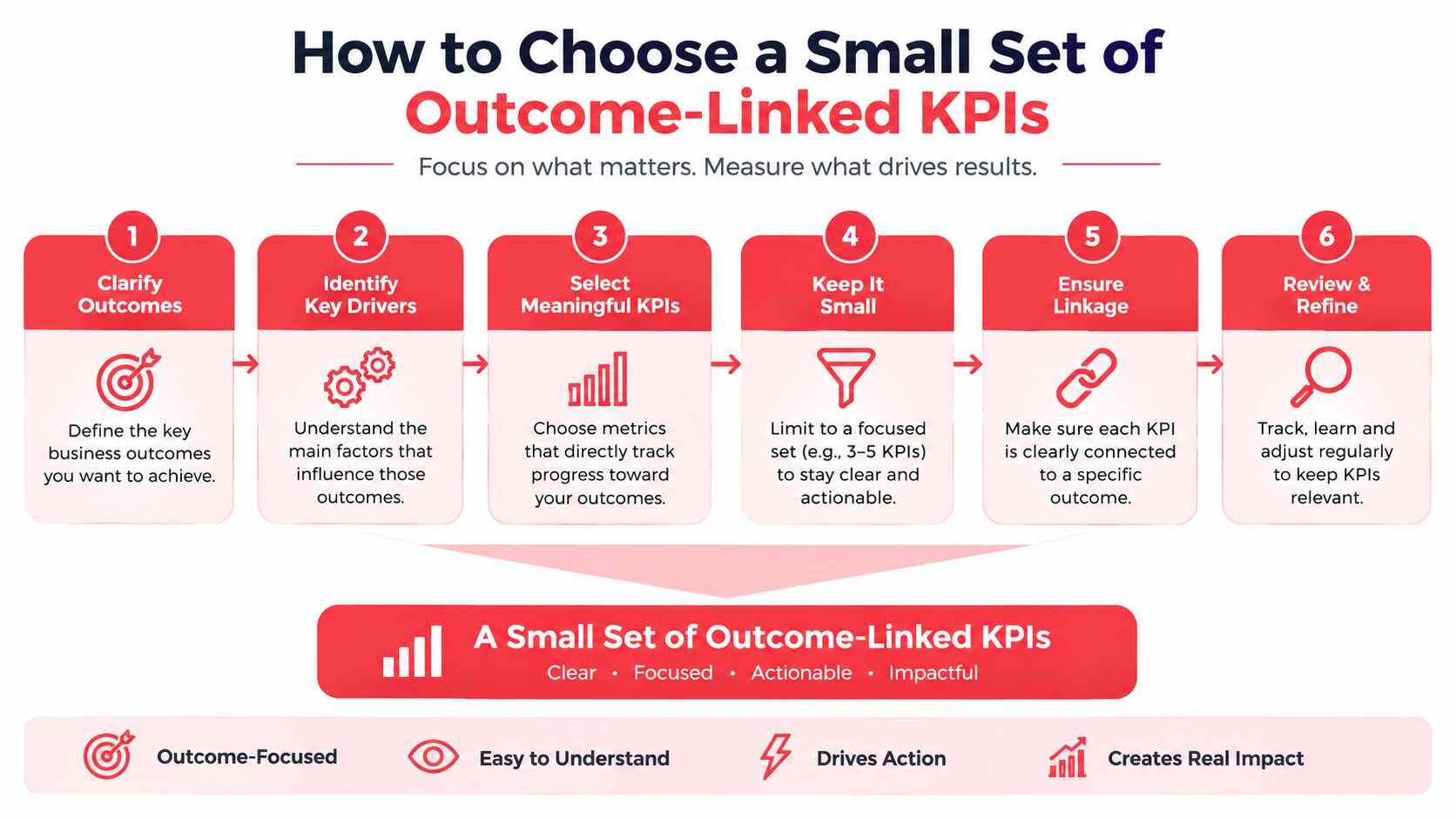
A practical selection filter looks like this:
- Name the outcome. What is the business trying to protect?
- Identify the levers. Which operational behaviors move that outcome?
- Choose the lead and lag pair. Use one early-warning KPI and one result KPI.
- Attach a consequence. A KPI without a remedy becomes a dashboard decoration.
- Remove duplicates. If two metrics tell the same story, keep the one that changes behavior.
If a KPI doesn't change a staffing decision, a review decision, or a vendor conversation, it's probably too weak to keep.
The best service level agreement KPI sets usually land in the five-to-seven range because that's enough to cover outcome, quality, and capacity without turning the scorecard into clutter. Fewer metrics force better decisions, which is exactly what operations leaders need when the queue gets messy.
Writing SLA Clauses and Reporting Tables That Work
Most SLA clauses fail because they sound like legal copy, not operating instructions. A functional clause needs to tell the team exactly what counts, when the clock starts, what system is the source of truth, and what happens when the number misses. If any of those pieces are missing, the clause is open to interpretation.
Build the clause in parts
Start with the metric definition, then add the measurement window, then the data source, then the target, then the consequence tier. That sequence keeps the language grounded in execution instead of abstractions. For support teams, the internal ticket-SLA reference at BUNCH's ticket SLA terms shows the kind of operational specificity that prevents arguments later.
Vague clause: the team will respond promptly to critical tickets.
Precise clause: priority-one tickets must receive a human response within the agreed service window, measured from ticket creation in the designated helpdesk, excluding only the exceptions listed in the contract.
That difference matters because it removes room for post-hoc interpretation. If the team closes tickets quickly but uses auto-replies as a substitute for real acknowledgement, the clause should already say whether that counts. If business-hour exclusions apply, they should be explicit. If volume spikes justify a temporary threshold adjustment, the contract should say how that adjustment is approved.
Reporting tables should separate breach types
A monthly scorecard should not collapse every miss into one green or red status. It should show the KPI, the threshold, the actual result, the severity of the miss, and the remedy tier. That structure helps both sides see whether the issue was isolated, repeated, or systemic.
For data labeling and moderation, the table should also show the QA gate tied to the output. For support, it should show whether the miss came from intake, routing, staffing, or resolution delay. The more operational the table is, the less time everyone spends arguing about what the metric meant.
Precise clauses and readable tables don't make disputes disappear, but they make them smaller and faster to resolve. That's usually the difference between a hard review and a dead-end argument.
Pairing Customer Outcomes with Process Health Metrics
A customer outcome metric tells you what happened. A process-health metric tells you why it happened, or at least where the pressure built up first. If you only track the outcome, you find out about the problem when it's already visible to the customer. If you pair it with a leading indicator, you can intervene earlier.
Pair the result with the pressure point
The pairings that work best in practice are usually simple.
- First Response Time plus queue depth: if the queue starts aging, the response SLA is at risk.
- Moderation turnaround plus reviewer throughput: if throughput drops, the queue can become unstable quickly.
- Labeling accuracy plus calibration pass rate: if calibration slips, accuracy often follows.
- Resolution time plus reopen rate: if cases are closing but reopening, the team is moving too fast.
The value of the process metric is not that it replaces the outcome metric. It acts as an early warning. In practice, a lead signal should trigger intervention before the contractual metric breaches. That might mean adding shift coverage, rerouting cases, retraining reviewers, or pulling in a QA lead.
Useful rule: every outcome KPI should have one process metric that can explain a bad week before the contract does.
The reporting model matters too. Clients usually want outcome metrics in executive reviews, but operational reviews need the process layer. Keep the customer-facing dashboard clean, then include the health metrics in the working review where staffing, routing, and QA decisions are made. That split keeps the conversation focused without hiding the root causes.
The strongest ops teams don't treat process metrics as noise. They treat them as the difference between a preventable miss and a contractual one.
Running SLA Reviews and Breach Analysis
SLA review meetings go bad when teams show up to defend themselves instead of explain the data. A strong review starts before the meeting, with a breach packet that isolates the time window, the workflow path, and the staffing or tooling condition that shaped the miss. Without that preparation, every breach turns into a debate about memory.
Make the breach packet specific
The packet should answer a few direct questions.
- When did the miss occur? Narrow it to the exact window, not just the month.
- What volume was present? Separate a normal week from a spike.
- Which team handled it? Include shifts, queues, and handoffs.
- What changed operationally? Tool downtime, training gaps, policy changes, or third-party delays should be visible.
That structure makes recurrence easier to spot. One-off anomalies need a different response than repeated pattern failures. If the same queue keeps missing the same threshold, the fix is probably systemic, not tactical.
For teams that want a reliability mindset beyond support, the guide to data pipeline resilience testing is a useful parallel because it treats failure analysis as a repeatable discipline rather than a blame exercise.
Run the meeting like an ops review, not a trial
The best reviews have the right mix of people, usually an operations lead, the QA owner, the vendor or team manager, and whoever owns the tool or workflow that failed. Keep the discussion on causes and corrective actions, not personalities. Then assign an owner, a due date, and a proof point that shows the action happened.
Corrective action should always be measurable. If the issue was coverage, the remedy might be a staffing change or a queue split. If the issue was quality drift, it might be calibration or double-pass review. If the issue was tool latency, it might be incident escalation with the platform owner.
When breach analysis is done well, the next review starts from a clearer baseline. That's the value, not the meeting itself, but the operational memory it creates.
Quick Reference SLA KPI Audit Checklist
Use this checklist to pressure-test an existing service level agreement KPI framework before the next renewal or vendor review.
- Does each KPI protect a real outcome? If it doesn't connect to customer experience, compliance, or service continuity, drop it.
- Is every metric defined with a clear source of truth? The team should know which system wins in a dispute.
- Does each speed KPI have a quality gate? Throughput without accuracy or conformance is easy to game.
- Are channel targets separated? Email, chat, phone, and social should not be forced into one blended threshold.
- Are severity tiers reflected in the SLA? High-risk work shouldn't be averaged with low-risk work.
- Is there at least one leading process metric per outcome KPI? Queue depth, calibration, and backlog aging are useful early warnings.
- Are breach consequences explicit? If missing the KPI has no contractual effect, it's not really an SLA control.
- Are exclusions written down? Business-hour carve-outs, force majeure, and temporary threshold changes should all be clear.
- Do reviews track recurrence as well as single misses? A repeated near-breach is often more important than one clean month.
- Can the team explain every number without a manual spreadsheet rescue? If not, the governance model is too fragile.
A good SLA KPI set is small, outcome-linked, quality-aware, and hard to manipulate. If your current scorecard doesn't pass that test, it's probably measuring motion more than performance.
If you're building or tightening human-in-the-loop operations, BUNCH can help structure the work around defined SLAs, QA, and 24/7 managed teams for data labeling, moderation, support, and KYC. Visit BUNCH to see how its managed services model fits the kind of quality-weighted KPI framework covered here.
About the Author
Stay in the Loop!
Related Content

Ethical Supply Chain: Your Reputation Extends to Your Outsourced Teams
Explore how ethical outsourcing protects your brand through fair wages, safe working conditions, mental health support, and end-to-end compliance.

How BUNCH Became a 24/7 Operations Powerhouse
Our 24/7 outsourcing services ensure seamless, efficient operations for businesses worldwide. From shift scheduling to cultural sensitivity, we guarantee continuous support in all time zones.

Operational Frameworks for AI Evaluation Beyond Benchmark Scores
When it comes to AI model evaluation, enterprise technology leaders are fast discovering that benchmark scores alone are insufficient in predicting real-world reliability.