Chat Support Outsourcing That Actually Works


Your chat queue does not care that the team is already stretched. It keeps growing, drains focus, and turns every delay into a customer problem. The real decision is not whether to buy another demo. It is what to keep in-house, what to automate, and what to hand off before support becomes the bottleneck.
Chat support outsourcing works when you treat it as a routing and governance problem first, and a staffing problem second. Done badly, it just pushes messy conversations into a cheaper inbox. Done well, it gives you reliable coverage, clear SLAs, AI for routine requests, and trained humans for the conversations that actually need judgment. If you want a practical primer on the commercial upside of live chat, the cleanest place to start is boost ROI with live chat, then come back to the operating model.
What Chat Support Outsourcing Looks Like in 2026
It usually starts on a Tuesday afternoon. The queue climbs, two agents are stuck on billing disputes, one is handling an emotional account lockout and your head of support is watching morale slide while CSAT drifts.
The honest answer is simple. Good chat support outsourcing routes a defined set of issues to a trained team against measurable SLAs, backed by automation and a usable knowledge base. Bad outsourcing dumps raw tickets on underpaid agents with no tooling, no authority and no way to escalate cleanly.
BUNCH's take on where this usually goes wrong: most teams treat outsourcing as a vendor search instead of an operating decision. They shop for a chat team before they've decided what should stay in-house. The framework below is how we walk clients through that decision.
The 2026 reality
The market around this is not small or experimental. The global call and contact center outsourcing market was estimated at USD 97.31 billion in 2024 and is projected to reach USD 163.86 billion by 2030, implying a 9.8% CAGR from 2025 to 2030 (customer support outsourcing statistics 2026). That scale matters because chat is now part of a mature operating category, not a side project.
AI deflection is table stakes now. What you outsource is increasingly the stuff automation can't settle cleanly, especially escalations, edge cases and high-empathy conversations. If you're still shopping for “a chat team” instead of a controlled workflow, you're already behind.
Practical rule: pay for resolution, not just coverage. A low sticker price per chat means nothing if the team can't close the loop.
Many leaders still buy by the wrong unit. Per-chat pricing can hide weak containment. Per-agent-hour pricing can hide overhead. Neither tells you whether the work is getting solved.
Decide What to Outsource and What to Keep
Start by splitting the work into three buckets. If you skip that, every vendor conversation turns into a vague promise and every scope document turns into a mess.
Make the triage hard, not polite
Keep security incidents, enterprise escalations and roadmap-sensitive bugs in-house. Those belong with the people who can make policy calls, talk to engineering and take ownership when the answer is ugly.
Automate password resets, order status checks and routine FAQ lookups. If the answer is repeatable and low-risk, a human should not be doing it all day.
Outsource the work that is repetitive but still needs judgment, like billing how-tos, onboarding walkthroughs, Tier-1 troubleshooting and after-hours coverage. Those are the tickets that benefit from trained humans without forcing your core team to sit on the queue all night.
A useful rule of thumb is volume. Monthly chat volume under 1,000 usually does not justify outsourcing. Across the accounts we've scoped, teams under 3,000 monthly chats almost always find the outsourcing overhead eats the savings. We've had to talk two prospective clients out of it this year for exactly that reason.
AI-handled volume lowers the human bench you need to buy, so don't scope against raw inbound if deflection is already doing real work.
What to Keep, Automate, or Outsource
Compliance changes the answer fast. If your workflow touches PCI, HIPAA or GDPR, the decision matrix needs to reflect that from the start. Language coverage matters too, especially if you serve the US and Europe across time zones.
Build a one-page decision matrix in an afternoon. Map every ticket class to ownership, then force a yes or no on in-house, automation or outsourced handling. That gives you a defensible scope before anyone gets on a sales call. Teams like BUNCH often help companies put this model into practice by implementing AI workflows for repetitive requests, taking over the hard tickets that still need judgment, and providing 24/7 customer support coverage for customers who still want to talk to a real human. That mix matters because the goal is not AI alone or humans alone. It is a system where both work together to solve issues faster and more reliably. For a concrete example of how an outsourced support scope is usually framed, the customer support outsourcing service page is a decent reference point. For a broader look at where support operations are heading, see the Customer Trend Report 2026.
Design the Operating Model
Once the scope is fixed, the operating model either holds or falls apart. Many teams get this wrong by staffing against inbound volume instead of the volume that needs humans.
Tiering is the backbone
Use four clear layers. Tier-0 is AI deflection. Tier-1 is first response on scoped issues. Tier-2 is escalation to your in-house team. Tier-3 is engineering or security.
That structure keeps you honest. If Tier-1 can't solve it within the playbook, it needs a fast handoff, not another loop of polite guessing.
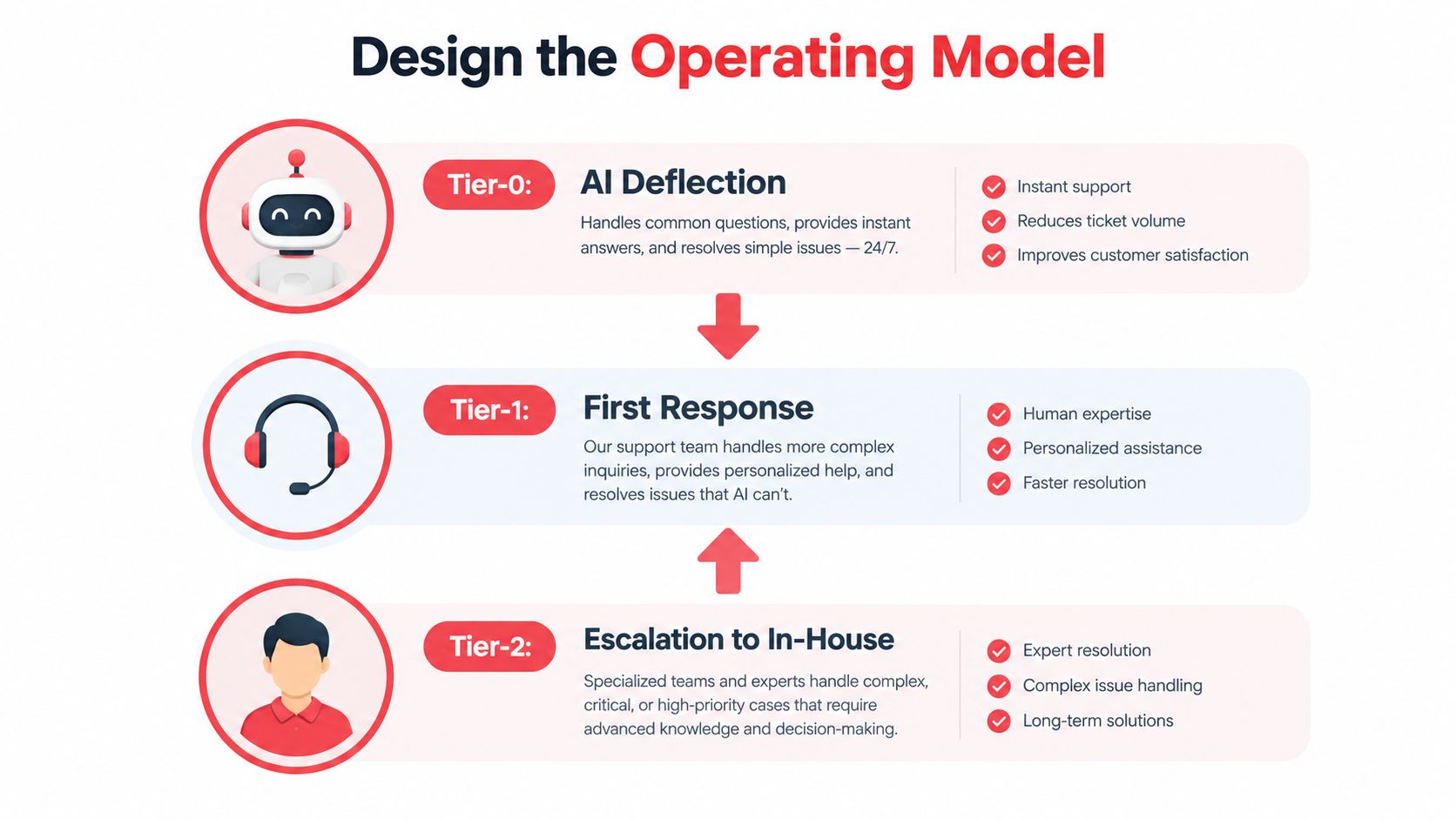
Working rule: no issue should bounce around more than twice before Tier-2 gets involved. If it does, your routing is broken.
Follow-the-sun coverage can work across three or four sites, but only if training, handoff discipline and latency are under control. It breaks when every site improvises its own macros or when the handoff note is too thin to trust.
Authority limits matter. If the outsourced team can't refund, reset or change account state within a written boundary, you'll force unnecessary escalations. If they can do too much, you'll create risk you didn't price in. The answer is a narrow authority matrix, not a vague “act like an extension of the team” line.
Pick and Pressure-Test the Partner
Shortlisting a partner is not about the prettiest demo. It's about whether they can handle the tickets that break under pressure.
Score the work that hurts
Judge candidates on vertical fit, agent tenure and attrition, native versus bring-your-own tooling, security posture and the manager-to-agent ratio. That last one matters more than most buyers admit, because it tells you how much coaching happens day to day.
Ask for a paid pilot using real ticket data, scored against your SLA draft. Don't accept reference metrics from the vendor's favorite account. Send one deliberately misclassified ticket during the pilot and time the handoff to your team. If the queue looks too clean, it usually means the pilot was understaffed.
Vendor Evaluation Scorecard
Before signing, lock down data ownership, agent non-solicit, ramp and exit terms, per-seat minimums, surge caps and termination for cause tied to QA failure. Those clauses sound boring until you need them.
If you want to sanity-check what “world-class” can look like in the right context, the Vodafone case study is useful as a point of comparison, even if your own operation will look different. Don't copy the number. Copy the discipline around escalation and resolution.
In practice, the manager-to-agent ratio question kills more shortlists than security posture does. Vendors will happily show you a SOC 2 badge but go quiet when you ask how many agents one QA lead actually reviews
Set SLAs, KPIs, and QA Loops
SLAs only matter if the QA loop can prove when they were breached. Anything else turns into dashboard theater.
Measure the right things
Anchor the contract to first response time, first contact resolution, CSAT and a handle time ceiling that matches your tiering model. A billing query can carry a tighter response target than a technical incident. If you force every ticket into the same target, you'll incentivize shallow replies.
Use a random QA sample in the 5 to 8 percent range and calibrate weekly with both teams scoring the same tickets. That keeps “good enough” from drifting into “we think it's fine.” The split matters because one team's average can hide the other team's misses.
.jpeg)
A spike in “did not identify billing issue” is not a dashboard problem. It's a training problem. Tie failure modes to coaching, not just reporting, and tie part of the invoice to QA score instead of CSAT alone. CSAT skews toward easy tickets and can make a weak team look better than it is.
For a concrete metric definition, the first response time reference is a useful internal anchor when you're writing the contract.
Integrations, Tooling, and Knowledge Base
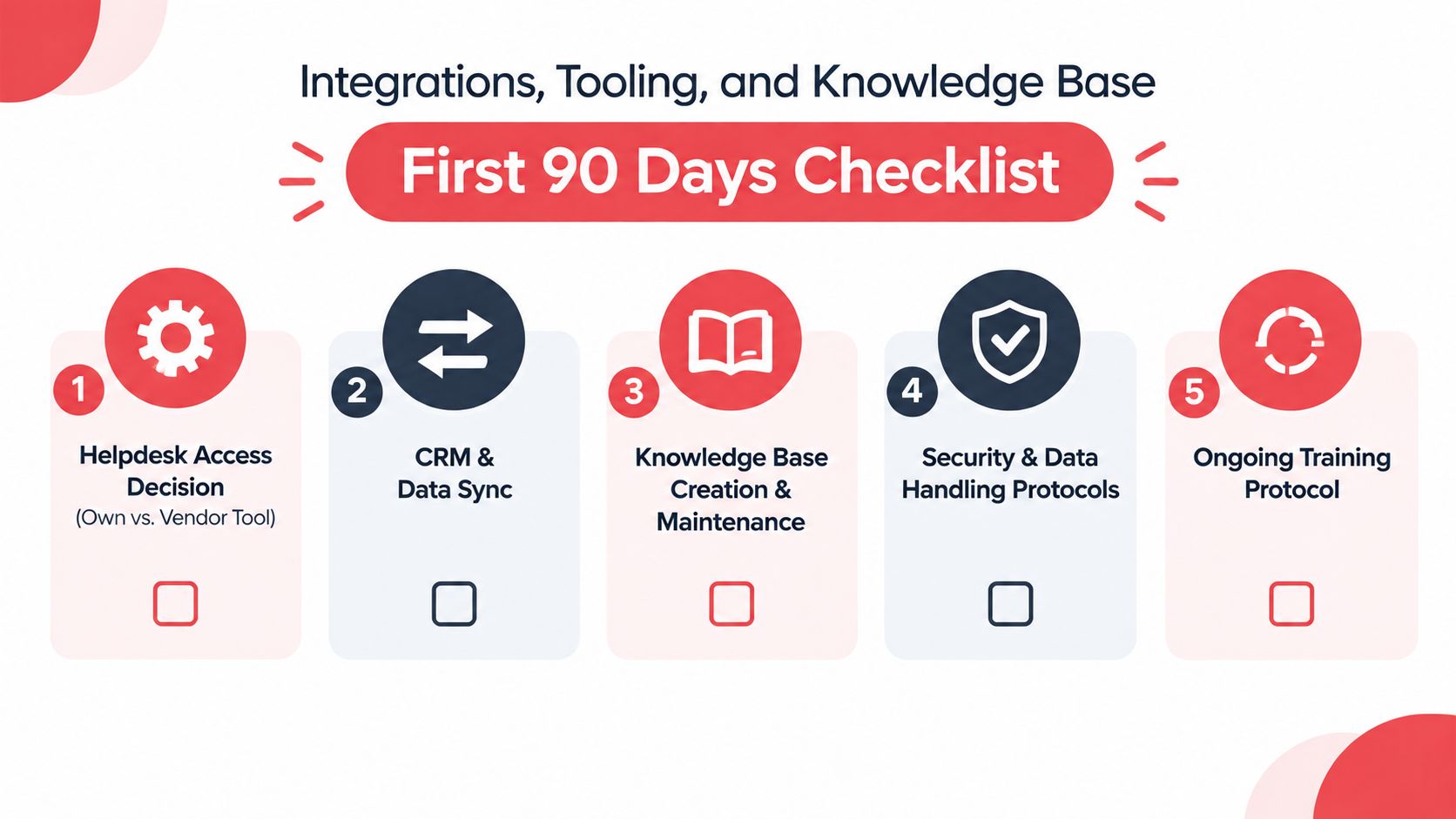
The first 90 days are where outsourcing either becomes operational or turns into cleanup work. Tooling is usually where the pain shows up first.
Decide who owns the system
Choose upfront whether the vendor works in their own helpdesk or logs into yours. Keeping the work in your stack preserves context, but it also means SSO, roles and audit trails need real setup. Skipping that is how you create a security problem you could have avoided.
Macros, routing rules and intents have to be rebuilt for the outsourced team. Internal language almost always confuses outside agents at the start. A shared knowledge base helps, but only if the vendor's edits pass through your editorial review. Otherwise you'll end up with two versions of the truth.
Non-negotiable: redacted views for PII and payment data. Full-record access is one of the easiest breaches to prevent and one of the easiest to ignore.
Pre-launch, test SSO, scope RBAC, verify redaction, seed the macro library, confirm escalation contacts and write a rollback plan for every integration. If any of those are missing, don't start the clock.
One practical option in this space is a managed team model like BUNCH, where human specialists work alongside AI rather than as a staffing marketplace. That matters if you need support, moderation or annotation processes to stay under one governance model instead of scattering them across vendors.
Launch Plan and the Questions That Come After
Launch in blocks. Don't pretend day one should look like steady state.
30, 60, 90 days
Days 0 to 30 should be shadow mode, KB parity and two agents live. That gives you time to catch routing mistakes before they multiply.
Days 31 to 60 is ramp to target volume, weekly QA calibration and the first SLA audit. This phase reveals bad macros and shaky handoffs.
Days 61 to 90 should be full load, cost reconciliation and contract review. If the team still needs heavy rescue by then, the scope or the partner is wrong.
30-60-90 Day Launch Milestones for Outsourced Chat Support
Scale when FCR plateaus above 70%, CSAT holds for four weeks and handle time stabilizes. Add shifts before you add headcount. If FCR drops or escalation rate climbs above 15%, stop expanding and fix the knowledge gap first.
Renegotiate 90 days before renewal, not when the clock is already pressing you. Bring actual performance data into that conversation. If tier-3 issues stay above 25% of volume, compliance scope expands into regulated workflows or per-chat cost trends 30% above your in-house break-even line, move work back in-house.
If you want a blunt review of scope, routing and governance before you sign anything, talk to BUNCH. We build managed teams for customer support, trust and safety and AI-related operations, which is a better fit than a generic seat marketplace when you need control, not noise.
About the Author
Stay in the Loop!
Related Content

Call Center Outsourcing: How to Plan, Evaluate and Run It
Plan, evaluate, and run call center outsourcing with a clear framework for vendor selection, SLAs, 24/7 coverage, training, and quality assurance.

SaaS: What’s the role of Humans in Customer Service in 2025
AI is transforming SaaS customer service, but humans remain essential for sensitive cases and personalization. Discover how to optimize both for the best user experience.
Service Level Agreement KPI Guide for Operations Teams
Master every service level agreement KPI that matters for support, moderation, and data operations. Includes targets, formulas, and sample SLA clauses.