Community Management for Social Media Operations


Your community is already a support, moderation and reputation queue. If you treat it like a posting calendar, it will drift, back up and create avoidable problems.
Community management for social media works when ownership is clear, SLAs are based on severity and off-hours coverage is planned. The goal is not to answer everything. It is to make sure the right issue gets the right response fast enough to protect trust.
The Shift from Engagement to Operations
Many teams still treat community work like light engagement, reply when someone has time, post updates, track follower growth and call it done. That approach breaks when volume, abuse or support demand rises. At that point, community becomes an operating function with moderation, escalation and relationship management built in.
That shift is well established. Community practice moved from forums and chatrooms into formal platform roles, and organizations started measuring community ROI and engagement inside marketing and support operations historical retrospective. Academic work also reframed the field as community relationship management, which puts connect, converse, create and collaborate ahead of one-way broadcasting. For high-growth tech, that is the right lens. Users do not experience your brand as a content stream. They experience it through replies, decisions and boundaries.
Treat replies like operational work
Once you accept that, the workflow changes. Public complaints become tickets. Safety issues get priority routing. Routine praise can wait until the queue is under control. The point is not to sound robotic. It is to keep real issues from getting buried.
Practical rule: if a message could affect safety, retention or public trust, it belongs in an operational queue, not a social inbox waiting on whoever is online
That is why teams need real moderation policy, not just tone guidance. Reddit's Moderator Code of Conduct says moderators should be active and engaged, including checking mod queue and mod mail regularly and recruiting more moderators as the community grows Reddit Moderator Code of Conduct. Discord's safety guidance says admins should make rules and etiquette explicit and equip moderators with Developer Mode so they can collect IDs and submit reports when needed Discord safety guidance. Those are operational decisions, not branding decisions.
Designing Severity Tiers and Response SLAs
A single SLA hides risk. A thank-you comment, a policy violation and a safety issue should not sit in the same queue with the same target. That is how urgent items get delayed while the team stays busy.
Start with severity, then channel, then routing. Public complaints should move quickly. Safety issues should move faster. Routine violations can wait until the urgent queue is clear. If you want a parallel outside social, the logic behind service level agreement KPI design is the same, measure the queue that matters, not just the one that looks full.
In practice, track two metrics. First response time shows how quickly users hear from you. Queue clearance shows whether backlog is growing faster than the team can handle it. You need both. Speed without consistency just creates a faster mess. A team that answers fast but reverses its own moderation decisions on appeal erodes trust faster than a team that's simply slow. Users forgive a wait, they don't forgive being told two different things.
A useful boundary is to keep human agents on nuanced complaints and safety-sensitive items, while low-risk repetitive messages can be drafted or pre-triaged. If your team is exploring automation for standard support flows, deploy WhatsApp AI support is a useful reference for thinking through routing and containment before putting AI in front of users. The trade-off is simple, automation can reduce manual load, but overuse can flatten tone and miss context.
Keep the queue small enough that moderators can spot pattern shifts before users do
Solving the Weekend and Evening Coverage Gap
Most communities do not go quiet at 5 p.m. Friday. The problem appears when in-house teams are least available, which is why off-hours gaps quickly become trust gaps.
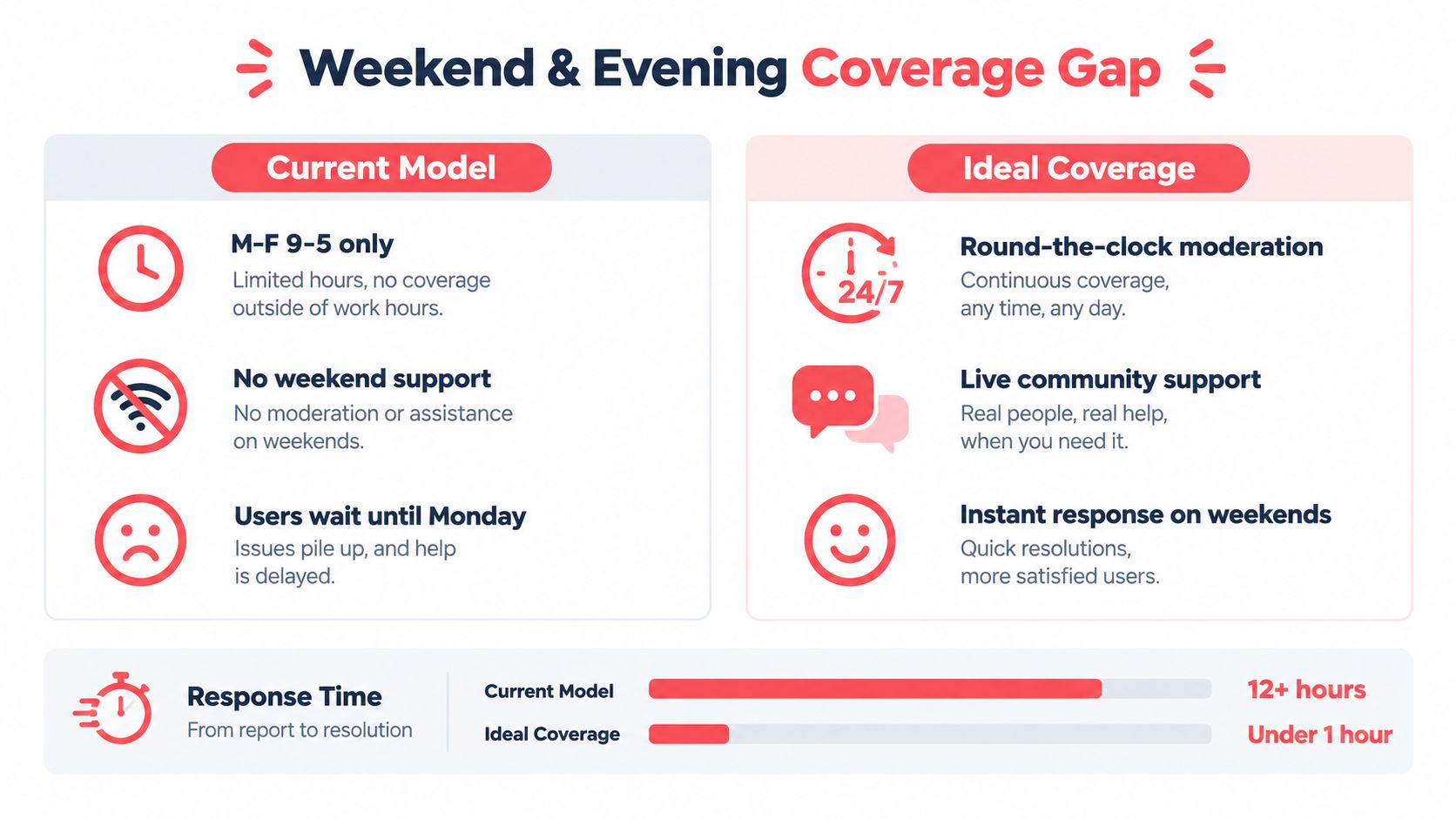
In-house only or managed coverage
An in-house team gives you tighter context. They know the product, the language and the history behind repeat complaints. The downside is straightforward, split shifts and weekend rotations burn out specialists quickly, especially when the queue includes both support and moderation.
A managed follow-the-sun model is often a better answer when volume is high and delayed response carries real risk. It works best when the external team is trained on policy, escalation paths and tone, then reviewed under the same QA standard as the internal team. That is the model BUNCH uses for human-in-the-loop operations, including community management, moderation and support, when companies need staffed coverage without turning the internal team into a 24/7 rota.
Coverage needs more than availability
Being available is not enough. Victoria's government social media moderation guidance recommends always having at least one person available during stated moderation hours and responding within 24 hours, sometimes with a holding statement while the issue is routed internally Victorian government moderation guidance. That is a useful floor, but high-growth platforms often need much faster handling for urgent complaints and safety signals.
If you are building always-on operations, the key question is not whether you can staff every minute internally. It is whether your off-hours process preserves the same standards, escalation rules and documentation trail. For a broader operating model, plan always-on customer support is a practical way to think about shift coverage and handoffs without improvising at midnight.
Where Human Judgment Beats Generative AI
AI is useful for triage, drafting and sorting repetitive requests. It is not reliable enough to own the full conversation when a thread is sensitive, public or likely to escalate. Sprout Social's 2025 Index found that 73% of consumers now expect a brand to respond within 24 hours or sooner on comments, mentions and DMs, and that a majority will buy from a competitor if a brand ignores their question. That shows how little room there is for a mishandled automated reply in high-stakes situations.
Keep humans on the hard cases
Use AI for obvious routing, templated acknowledgments and first-pass summaries. Keep humans on policy disputes, ambiguous intent, harassment, safety concerns and public replies where brand voice matters.
A tone-deaf automated reply can be worse than a slow one. Users will tolerate a queue if they see judgment and consistency. They are much less forgiving when a machine responds as if it did not read the thread.
Build the hybrid workflow on purpose
A hybrid model only works when handoff is explicit. Every AI-drafted reply should carry a visible tag until a moderator approves it; never publish untagged. Messages that are emotionally loaded, legally risky, or tied to personal safety get treated as input, not output: AI drafts, a human decides.
AI should reduce repetition, not reduce accountability.
Managed teams apply this split at scale. Moderators handle policy calls, tone, and escalation, while AI handles the parts that don't need judgment.
Operational Bottlenecks and Next Steps
The first bottleneck is usually appeals. If a user challenges a moderation action, the appeal path should be visible, separate from the original queue and reviewed by someone who understands the policy, not just the message. When appeals are buried in the same inbox as live moderation, they slow down and feel arbitrary.
When appeals live in the same inbox as new reports, they get triaged by whoever's clearing the queue fastest. On one account that meant a wrongly-banned user waited 11 days for a reversal that should have taken one.
The second bottleneck is policy drift. When community guidelines, safety rules and support macros fall out of sync, different moderators give different answers to the same question — and users notice fast. Discord's safety guidance and Reddit's Moderator Code of Conduct both point to the same fix: a standard only works if it's visible and applied the same way every time.
A quick audit should answer three questions.
- Who owns urgent replies: If the answer is "whoever sees it," the queue is not controlled
- What gets escalated: If the answer is fuzzy, moderators are making policy on the fly
- What happens after hours: If the answer is "we'll catch it Monday," you do not have coverage
If you have real volume and a real quality problem, the fix is rarely another dashboard. It is clearer SLAs, explicit routing and coverage that matches when users show up.
BUNCH builds managed teams for community management, moderation and other human-in-the-loop operations when internal coverage is too thin to stay consistent. If you are trying to keep response quality, escalation discipline and off-hours coverage aligned, book a call with a BUNCH expert and see how a managed services model can fit into your workflow.
About the Author
Stay in the Loop!
Related Content

Community Management Social Media: The 2026 Operations
Master community management social media with practical moderation policies, engagement tactics, crisis handling, and KPIs that drive real growth in 2026.

Online Community Moderation: How Communities Handle Content Moderation
A community without a moderation system is like a dinner party without a host. Most people are there to have fun, but with no one watching, some get carried away.

How AI Spawned "Second-Gen Bias" in Content Moderation Services
AI created a whole new layer of bias nobody saw coming: second-gen bias. Learn how this hidden flaw impacts content moderation and why humans are key to keeping AI in check