Beyond the Inbox: How SaaS Teams Build Support That Holds Up


Good customer support for SaaS needs clear ownership, not just a shared inbox. As ticket volume rises, teams need rules for who responds, how quickly, and what they can resolve without approval.
On one billing queue, our agents consistently caught double charges but had to route every refund for approval. We proposed a refund limit agents could approve on their own, with a weekly review of the exceptions. Customers got their money back in the same conversation, and the escalations that remained were the ones that needed real judgment.
Without that structure, onboarding questions, billing issues, and escalations pile up. Better coverage and routing matter more than another macro.
At BUNCH, we provide customer support outsourcing for SaaS companies, including 24/7 coverage. We build managed support teams that work inside your help desk, your documentation and your playbooks, so your customers get one support experience instead of a handoff to a separate vendor.
Here is how we typically work with a SaaS company:
- We start with one bounded queue. We usually begin with a single, well-documented queue, such as onboarding questions or billing, rather than taking on your whole inbox.
- We define authority up front. Before the first ticket, we agree with you on what our agents can resolve on their own, what needs approval and who your named escalation owner is.
- We work in your tools. Our agents use your ticketing system and account data, so context stays with the customer and your reporting stays in one place.
- We keep QA and feedback running. We review tickets against your standards and pass product feedback back to your team, so our work improves your product as well as your queue.
- We expand only when it’s working. Once the first queue meets its targets, we add queues, channels or coverage hours together.
In the rest of this guide, we explain how to decide whether outsourcing fits your team, including the cases where it doesn’t.
What SaaS Customer Support Actually Does
Support helps customers get started, fix product issues, and keep using the service. That makes it part of retention, not just a cost center.
Typical work includes onboarding, integrations, billing, incident updates, and renewal risk escalation. 2025 SaaS market analysis and the 2022 Morning Consult findings summarized by Zoom offer broader market and customer-expectation context.
The Three Operating Models
Compare total costs, including training, QA, tools, management, and the impact of slow support. Hybrid teams work best when partners know exactly what they can resolve and when to escalate.
Designing SLAs That Match Reality
Fullview's compiled support statistics report that 60% of customers define immediate as 10 minutes or less. That does not mean every ticket needs the same target.
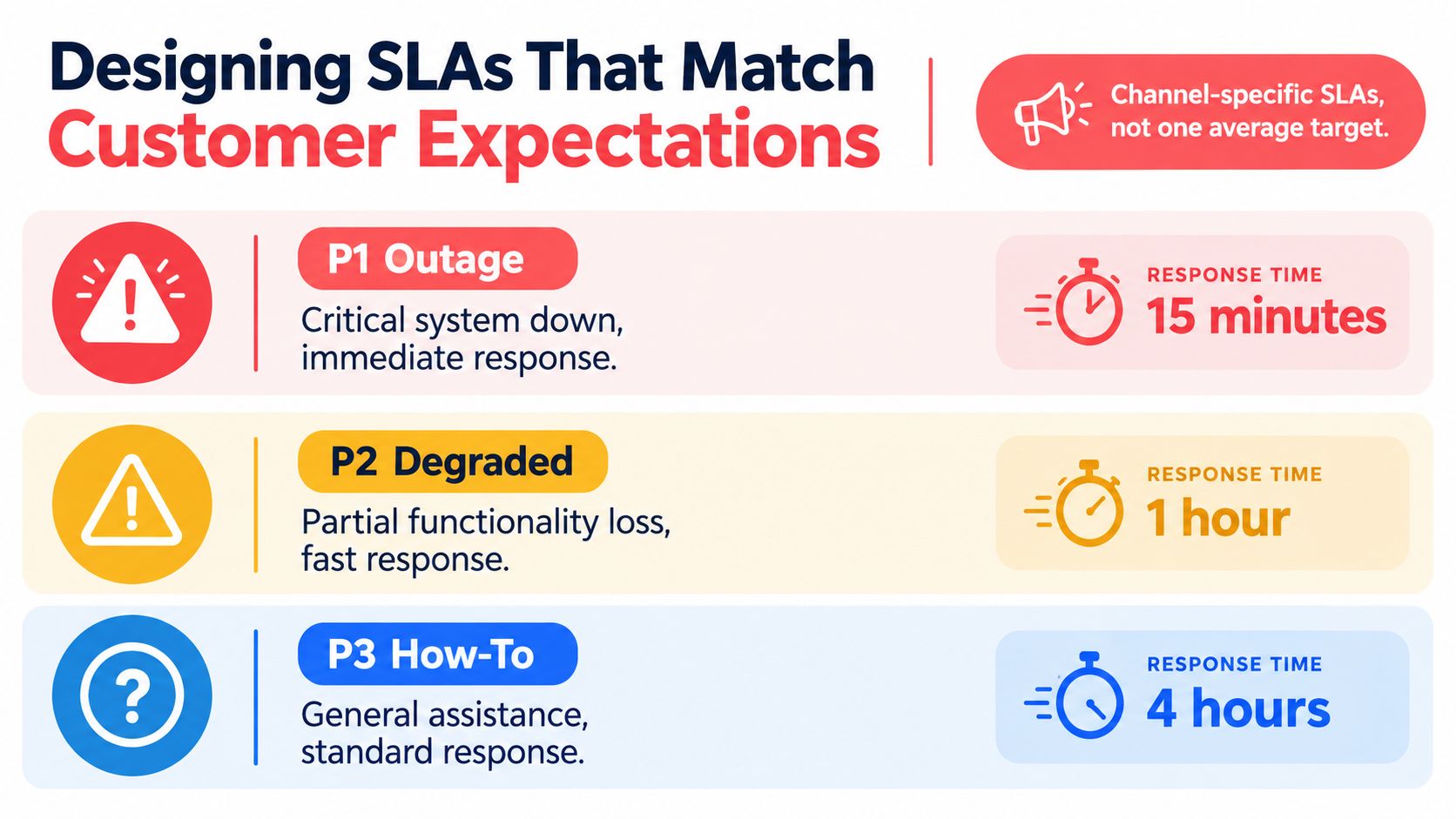
Set severity by asking whether the customer can work, whether data or security is at risk, and whether a workaround exists. Give each tier separate first-response and resolution targets. Review the slowest cases, not just the median. An SLA is a staffing decision before it is a promise. For related workflow ideas, see how Cyndra transforms support.
A client’s dashboard looked healthy because the median first response was fast. When our team sorted by the slowest tickets, a pattern showed up: data-export requests arriving after the client’s US hours. We added coverage for that window and wrote a short playbook for those requests, so the slowest cases now get the same attention as the rest.
KPIs Worth Tracking
Track first response time, resolution time, CSAT, escalation rate, reopen rate, and repeat contact. In its 2026 response time benchmarks, Converge reports 92% CSAT for responses under five minutes, compared with 23% after 24 hours.
Terms vary between teams, so we define ours up front. First response time is measured from ticket creation to the first human reply, excluding auto-acknowledgments. Reopen rate is the share of tickets reopened within seven days. Repeat contact is the share of customers who contact us again about the same issue within a set window. Escalation rate is segmented by reason (product bug, billing exception, access issue), because a high rate for one reason usually points at a specific fix, such as documentation, agent authority or the product itself.
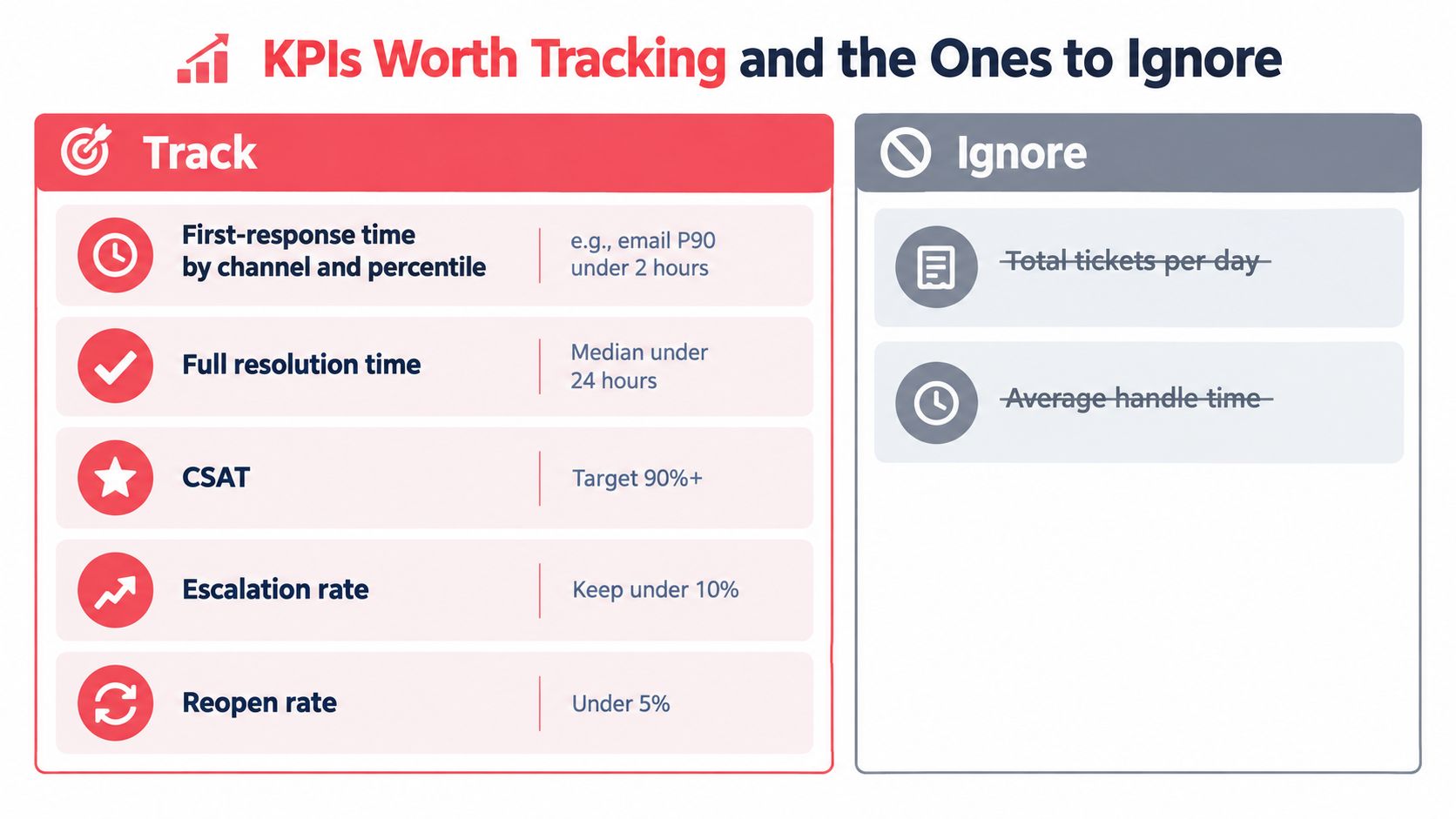
Do not reward ticket closures or bot deflection if customers return with the same issue. Closure rate told us little about whether customers were actually helped. Reading the reopened integration tickets, we saw that a docs link wasn’t always enough. We moved the team’s scorecard from closures to repeat contact per customer, and our agents responded by staying on integration threads until things worked. They were already skilled at this, and the new metric rewarded it. This guide to service-level agreement KPIs can help define measurable standards.
Building a Support Stack
Choose tools that route by severity and owner, retain context across channels, support QA, and connect tickets to account information. A Gartner survey of 5,728 customers found only 14% of issues were fully resolved through self-service, according to CMSWire's summary of the Gartner survey. Make it easy to reach a person when self-service fails.
When comparing tools, test handoffs and reporting with real tickets. This look at the best gorgias alternative raises similar workflow questions.
What Good 24/7 Coverage Requires
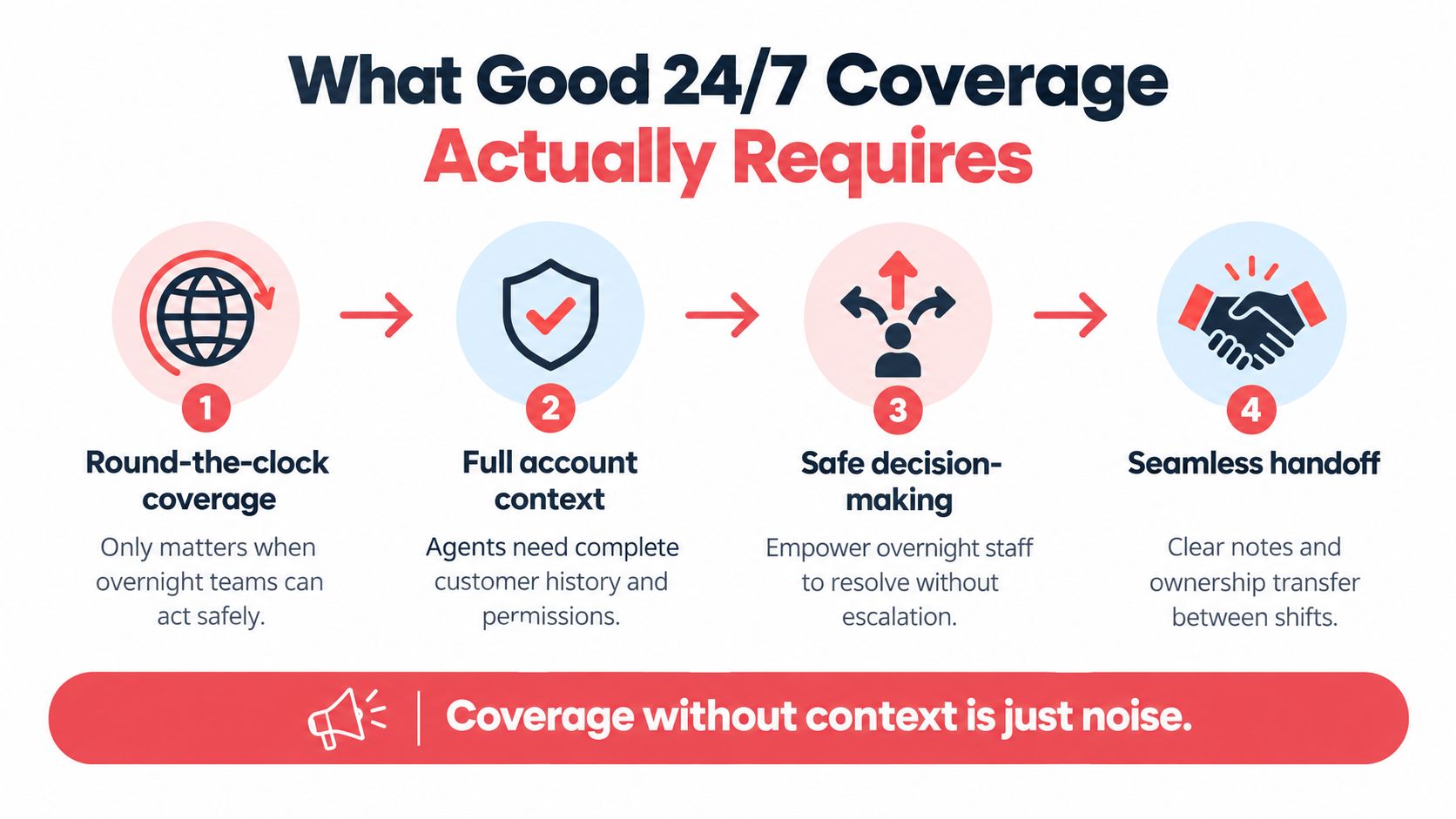
Overnight agents should be able to verify issues, identify active incidents, and reach a named escalation owner. If they can only promise a morning reply, the queue is staffed but the problem is not covered. Aissist's B2B SaaS support benchmark review also underscores the importance of an escalation path when AI cannot resolve an issue. Overnight agents on one account spotted a spike in login failures within minutes. What they lacked was a way to confirm an outage and a named person to wake. We worked with the client to set up an on-call owner and a simple rule: three similar reports in an hour triggers a page. The agents already had the instinct, and the rule gave them a clear path to act on it.
When Outsourcing Is the Wrong Answer
Keep support close to the product when features change quickly, documentation is thin, or access rules are unsettled. Before hiring a partner, define authority, QA, escalation ownership, product updates, and exit terms. Start with one bounded queue. This overview of customer support outsourcing explains how to scope it.
We once scoped a queue for a product that shipped changes weekly while its documentation was still catching up. Rather than have agents work from outdated articles, we recommended keeping that queue in-house for a quarter and returning once release notes flowed to us ahead of each change. The client got accurate answers in the meantime, and the handoff went smoothly when we resumed. Because of that experience, we now check how fast documentation changes before we scope any queue.
Common Questions About SaaS Customer Support
How Many Agents Does a SaaS Company Need?
Estimate from contact volume, handling time, channel mix, and coverage hours. We start with a simple formula: monthly tickets × average handling time ÷ 60 gives agent-hours. For example, 1,500 tickets at 12 minutes each is 300 agent-hours. An agent has roughly 120 productive hours a month once you account for breaks, training, meetings and QA time, so that’s about 2.5 agents. Then we adjust for what the formula misses: coverage hours (one agent can’t staff a 24/7 queue), spikes after releases, and channel mix, since live chat handles fewer concurrent conversations than email. In practice, round up and plan for a schedule, not just a headcount.
Does AI Reduce Support Headcount?
In our experience, AI changes the mix of work before it changes the size of the team. Simple, repeatable questions get resolved faster, and what remains is harder: multi-step troubleshooting, account-specific issues and judgment calls. That work needs more skilled agents and stronger escalation paths, so we measure AI by issues fully resolved and by whether customers had to come back, rather than by bot interactions. Headcount can come down once a queue is stable and well documented, but the savings come from the resolved-without-return rate, not the deflection rate. Measure resolved issues, not bot interactions.
How Do You Know 24/7 Coverage Is Working?
Check overnight response, resolution without morning rework, and CSAT by timezone.
If your queue has outgrown business hours, BUNCH builds managed teams that work inside your tools and playbooks.
About the Author
Stay in the Loop!
Related Content

SaaS: What’s the role of Humans in Customer Service in 2025
AI is transforming SaaS customer service, but humans remain essential for sensitive cases and personalization. Discover how to optimize both for the best user experience.

How AI Is Changing the Human Side of Customer Support
With AI and automation now part of everyday support structures, the role of humans, and the nature of the work they handle, has evolved dramatically.
Service Level Agreement KPI Guide for Operations Teams
Master every service level agreement KPI that matters for support, moderation, and data operations. Includes targets, formulas, and sample SLA clauses.