Customer Support Outsourcing How to Choose and Onboard


Your support queue is growing faster than your team can hire. Chat waits rise, email backlogs return after every launch, and your most capable people get pulled away from product work. Customer support outsourcing can relieve that pressure, but only when you outsource defined workflows, give agents usable knowledge, and measure resolution quality instead of agent activity.
For a high-growth technology company, this is rarely just a labor-cost decision. It is about building reliable coverage across channels, time zones, and demand spikes without losing control of brand voice, customer data, or escalation policy.
At BUNCH, we build and manage customer support teams for high-growth technology companies, so we see where outsourcing works and where it doesn't. This guide covers how to decide what to outsource, how to choose a partner and cost model, and how to set quality targets that protect your customers.
What Customer Support Outsourcing Actually Solves
Customer support outsourcing gives a company an operating team for recurring customer interactions across chat, email, voice, social channels, and overflow coverage. It can also support a 24/7 model, but it will not fix unclear policies, broken product flows, or an outdated knowledge base.
Teams usually consider outsourcing when volume is real but internal hiring cannot keep up. A SaaS company may need tier-one support while engineers handle technical escalations. A fintech company may need structured KYC questions and account support. A marketplace may need coverage based on user activity instead of office hours.
The model has matured beyond a narrow cost decision. Grand View Research estimates the global outsourced customer care services market at USD 77.12 billion in 2024, with a projection of USD 113.18 billion by 2030 and a projected 6.6% CAGR from 2025 to 2030 (Grand View Research market analysis).The market's size shows that outsourcing is widely used, not that any given provider is good. Judge a partner on the criteria in the sections below.
Cost still matters. Industry reporting places offshore agent costs at roughly USD 6 to USD 14 per hour and describes possible labor-cost reductions of 40% to 70%, depending on geography and scope (Ringly's 2026 customer service outsourcing statistics). Those figures should inform your model, not decide it. A low hourly rate means little if repeat contacts rise or your internal team spends its time correcting outsourced work.
Practical rule: Keep strategy, sensitive escalations, product feedback, and policy ownership in-house. Delegate repeatable execution only after you can describe the correct resolution path.
Outsourcing is the wrong call when support volume is still sporadic, intents are undocumented, or every case requires founder judgment. In that situation, an internal generalist often learns faster and protects context better.
For a broader view of the organizational trade-offs, why companies outsource staffing is useful context. The next step is to decide which work belongs in an external queue, which stays internal, and how the handoff will be governed.
How to Evaluate If Outsourcing Fits Your Support Operation
Start with the work, not the vendor list. Export recent conversations, group them by customer intent, and map the path required to resolve each one. “Billing issue” is too broad. Break it into failed payments, duplicate charges, refunds, plan changes, and suspected fraud.
.jpeg)
Use five filters:
- Volume patterns: Identify recurring demand, launch spikes, and time-of-day concentration. A partner helps most when work is predictable enough to train and schedule.
- Channel mix: Separate chat, email, phone, and social requirements. Each channel needs different concurrency, writing standards, and escalation behavior.
- Intent complexity: Mark intents as routine, technical, regulated, or emotionally sensitive. Routine account questions may be external-ready, while policy exceptions may need internal ownership.
- Internal hiring: Compare the time your team spends recruiting, training, and scheduling with the value of keeping the work in-house.
- Cost versus quality: Define the customer outcome you need before comparing fees. Coverage without resolution quality is a false economy.
The right scope varies by company type. A SaaS business might outsource password, billing, and account-access questions while keeping product bugs with an internal technical team. A fintech operation may outsource documented status questions but retain fraud decisions and regulated escalations. A marketplace may externalize order, seller, and buyer workflows while keeping disputes with policy specialists.
Write a resolution map for every candidate intent. Show the customer's entry point, required verification, actions an agent may take, conditions for escalation, and the closing message. Then give agents authority to complete the workflow where risk is controlled. Forced transfers make a queue look orderly while creating repeat contacts.
If you cannot explain how an agent resolves an intent without asking three different internal people, the workflow is not ready to outsource.
Set success criteria before speaking with partners. Include FCR, channel response times, CSAT, backlog health, escalation quality, and knowledge freshness. If you only ask for a price per agent, you will select for capacity instead of performance.
Choosing the Right Outsourcing Partner and Cost Model
Partner models create different accountability structures. A marketplace gives you access to individuals, but you manage more of the hiring, coaching, and continuity. A managed team gives you an operating unit with recruitment, training, scheduling, and QA under one accountable structure.
A boutique specialist can fit a technical company that needs close knowledge transfer and a narrow domain focus. A high-volume BPO may suit standardized demand across many queues. Neither model is automatically better. The right choice depends on intent complexity, channel coverage, and how much management capacity your team can spare.
BUNCH was founded in 2017, operates from Metro Manila and Cavite in the Philippines and serves high-growth technology companies through a boutique managed services model rather than a marketplace model. A third-party listing describes its model as sourcing, training, and managing teams to client requirements under a flat monthly fee, with customer support among its services.
During diligence, ask who owns the QA rubric, who updates the knowledge base, how new product releases reach agents, and which tools the team can use. Tool agnosticism matters because your helpdesk, CRM, and routing logic may change as the company grows.
Review sample scorecards and calibration records, not just the sales presentation. A partner should be able to discuss failed resolutions, escalation patterns, and coaching actions without hiding behind aggregate volume.
Setting SLAs and Quality Metrics That Protect Customer Experience
A support SLA should describe the customer experience you intend to deliver. It should not be a target agents can hit by closing tickets before the problem is solved.
First-contact resolution is the clearest test of resolution quality. SQM Group data cited by ShyftOff places average call-center FCR at 69% in 2024, with an industry range of 43% to 88%. The same benchmark describes 80% or higher as world-class, with only about 5% of centers reaching that level (ShyftOff's 2026 contact-center benchmarks).
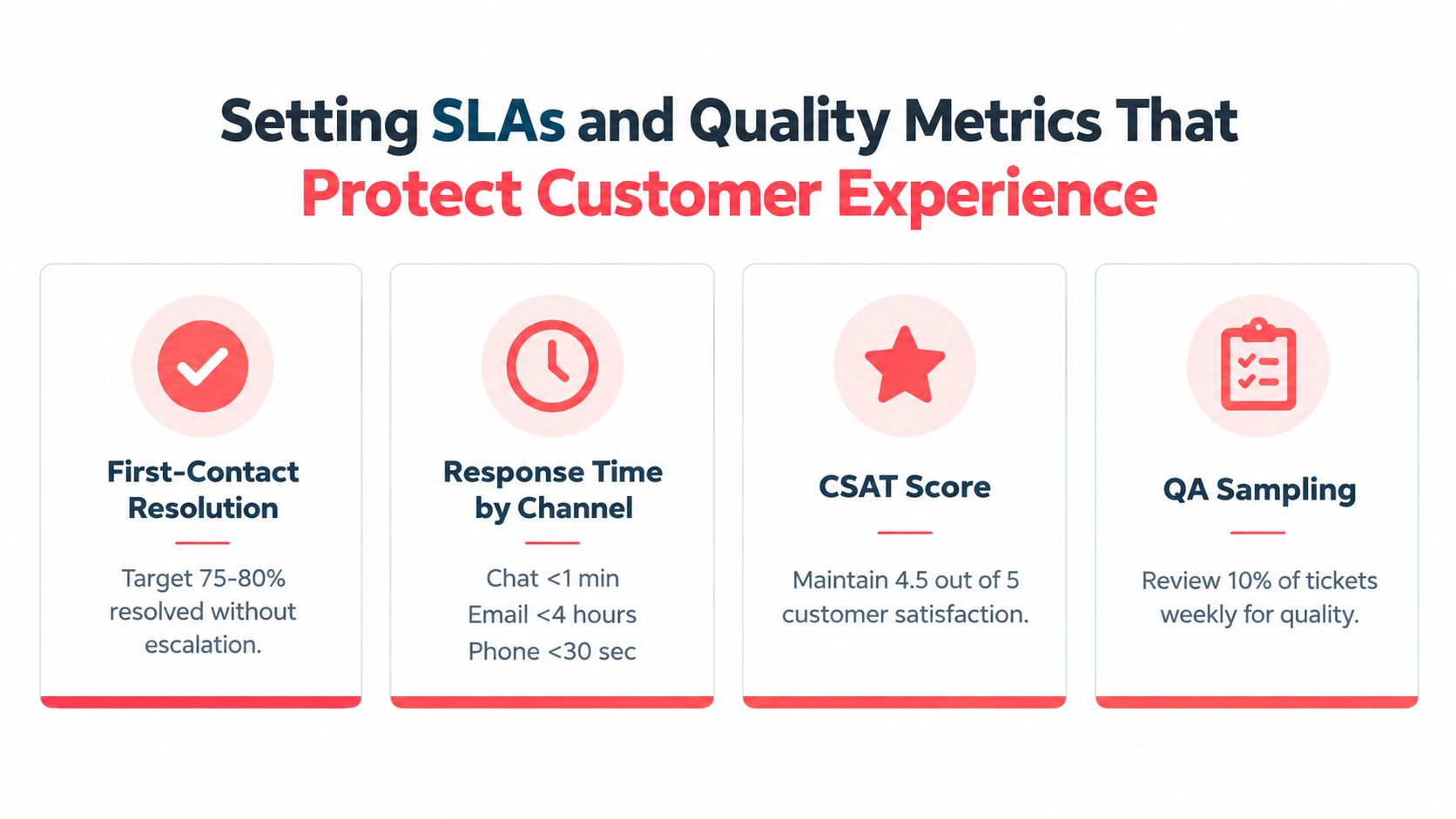
Use FCR by intent, not only as a blended average. A password-reset queue and a technical integration queue should not share the same resolution expectation. QA reviewers should check whether the agent identified the intent, followed the correct path, completed the permitted action, and left accurate internal notes.
Response targets need channel-specific queues. Industry guidance commonly uses 80% of calls answered in 20 seconds, with live-chat first response under 40 seconds, phone under 30 seconds, and email under 4 hours as 2026 benchmarks (CallForce support operations benchmarks). Treat these as operating references, then adjust them to customer urgency and staffing reality.
Track these together:
- FCR: Did the customer receive a complete resolution without another contact or unnecessary transfer?
- SLA compliance: Did each channel meet its response and resolution commitment?
- CSAT: Did the customer rate the interaction positively after the issue was handled?
- Abandonment: Did customers leave before receiving help?
- Occupancy: Are agents overloaded, underused, or unable to complete quality work?
- QA by contact type: Does the interaction meet policy, accuracy, tone, and documentation standards?
Average handle time can help with workforce planning, but it should not lead the scorecard. If agents rush to end calls, FCR falls and repeat demand returns. The call-center outsourcing guide provides additional operational context for structuring this work.
Onboarding and Integrating Your Outsourced Support Team
Onboarding starts with access and ends with controlled ownership. Give the team the helpdesk, CRM, product environment, policy library, and escalation channels they need, but use role-based permissions and remove access that is not required for the workflow.
Build one source of truth for knowledge. Include decision trees, approved language, screenshots, known defects, refund rules, and examples of difficult cases. Assign an owner on your side for every major knowledge area. A document without an owner becomes stale as soon as the product changes.
Use this sequence:
- Access: Grant the minimum tool permissions required and test login, routing, and reporting.
- Shadowing: Let new agents observe live interactions and internal escalations.
- Calibration: Score the same sample conversations together until tone and resolution standards align.
- Soft launch: Release a limited queue with close supervision and daily issue review.
- Full handover: Expand coverage only when the team can handle the defined intents without constant internal intervention.
Training should include brand voice, not just product facts. Short product demonstrations and scenario-based videos can make complex workflows easier to revisit. These customer education video production tips offer a practical reference for building training materials that agents can use during ramp-up.
Do not combine every channel into one blended queue. Chat, email, voice, and social require different staffing logic, and a single queue can miss response commitments while appearing fully staffed. Separate urgent paths from routine work, then define what happens when AI routing sends an edge case to a human agent.
A sensible first 30 to 60 days should include access validation, shadowing, calibration, limited-volume handling, progressive channel expansion, and recurring review. The exact pace depends on product complexity and policy risk. If the partner needs constant rescue after launch, the problem is usually incomplete documentation or unclear authority, not insufficient effort.
In one of our early launches, the team handled the soft-launch queue well, but we noticed customers were coming back about the same refund questions. When we traced the repeat contacts, the cause wasn't the agents. The refund macro they were using had been written before a policy change, and nobody on either side owned keeping it current. We fixed it by asking the client to name one person responsible for each major knowledge area, and by adding a knowledge audit before every launch day. That's why we now treat "who owns this document?" as an onboarding question, not a cleanup task.
For a channel-specific view, see the chat support outsourcing guide.
Running and Scaling Outsourced Support Without Losing Quality
Launch is the start of governance. Hold weekly operating reviews that examine queue health, FCR by intent, SLA misses, escalations, QA findings, and knowledge changes. Keep the meeting focused on decisions, not a slide deck full of undigested metrics.
Omnichannel consistency needs direct testing. Send the same customer scenario through chat, email, voice, and social, then compare tone, verification steps, resolution, and handoff notes. A customer should not receive four different policies because four teams maintain four versions of the truth.
The market is also moving toward longer-term outsourcing partnerships and more nearshore sourcing, while unified omnichannel systems are becoming a baseline expectation, according to 2026 industry coverage from Unity Communications (customer service outsourcing trends for 2026). That does not mean a nearshore or offshore model is automatically right. It means you should assess language coverage, time-zone design, knowledge control, and escalation continuity as one operating system.
Scale the workflow only after the evidence shows the workflow is stable.
When demand rises, add capacity by intent and interval instead of dropping more people into a general queue. For seasonal peaks, prepare a temporary routing plan, refresh the knowledge base before volume arrives, and define which internal team will absorb technical escalations. If the product changes frequently, schedule release briefings and update examples, not just policy headings.
How do you know quality is slipping?
Look for repeat contacts, rising escalations, inconsistent answers, and longer backlogs before CSAT shows the full effect. Review conversations by intent and channel, then trace the failure to training, policy, tooling, or staffing.
What should remain in-house?
Keep product strategy, sensitive regulatory decisions, major complaints, VIP relationships, and voice-of-customer analysis close to the internal team. Expand the outsourced scope when the partner has demonstrated accurate execution under your governance rules.
Is outsourcing always cheaper?
No. It can reduce hiring and operating burden, but the right comparison includes QA management, tooling, training, repeat contacts, and internal oversight. Outsourcing is valuable when it improves the operating model, not when it only lowers the visible labor line.
If you want to assess whether your support workflows are ready for managed delivery, BUNCH builds custom teams for customer support and CX, including human specialists working with AI across recurring operational workflows. Book a call with a BUNCH expert to discuss your channels, resolution paths, and quality controls, then decide together whether outsourcing fits the operation you have.
About the Author
Stay in the Loop!
Related Content

Call Center Outsourcing: How to Plan, Evaluate and Run It
Plan, evaluate, and run call center outsourcing with a clear framework for vendor selection, SLAs, 24/7 coverage, training, and quality assurance.

Chat Support Outsourcing That Actually Works
A practical guide to chat support outsourcing for tech teams. Covers staffing, training, tooling, SLAs, and how to avoid the mistakes most buyers make.

How AI Is Changing the Human Side of Customer Support
With AI and automation now part of everyday support structures, the role of humans, and the nature of the work they handle, has evolved dramatically.