Data Annotation Process: A Reliable Pipeline Guide

Your labeling queue is full, reviewers disagree on edge cases, and the model team is waiting for data that keeps getting reworked. A reliable data annotation process is not a spot check. It is a repeatable system for task design, reviewer training, independent labeling, adjudication, quality measurement, and feedback.
At BUNCH, our managed annotation teams provide data labeling services 24/7, and this guide reflects how we set up task design, reviewer calibration, and quality control for those programs.
The real question, then, is not whether your team can produce labels. It is whether you can explain why each label should be trusted, where uncertainty remains, and what model risk the process controls.
What a Reliable Data Annotation Process Looks Like
A strong pipeline starts with a precise task specification, trains reviewers on realistic examples, collects independent first-pass labels, routes disagreement for review, measures quality during production, and feeds recurring errors back into the guidelines.
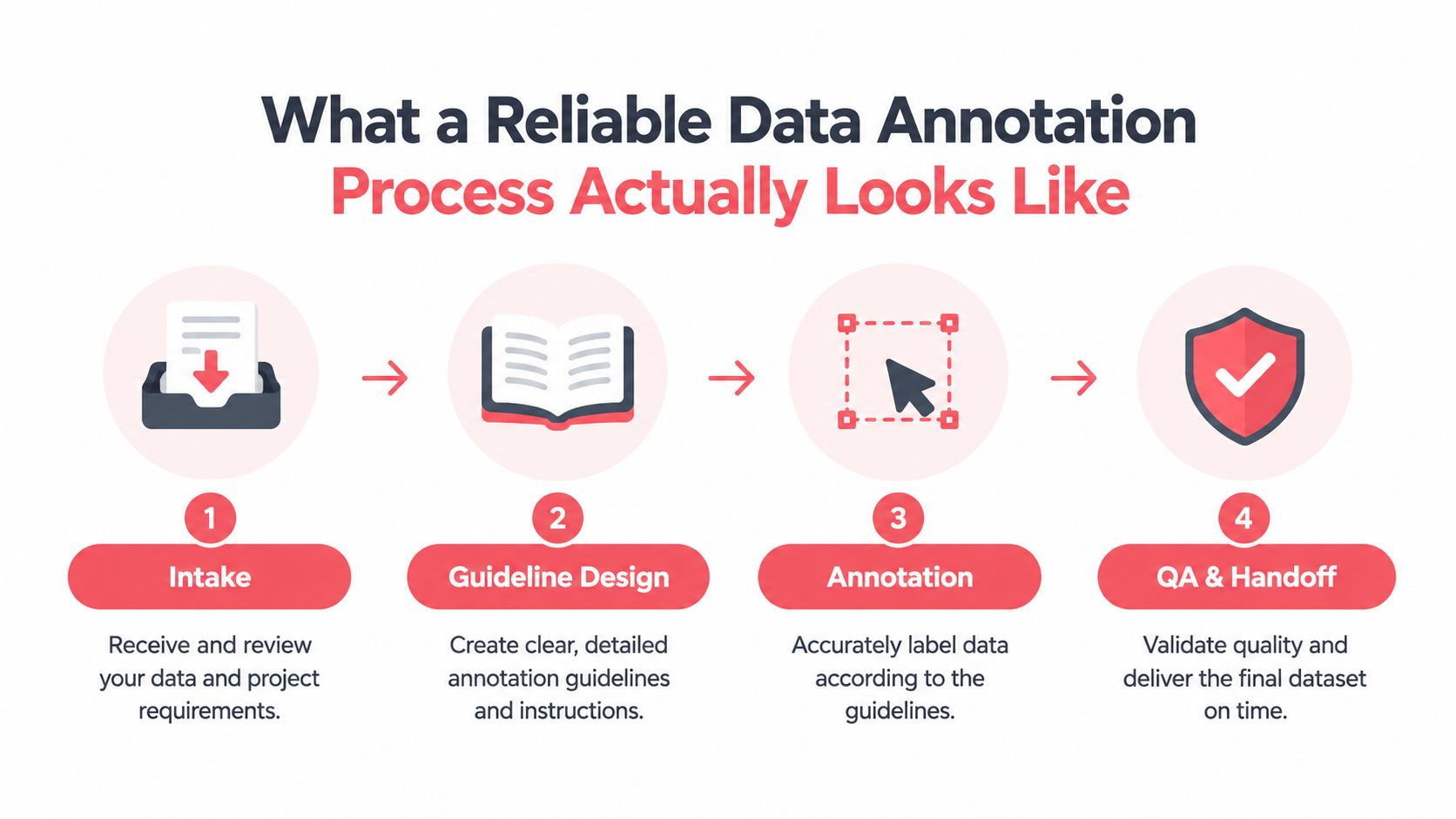
Start with intake. The ML lead defines what the model must learn, and the domain expert defines what labels mean in practice. The output should cover ontology, inclusion and exclusion rules, edge cases, metadata, and delivery criteria.
Next comes training.
On one project, our calibration round surfaced a split on whether a partially occluded object counted as present. That is exactly what calibration is for. We added a rule and two annotated examples before the main queue opened.
Reviewers need production-like examples, not only clean samples. A calibration round should surface ambiguous categories before the main queue opens.
Then comes annotation and review. Independent second-pass review matters when you want to measure disagreement. If the first label is visible, you are measuring conformity, not agreement.
Quality should be tracked across the full program. Record reviewer ID, schema version, task category, difficulty, and review outcome. NIST treats annotation methodology and inter-annotator agreement as key parts of dataset documentation, including who annotated the data and how consistency was measured (NIST AI documentation guidance).
A pipeline also needs a delivery contract. Define output format, rejected-item handling, metadata requirements, and ownership of corrections.
The Six Stages of the Pipeline
- Task specification: ML and domain owners define objective, ontology, label boundaries, examples, and escalation rules.
- Reviewer training: The program owner runs calibration, tracks readiness, and updates guidance when confusion repeats.
- First-pass annotation: Reviewers apply the schema and record metadata needed for throughput and QA.
- Second pass or adjudication: Independent review measures disagreement. Adjudication resolves disputes that affect class definitions, safety, or domain interpretation.
- Quality measurement: Track agreement by label type, reviewer, difficulty, and risk category.
- Delivery and feedback: The receiving team accepts, rejects, or requests rework, and systemic issues go back into the spec.
Your tools do not need to be custom on day one. Every item we label carries its schema version. If a definition changes mid-project, items labeled before and after look identical in the export unless the version travels with them, so any change stays traceable in minutes instead of guesswork. They do need traceability for annotator ID, schema version, review history, time per item, disagreement reason, and per-label metadata.

Double-Pass, Consensus, and Gold Sets
A few weeks into one queue, our seeded gold items flagged a reviewer who had scored well in training. Their agreement with peers looked fine, which is exactly why we seed gold items. We paused them, found a shortcut they had adopted on a hard category, and retrained them before it affected the delivered data.
These are not interchangeable.
- Double-pass annotation shows whether two reviewers independently apply the same rule.
- Consensus resolves conflict when the production system needs one accepted label.
- Gold sets are expert-verified items seeded into the queue to detect drift.
A clinical annotation study shows why this matters. Eleven clinicians labeled intensive-care data and achieved Fleiss' κ = 0.383, with even lower agreement on some decisions. Models trained from different annotators' labels also diverged (the intensive-care annotation study). The practical takeaway is to spend review effort where disagreement is concentrated.
The ImageNet project also showed the value of structured, redundant annotation at scale, with about 49,000 workers in 167 countries helping organize more than 14 million images into roughly 20,000 to 22,000 categories (the ImageNet history and annotation analysis).
A practical explanation of when to use independent review, conflict resolution, and seeded checks is available in this guide to double-pass annotation.
Match Precision to the Model Objective
When a client’s segmentation project began with tight masks, we ran a quick pilot to test whether that precision was needed. It wasn’t, and moving to coarse polygons saved the client reviewer time without hurting their use case. We now pilot on representative samples before locking any precision standard.
Pixel-perfect labels are worth the cost only when boundary accuracy changes model behavior or a downstream decision. A segmentation annotation cost-effectiveness study found that coarse polygons, rough contours, and in some cases bounding boxes with Segment Anything Model preprocessing could approach the same performance more cost-effectively than pixel-wise annotation.
Pilot on representative samples before locking the production standard.
Treat Disagreement as Information
Reviewers kept disagreeing on one category. Reading the disagreement reasons showed the items were genuinely ambiguous and two readings were defensible, so we kept both labels and let the model team decide how to use them.
Disagreement can reveal reviewer error, unclear guidelines, real uncertainty, or contextual variation. Do not erase it too early. Research on disagreement in instruction-tuning data argues that disagreement may reflect genuine ambiguity or annotator preference.
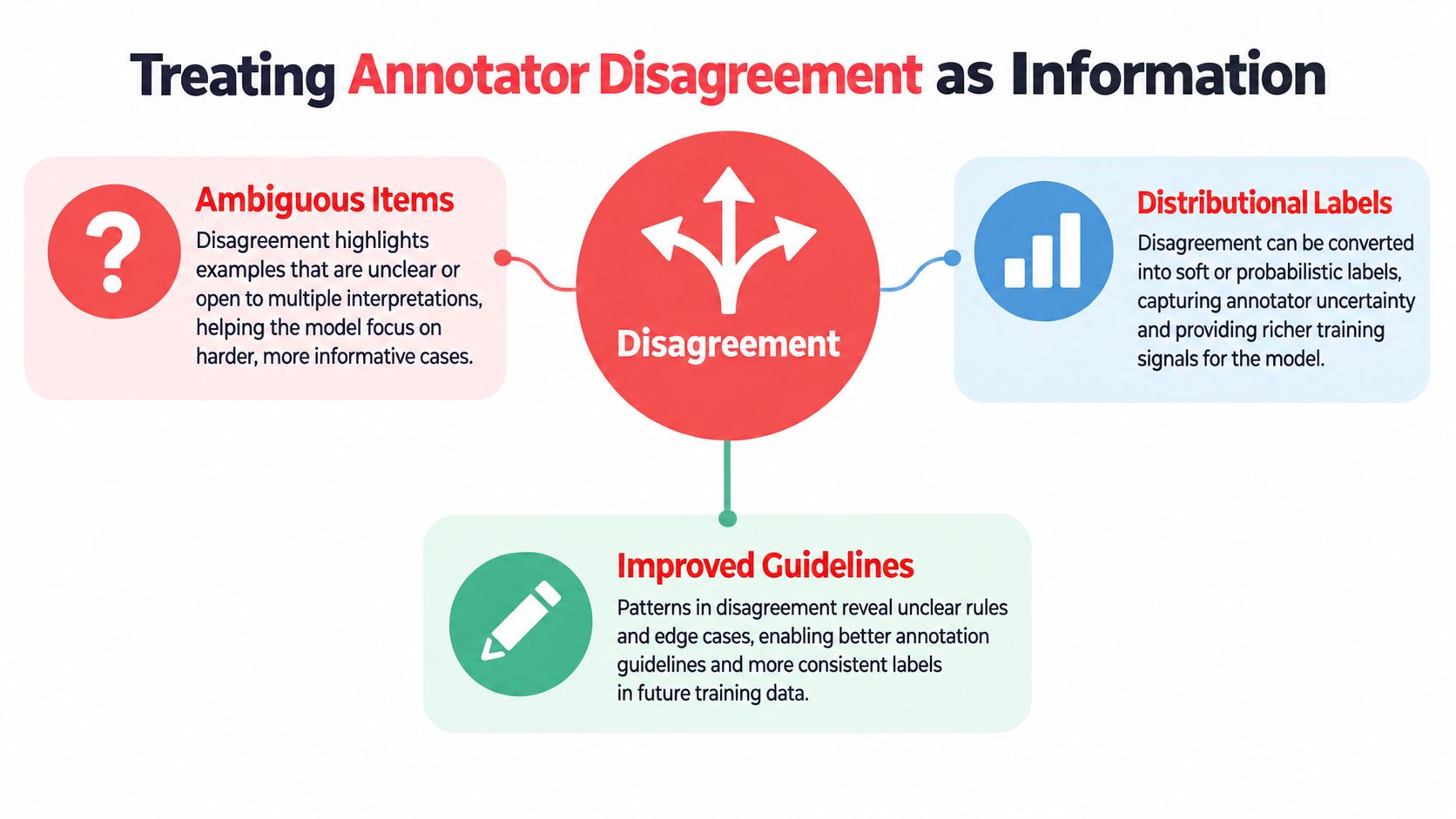
Store raw labels before adjudication, plus confidence, disagreement reason, expertise, and final outcome. Use soft labels when multiple interpretations are valid. Use one adjudicated label when production requires a single decision.
Team Model, Compliance, and Oversight
Your operating model shapes the burden of annotation.
- In-house specialists offer maximum control for sensitive data or rare expertise.
- Freelance or crowd pools scale quickly but require strong training and QA.
- Managed outsourced teams handle staffing and operations while your team retains policy ownership.
Managed teams are the fastest way to add capacity without giving up policy ownership. BUNCH runs annotation programs this way. Every team has a team lead, workforce manager and QA, we own the guidelines and keep improving them, and we keep adding edge cases as they show up in production. We have been doing annotation and labeling since 2018.
For high-risk AI, annotation records are part of compliance. Article 14 of the EU AI Act requires human oversight that lets authorized people monitor, interpret, and override systems when needed (Article 14 of the EU AI Act). NIST also distinguishes routine review from structured evaluation and red-teaming (NIST guidance on human evaluation and red-teaming).
Maintain training records, guideline versions, per-item review logs, agreement data, escalation records, and remediation status.
If you need an annotation team rather than advice on how to run one, that is what we do. Tell us the task types, the volume and the quality bar and we will prepare a custom proposal.
About the Author
Stay in the Loop!
Related Content

Scalable Data Labeling Solutions: Growing Teams Without Compromising Quality
Learn how to scale data labeling for ML without sacrificing quality through double-pass annotation, AI integration, dedicated teams, continuous training, and strong project management.

Data Labeling Company Guide for AI Teams
Learn what a data labeling company does, why quality matters, and how BUNCH helps AI teams with managed annotation, QA, and guideline ownership.

A Brutal Disruption in Image Annotation Services in 2025
AI data labeling just got disrupted. Generalist models are out, and expert-driven, specialized data is in. Here’s how the landscape is evolving faster than anyone expected.