Machine Learning in Computer Vision: A Practical Guide


A computer vision project can stall even with a strong model. Unclear tasks, inconsistent labels, and unrealistic tests often cause more trouble. If your team needs to review video, detect safety violations, or label product images, start by defining the decision the system must support. If you’d rather not build that process alone, our team at BUNCH can help you structure the image and video annotation and human review behind it.
Machine learning in computer vision trains software on images or video to classify, locate, segment, or track visual information. A working system needs representative data, consistent labels, a model, and an evaluation loop.
At BUNCH, we run a managed data labeling for AI service, and we’ve been training ML models since 2017. Our in-house annotator teams handle image annotation, video annotation, and semantic segmentation using double-pass annotation and QA processes, and they work 24/7 so your labeled data is ready when you need it. We deliver it under a managed services model: a defined scope of work, an SLA, and a flat monthly fee. The guidance below applies whether you label in-house or with a partner like us.
Start With the Task, Not the Architecture
Choose the simplest output that supports the decision:
A bounding box is enough for many review workflows; don't pay for pixel masks unless the boundary changes the decision. Video doesn't automatically require tracking.
CNNs, Vision Transformers, and Model Choice
CNNs learn local features such as edges and textures, then combine them into larger patterns. They are often an efficient starting point, especially with a pretrained backbone. Vision Transformers (ViTs) divide an image into patches and use attention to relate distant regions. They can help when wider context matters, but small datasets may need suitable pretraining. Hybrid models combine both approaches.
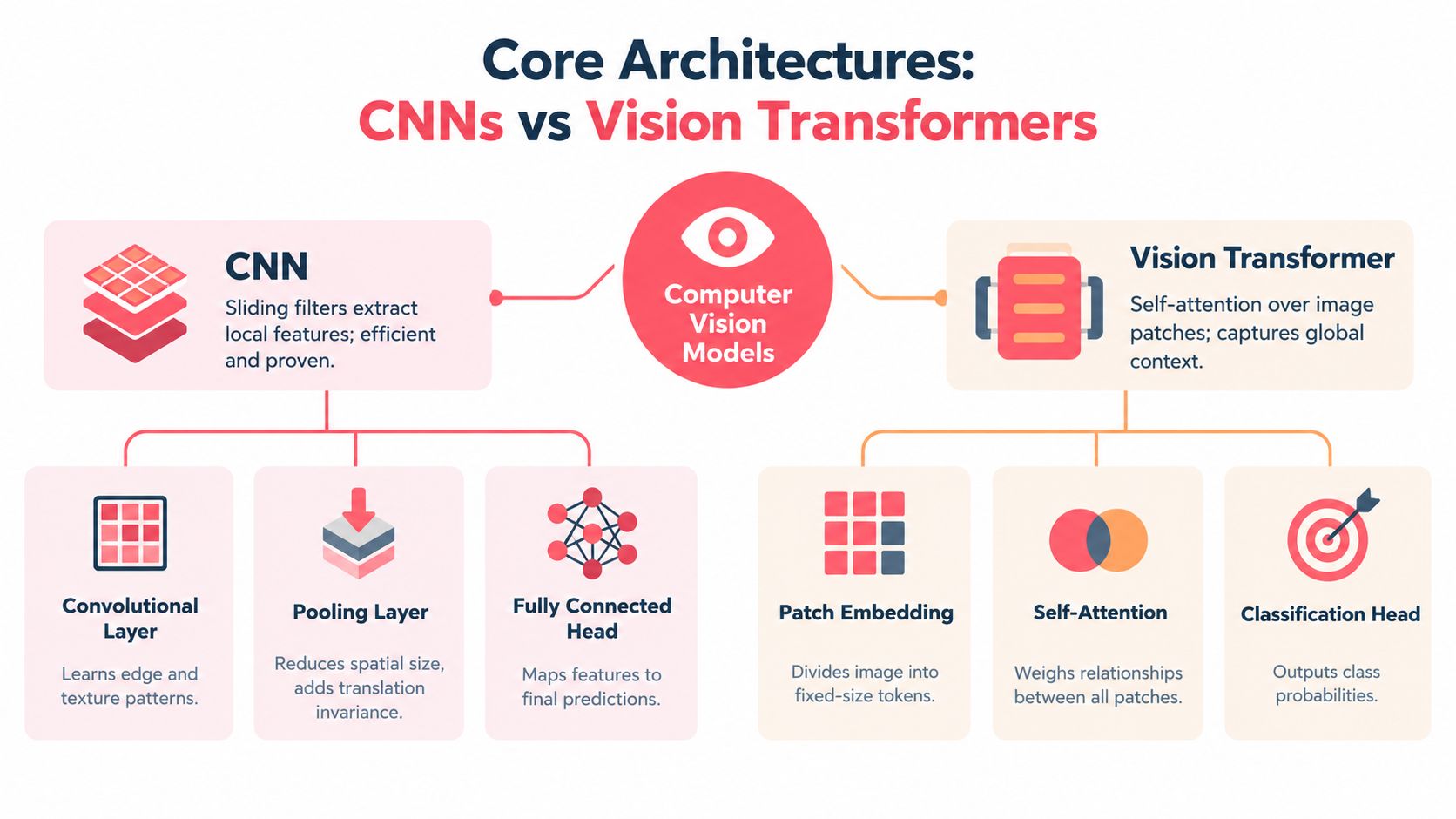
Compare a compact model with a higher-capacity option using the same data and evaluation conditions. Check accuracy by important class and environment, but also check confidence calibration, latency, and failures on blur, occlusion, and unfamiliar images. For broader trade-offs, see this guide to model selection.
Labels Are Part of the Product
On one segmentation project, our annotators kept disagreeing about whether a shadow belongs to the object. We settled it by adding a written rule with a reference image, so everyone resolved the case the same way.
Decide how reviewers handle partial objects, uncertain boundaries, and ambiguous classes before scaling annotation. A guideline entry might read: “Draw the box around the visible portion of the object. If less than a quarter is visible, mark it as partial instead of labeling it as a full object.” The exact cutoff matters less than having one. Use single-pass labeling for straightforward exploration, double-pass review to expose disagreement, and expert adjudication for high-impact cases. Document disputes rather than forcing a confident label where none is defensible. Our data labeling company guide can help frame the build-or-partner decision.
A WACV 2025 label convergence study reports 8% to 38% noisy or incorrect labels in real-world datasets and notes that 33% of the full ImageNet validation set received identical labels across multiple studies. Spend review time on rare classes, costly mistakes, and cases the model finds uncertain.
For segmentation, inspect boundaries closely. Under tested corruption conditions, misplaced masks reduced mask mAP by 18% and boundary mAP by 21% in a segmentation annotation study. Consistent rules for shadows, occlusion, and partial objects matter. For retail product images, the usual trouble spots are reflections on glossy packaging, overlapping items, and text that is partly cut off. Each needs a rule before annotation begins.
Evaluate the Errors You Can Afford
Use metrics that match the workflow. Top-1 accuracy measures whether the leading class is correct; top-5 accuracy can matter when a reviewer sees ranked suggestions. AlexNet's 2012 ImageNet result had a 15.3% top-5 error rate, versus 26.2% for the runner-up (historical account). For detection, use mAP; for segmentation, IoU; for tracking, identity-focused measures such as IDF1.
Don't stop at an aggregate score. Break results down by class, camera, lighting, location, and confidence. Inspect false positives, missed objects, and ground-truth errors separately. Say two annotators label the same shelf image. One calls an item a ‘bundle,’ the other labels each product separately. Double-pass annotation flags the mismatch, a reviewer decides which reading fits the project’s rules, and the decision goes into the guideline so the next annotator doesn’t have to guess. An annotation uncertainty study found that incorrect classes, missing annotations, and uncertain locations all lowered detection mAP. Compare model versions against a consistent, trusted test set.
Keep Humans in the Loop
Production images may differ from training data in lighting, camera quality, background, or geography. Models can also learn shortcuts, such as relying on a product's packaging or a medical image's setting rather than the intended signal. Cluster failures by visual context and have reviewers check whether the pattern is legitimate. Concept-based methods can help identify correlations even when demographic labels are unavailable; ConceptScope, presented at NeurIPS 2025, is one research example.
Route low-confidence predictions, model disagreements, unfamiliar images, and policy-sensitive cases to human review. A reviewer opening a low-confidence prediction usually isn’t asking ‘is this right?’ but ‘which rule applies here?’ Giving reviewers the guideline next to the image shortens that decision and keeps answers consistent. In an active-learning loop, reviewers label selected examples, the team retrains, and evaluation checks whether the targeted failures improved. An in-house team offers direct control; managed capacity requires clear policies, QA, escalation, and security controls. We support image and video annotation, bounding boxes, keypoints, segmentation, content moderation, and AI validation. See our active learning loop overview for the operating pattern.
Start with a representative labeled slice covering ordinary cases, rare classes, and difficult conditions. There is no universal data count; label quality often matters more than volume. We start with a small pilot batch before scaling, then read the disagreements first. If annotators split on the same cases, the guideline needs fixing, not the annotators.
Choosing a model and delivery approach: Fine-tuning a pretrained model is often a practical middle path. Build when the task is central and you can own the pipeline; buy when a standard service meets the need and its trade-offs are acceptable.
Review the model when data, label policy, classes, or monitored errors change. Feed representative production failures into the next labeling cycle.
If your pipeline needs structured review or annotation capacity, talk to our team about your workflow and scope.
About the Author
Stay in the Loop!
Related Content

10 Machine Vision Applications Across Industries
Explore 10 machine vision applications in manufacturing, healthcare, retail, automotive, robotics, and quality control, with data and implementation guidance.

Data Labeling Company Guide for AI Teams
Learn what a data labeling company does, why quality matters, and how BUNCH helps AI teams with managed annotation, QA, and guideline ownership.

Scalable Data Labeling Solutions: Growing Teams Without Compromising Quality
Learn how to scale data labeling for ML without sacrificing quality through double-pass annotation, AI integration, dedicated teams, continuous training, and strong project management.