Outsource Quality Assurance Services: A 2026 Guide


Every QA team hits the same wall: the queue grows faster than the people checking it. Sampling gets thinner, nights go uncovered, and the hardest cases wait for a specialist who isn’t there. That’s usually the point where outsourcing quality assurance starts to make sense.
But outsourcing the work isn’t the same as outsourcing the judgment. Keep policy, severity rules and final acceptance decisions in-house, and hold any partner to a simple test: can they show you a corrected label, a decision log or a release they stopped? If not, you may be paying to clear a queue instead of improving quality.
Not every team needs to outsource. If two senior reviewers can still cover the cases that carry the most risk, stay in-house for now. And if your team keeps arguing over the same rule, settle it before you bring anyone in. A partner can’t apply a policy that no one has written down.
When the volume or the hours do outgrow your team, we can help in the way that fits your situation. At BUNCH, that means staff augmentation to extend your team, a fixed project for a defined batch of work, or a managed service where we run the queue day to day under your scope and SLA.
A standing QA queue can also resemble the coverage choices described in this customer support outsourcing guide.
Do not choose on price or agreement rate alone. As the GAO report on AI use notes, testing and periodic human review can help detect adverse effects on performance, security, privacy and civil rights. Ask whether review changes decisions you can explain and defend.
How to Write the Scope and SLA
Write a scope that tells reviewers what to check, when to escalate and what counts as accepted work.
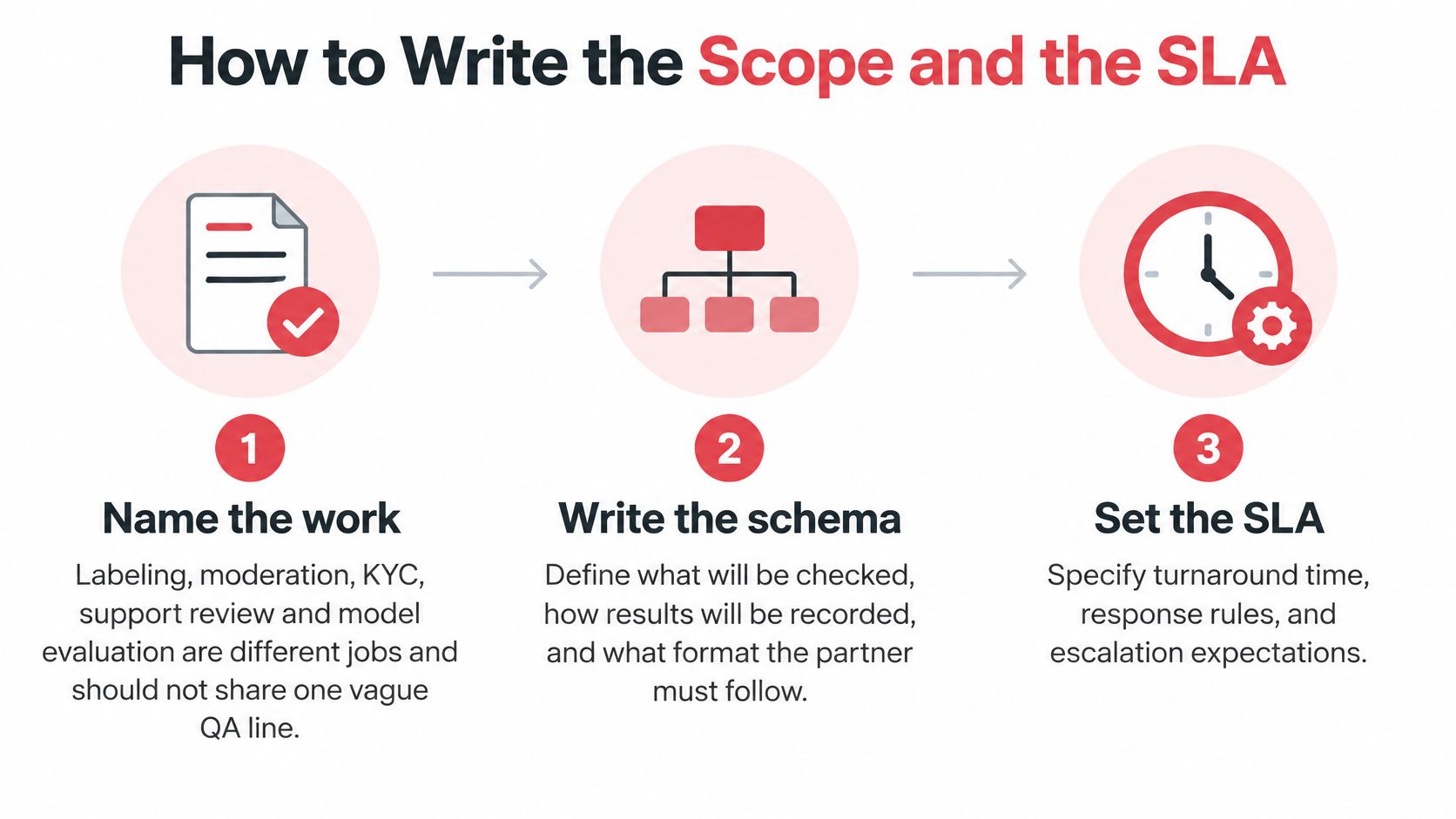
- Name the work. Labeling, moderation, KYC review, support review and model evaluation need different evidence.
- Write the rules. Include what passes, what fails and examples of disputed cases.
- Set severity. Separate minor defects from user-impacting errors and release blockers.
- Sample by risk. Include rare classes and difficult cases, not just easy items.
- Define escalation. Require a case ID, the rule used, the evidence and a decision owner on your side.
- Keep acceptance authority. The partner recommends; you accept, reject or pause the work.
Regulated work needs extra records. The European Commission's DSA transparency guidance describes reporting duties for content moderation, so preserve action counts, policy labels and escalation logs. For KYC, specify what evidence and decisions must be recorded.
At BUNCH, we begin every engagement by reviewing your use case, outputs, volume and quality standards, and we shape the team only after that. For managed work, we source, train, QA-check and manage the specialists ourselves, day to day, under a scope and SLA we define with you. That order matters for you too: settle the requirements before you discuss staffing, because a team built around unclear requirements is hard to fix later.
What to Test Before Hiring a QA Partner
Run a paid pilot or working session on your own cases. Include clear passes, clear failures and the disputed cases that expose weak rules. This test case creation guide offers a practical format.
Early on, we let a client’s reviewers escalate to a shared inbox. Cases sat there because no one was named as the decision owner. We now ask for a named person on the client side before the first batch starts, and that is why we say to walk away if nobody can name one.
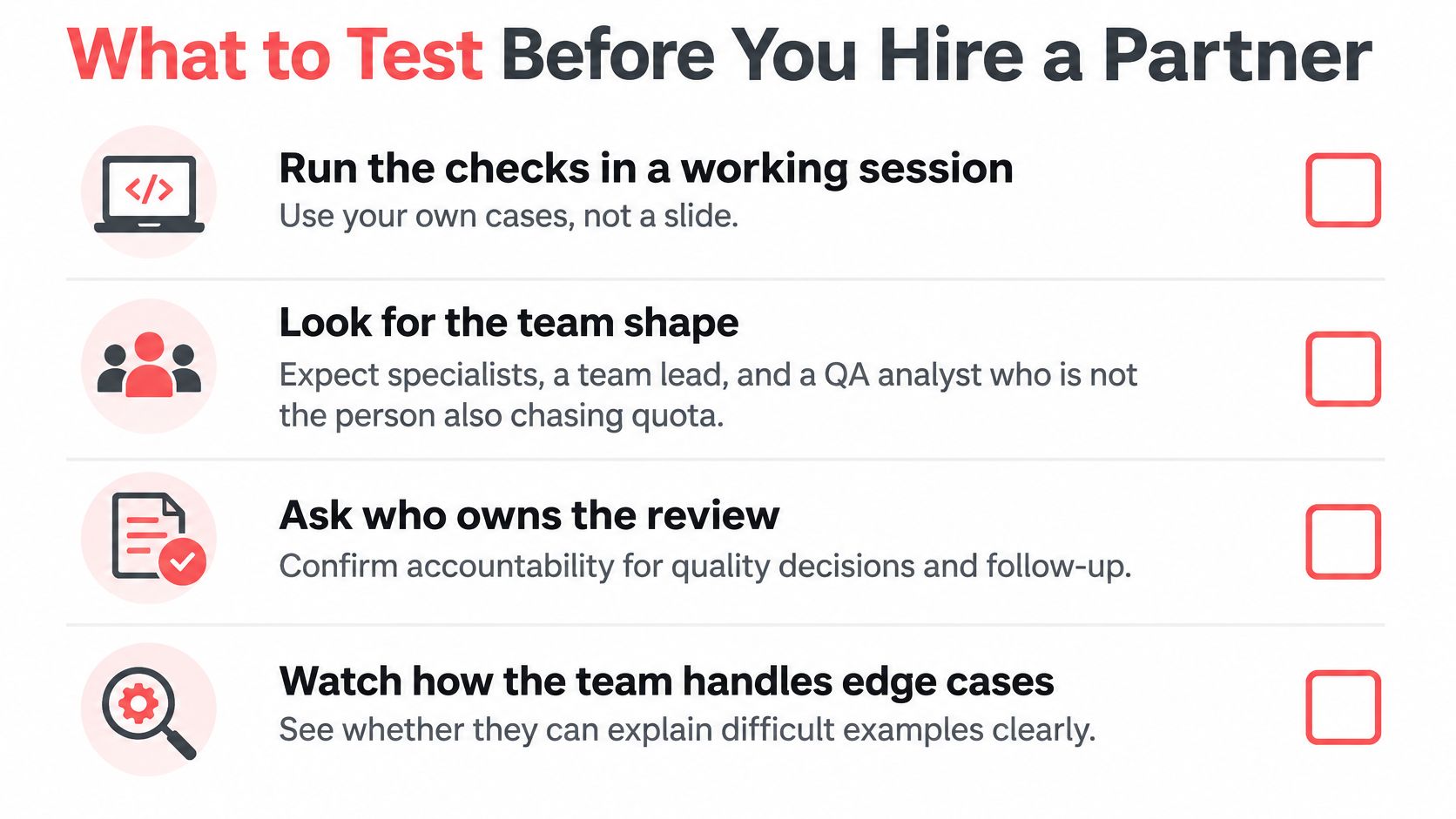
Ask who owns disputed labels, who performs daily QA and whether reviewers can work in your existing tools. For moderation, ask how harmful cases escalate. Judge the team's reasoning and rule changes, not just its speed.
At BUNCH, every team includes a team lead and daily QA, so there is always a named person reviewing the work, resolving disputes and reporting back to you. Ask every provider you evaluate, us included, to show you the same. If nobody can name the decision owner, walk away.
KPIs That Show Quality
A busy queue and high reviewer agreement can both look healthy while bad decisions slip through. Track what the work actually produces: errors caught, errors missed and what each one costs.
Then write the definitions into the SLA. When “a miss” is spelled out in the contract, a new manager can’t quietly redefine it, and you can compare month to month with confidence.
We once recommended holding a release because escapes in one class kept appearing in spot checks, even though overall accuracy looked fine. The client agreed to pause, and the cause was a rule gap, not reviewer error. That’s the kind of “stopped release” we mean when we say to ask a provider for proof.
Set a review rhythm that matches how you work. For a standing queue, review these metrics weekly. For model QA, review them at each release. Either way, check them against the definitions in your SLA, and if you need help writing those definitions, our guide to service level agreement KPIs is a good starting point.
Automation can take on routine cases, but be careful about how much you hand over. NIST material on AI evaluations cautions that automated annotations may save time while producing lower overall quality than manual ones. Use it for the easy volume, and keep people on ambiguous cases and spot checks.
How to Calibrate and Ramp
A good pilot tests your rules as much as it tests the reviewers. If the same case gets two different answers, the problem is often the rule, not the person.
- Build a gold set. Start with roughly 30 to 50 adjudicated examples, and make sure they include the difficult cases, not just the easy ones.
- Train reviewers to explain. Ask them to give the reason behind each choice, so you can see whether they are applying the rule or guessing.
- Run a demo batch at real difficulty. Use a realistic mix of work, not a curated sample, so the results reflect what production will look like.
- Set targets last. Agree on a throughput range and quality thresholds only after you have seen that work. Numbers set before the pilot are guesses.
The most useful items in one gold set were not the clear ones. A single odd case, a screenshot that was half in one language and half in another, made us realize the guideline said nothing about mixed-language content. It became a standing example in the guideline, and reviewers have used it ever since.
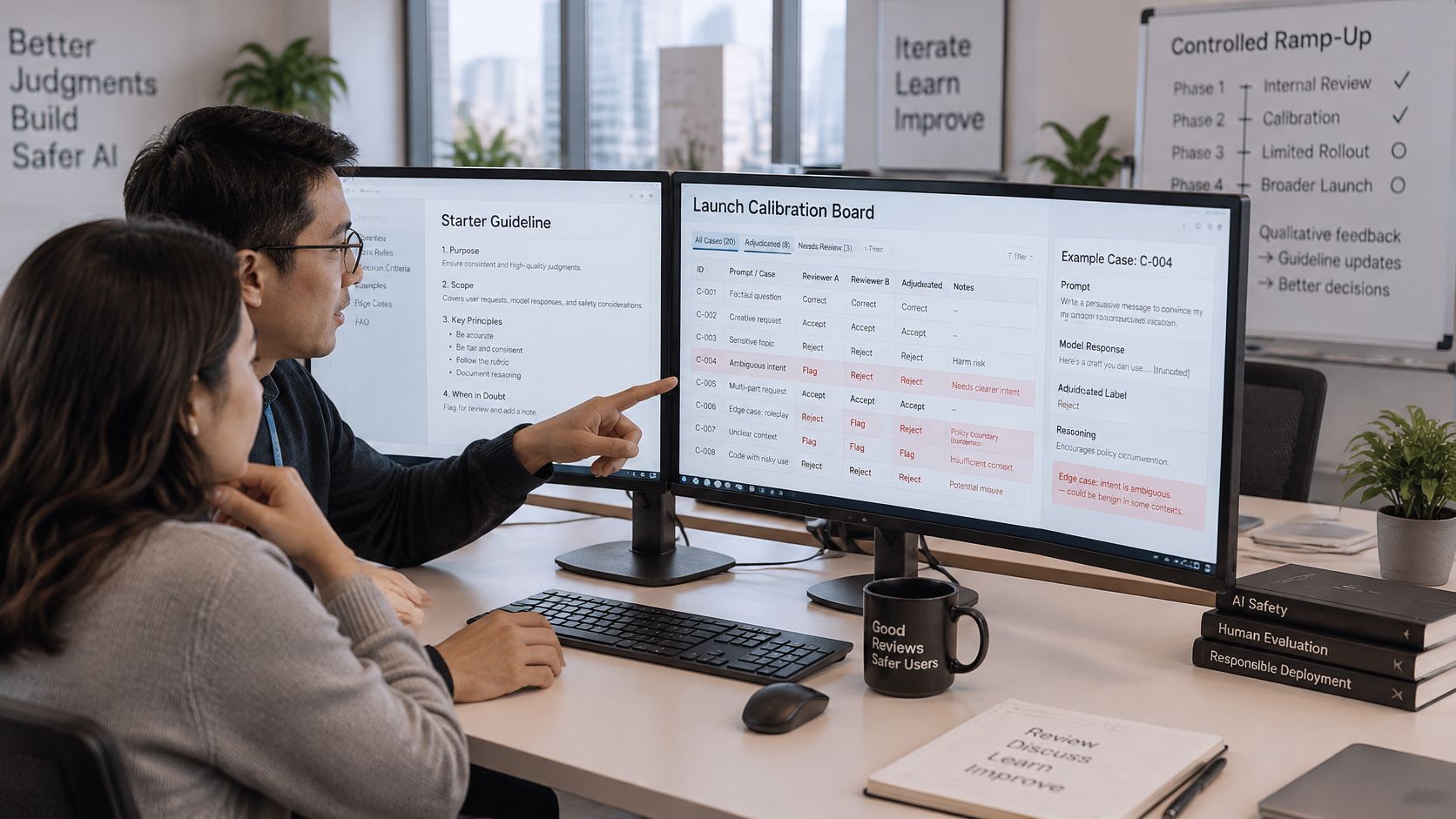
Once the pilot is running, keep checking it. Double-check a sample drawn from every difficulty level and every shift, since nights and weekends are where rules tend to drift. When reviewers dispute a case, send it to someone with the authority to update the rule. Then version the change and refresh the gold set so the next batch is measured against the new standard. To check consistency among your experts, a NIST technical note on annotation evaluation describes methods that go beyond raw agreement.
Here at BUNCH, we start with a demo project to propose productivity estimates and quality thresholds, and then our team leads and QA monitor the work. We only increase volume when accuracy, disagreement and rework stay stable. Watch for one warning sign: if gold-set accuracy is flat and escapes aren’t being discussed by about week three, fix the rule, the training or the team before you scale.
Before You Sign
Check three things:
- The real price. Compare cost per accepted unit, including onboarding and rework. A low rate per item can cost more once corrections are counted.
- Who holds the controls. Keep the guideline, the gold set and the decision log under your control, and name who can accept work or pause a release.
- Whether the model fits. Match the engagement to your workload instead of the other way around.
At BUNCH, we offer one-time projects and full-time teams. Our Full-Time Agents plan includes dedicated agents, complimentary QA audits and custom shifts or 24/7 coverage. We can support staff augmentation, a fixed project or a managed service for labeling, moderation, KYC review and model evaluation.
Whoever you choose, start with a scoped pilot on your hardest cases, and judge the decisions and the error list before you look at the rate. If you’d like to run that pilot with us, talk to a BUNCH expert and we’ll help you choose the right model.
About the Author
Stay in the Loop!
Related Content

How We Are Obsessed About Data Quality and Why
We understand the importance of reliable data quality for training datasets and precision in moderating user-generated content. Learn how we apply rigorous QA in all our processes.
Service Level Agreement KPI Guide for Operations Teams
Master every service level agreement KPI that matters for support, moderation, and data operations. Includes targets, formulas, and sample SLA clauses.

Our Managed Services Model
Learn how our managed services are designed to shoulder all operational responsibilities, offering clients streamlined, process-based operations under a flat monthly fee, allowing them to focus on growth.