Semantic vs Instance Segmentation: Key Differences

At BUNCH, we have supported segmentation and data annotation workflows since 2017, and the same issue appears again and again: teams treat semantic vs instance segmentation as a model choice when it is usually an output choice first. The better starting point is the product decision, the label structure needed to support it, and the QA process required to keep labels consistent.
Semantic segmentation assigns a class to every pixel. It fits use cases like road scenes, tissue regions, water detection, and land cover mapping. Instance segmentation separates each object into its own mask. It fits use cases like counting shelf products, tracking cells, or assigning a defect to one specific part.
If you choose the wrong output, the problem goes beyond model performance. The annotation schema, review rules, export format, and downstream analytics may all need to be rebuilt.
What Each Task Teaches the Model
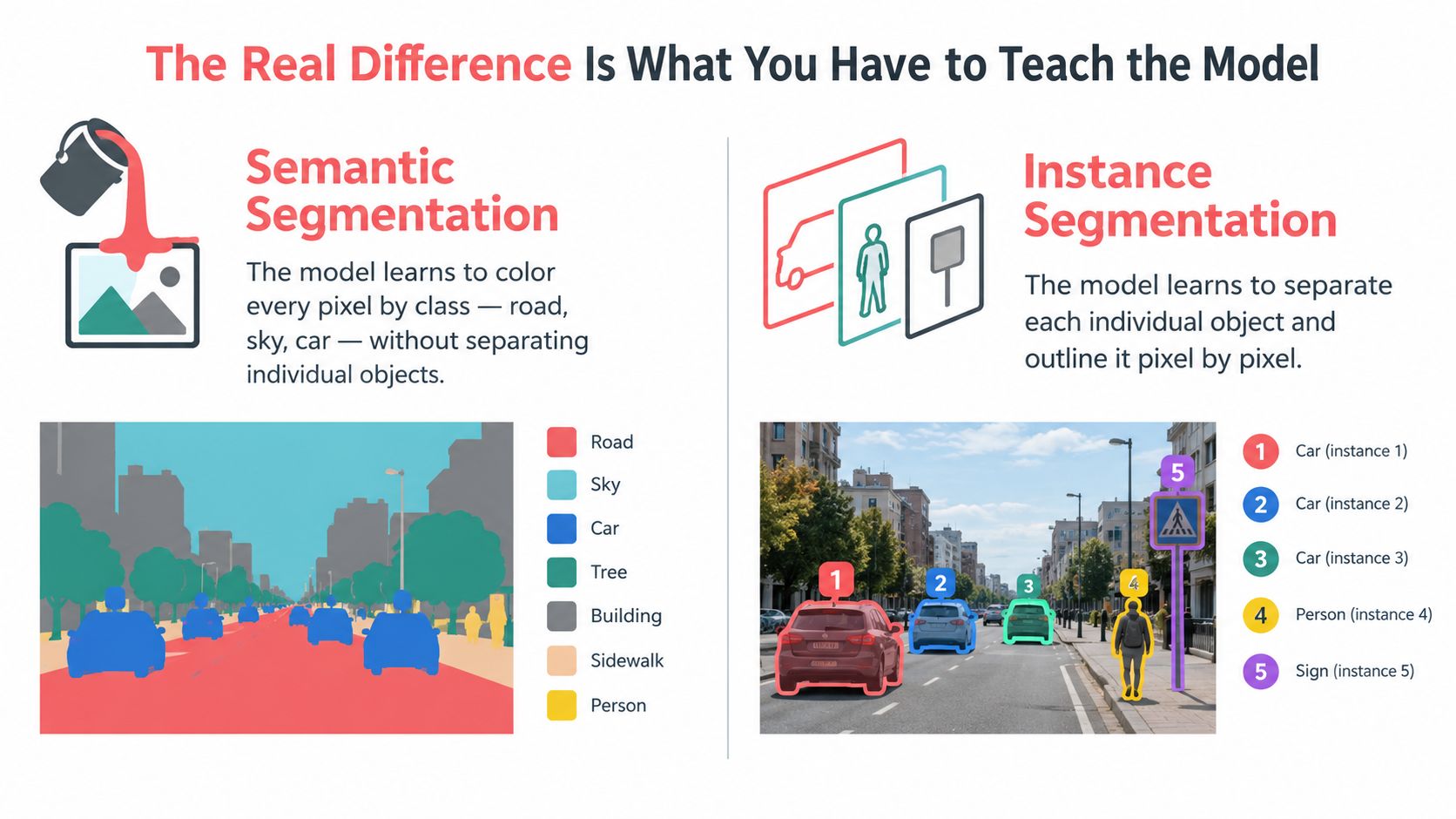
Semantic segmentation teaches a model to assign a class to every pixel in an image. The model learns region membership. It answers questions like, "Is this pixel part of road, wall, leaf, or tumor?" Instance segmentation teaches a model to separate each individual object and return a distinct mask for each one. It answers questions like, "How many bottles are here, and which pixels belong to bottle 1 versus bottle 2?"
In practice, semantic labels merge same-class objects into one region, while instance labels preserve separate masks for each object, as shown in the Ultralytics semantic segmentation documentation and instance segmentation documentation.
This choice should be treated as a workflow and budget decision early. Semantic review often looks simpler, because reviewers check whether the right class covers the right region. In our pilots, though, reviewers agreed more often on instances, because object edges were easier to judge than region boundaries. Instance review adds another layer. Reviewers must confirm that touching objects are split correctly, small objects are not missed, overlaps follow policy, and each object is represented once.
A simple example shows the difference. A semantic mask can show where cars are in a street scene. An instance mask shows that there are three separate cars, even if two are touching bumper to bumper. That distinction matters if the product must count vehicles, estimate parking occupancy, or assign damage to one car instead of the whole cluster.
Practical rule: Choose the output your product consumes, then design the annotation workflow around that output.
Teams assessing the wider computer vision stack can use this overview of CNN and transformer image models to understand why architecture discussions should follow task definition, not replace it.
Semantic vs Instance Output
Imagine one street image with road, buildings, sky, pedestrians, and three overlapping cars.
A semantic pipeline creates one class map for the whole image. Every road pixel gets the road label, every sky pixel gets the sky label, and every car pixel gets the car label. If the cars touch, they may appear as one continuous car region. This is useful when the product needs scene layout, drivable area, curb boundaries, flood extent, or land-cover regions. It is less useful when the product needs object counts or object-by-object actions.
An instance pipeline creates separate object records. Car 1, car 2, and car 3 each receive their own mask and identity, often along with a box and confidence score, which matches the pattern described in the Ultralytics instance segmentation guide. This output supports counting, sorting, object-level alerts, and post-processing logic such as "flag the leftmost damaged pallet" or "track this worker through the next frame."
This difference changes the full data pipeline. A semantic export may be one dense mask image per frame. An instance export may contain many records per image, each with its own polygon or mask, class, confidence, and sometimes attributes. That affects storage, parsing logic, dashboard design, and even which errors matter most in production.
What It Means for Annotation Work
Semantic annotation often uses brushes, fills, or polygons tied to a class picker. The workload depends mostly on image resolution, boundary complexity, and class count. A satellite image with large clean regions can be relatively efficient. A surgical image with fine tissue boundaries can still be slow because the edges matter.
Instance annotation usually needs polygon-per-object or mask-assisted workflows. Workload grows with object count, occlusion, truncation, fine boundaries, and ambiguous contact between touching objects. Fifty overlapping products on a shelf can take much longer than one large background region, even if both images have the same resolution.
On a street imaging project, the slowest images were never the biggest ones. They were the crowded ones: trees and bushes with dense leaf edges, and busy foot traffic where pedestrians overlapped. Annotators kept stopping to decide where foliage ended and where one person stopped and the next began, or whether two touching objects were one or two. Once we added a written example gallery of ambiguous cases, those pauses mostly went away.
Instance QA needs a clear written policy. Reviewers need answers to operational questions before production starts. Does every visible object need a label, or only those above a size threshold? Should heavily occluded objects get full masks or only visible regions? If two objects touch, should annotators split them at the visible seam or merge them when the separation is unclear? Without those rules, teams get inconsistent data even if individual annotators are skilled.
Before production, we ask clients to decide three things: a minimum object size, whether occluded objects get full or visible-only masks, and where to split touching objects. On one street-image pilot, we skipped this and let annotators use their own judgment. Reviewers disagreed frequently, so we paused to write the rules down before continuing.
Semantic work also needs policy, but the ambiguity is often narrower. The team usually needs clear class definitions, boundary rules, and priority rules for overlapping classes. For example, if a transparent bottle covers a shelf label, which class owns the visible pixels? If a wet road has reflections, should the reflection stay road or become water-like artifact? Those decisions affect consistency and model behavior.
Annotation format also matters. Ultralytics' semantic dataset documentation explains how folder structure and mask format can change how data is interpreted. Small setup decisions can create avoidable failures.
If your team needs managed annotation rather than a loose freelancer pool, BUNCH's image annotation outsourcing service is one option to evaluate. The guidance above applies whichever provider you use.
How These Tasks Are Evaluated
Semantic segmentation is usually measured with mIoU, which compares predicted pixels with ground-truth pixels across classes. It is a region-overlap metric. High mIoU means the model is covering the right classes in the right places. It does not mean the model can separate object instances within a class.
Instance segmentation is usually measured with mask Average Precision, often reported as AP50 and AP75. It evaluates whether the model found the right objects, ranked them correctly by confidence, and generated masks with enough overlap, as described in this segmentation survey. A model can have good masks for large obvious objects and still perform poorly on crowded scenes if it misses small or overlapping instances.
These numbers are not interchangeable. A model can achieve strong semantic coverage while still failing to separate individual objects. For example, a warehouse model may correctly label all pallet pixels as pallet and still fail the business need if it merges two pallets that should be counted separately. The reverse is also true. A model can detect product instances well enough for counting, but still provide poor background labeling, which would hurt applications such as shelf-space estimation or scene understanding.
Evaluation should match the production decision. If the product triggers on object count, measure count error and missed-instance rate alongside mask AP. If the product depends on area measurements, examine per-class IoU and boundary quality, not just a global average. Task-level metrics often reveal problems that leaderboard metrics hide.
Which Use Cases Fit Best
Road scene understanding often favors semantic segmentation because drivable surface, sidewalks, sky, buildings, and vegetation are region classes. The system usually needs a coherent spatial map more than a separate identity for every patch of asphalt. Retail shelf monitoring often favors instance segmentation because the system needs separate products, counts, facings, or planogram comparisons. In medical imaging, tumor delineation is often semantic when the core question is extent of abnormal tissue, while cell tracking is instance-based when each cell must stay distinct over time.
A few edge cases are worth calling out. Crop-field analysis can be semantic if the goal is land-cover classification, but instance-based if the goal is counting fruit. Construction monitoring can be semantic when measuring excavated area, but instance-based when verifying how many cones, vehicles, or workers are present. Manufacturing inspection can use semantic masks for spill, corrosion, or heat-affected zones, but instance masks for parts that need serial-level traceability or defect assignment.
This is the simplest test: ask whether the decision depends on where a class is or which object is which. BUNCH's semantic image segmentation services fit projects that need class-level pixel annotation, expect a more detailed schema and review plan before production starts.
When a Hybrid Approach Makes More Sense
Some production systems need both. Panoptic segmentation assigns class labels to every pixel while preserving unique IDs for countable objects. That means the road, sidewalk, and sky can remain semantic regions, while cars, people, and bikes are represented as separate instances.
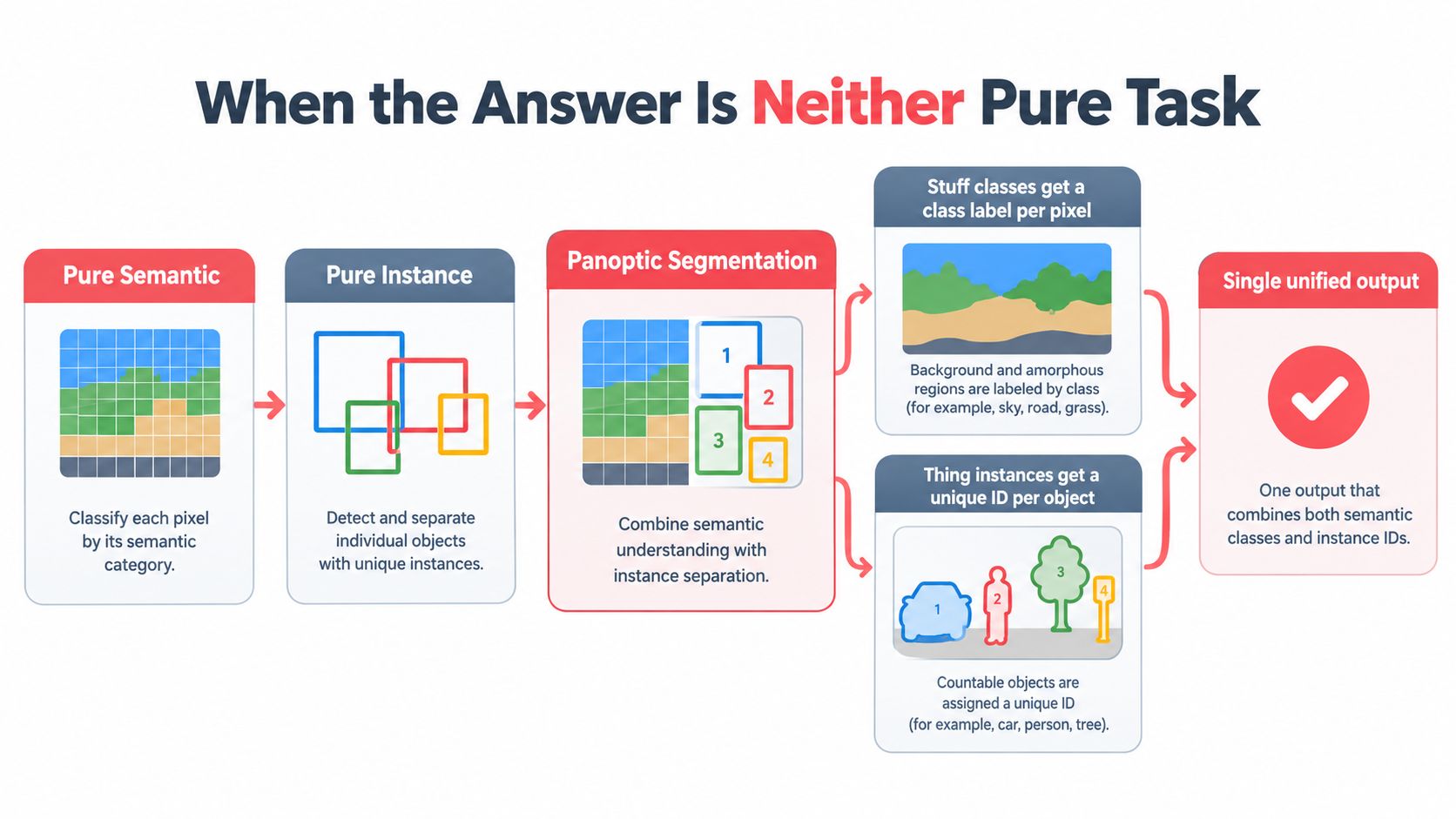
A staged pipeline can also work well. A semantic model handles broad background regions first, then an instance model runs only where object separation matters. For example, in an autonomous yard workflow, semantic segmentation can map pavement, grass, and buildings, while instance segmentation runs on forklifts, trailers, and workers. In retail, semantic labeling may define shelf zones first, then instance labeling identifies products only inside those zones. This can reduce labeling cost and simplify review because not every class needs the same level of object detail.
Hybrid setups do introduce extra decisions. Teams need rules for which classes are semantic only, which are instance-aware, and how conflicting outputs are resolved. They also need evaluation that reflects both region quality and object quality. If those rules are not set early, a hybrid pipeline can become harder to maintain than either pure approach.
Recent reviews also show segmentation moving toward diffusion-based methods, Segment Anything style workflows, and multimodal approaches, while still reinforcing a practical point: define the task around the business decision first. See the recent review of segmentation methods for more context.
Quick Decision Checklist
Use these checks before labeling starts:
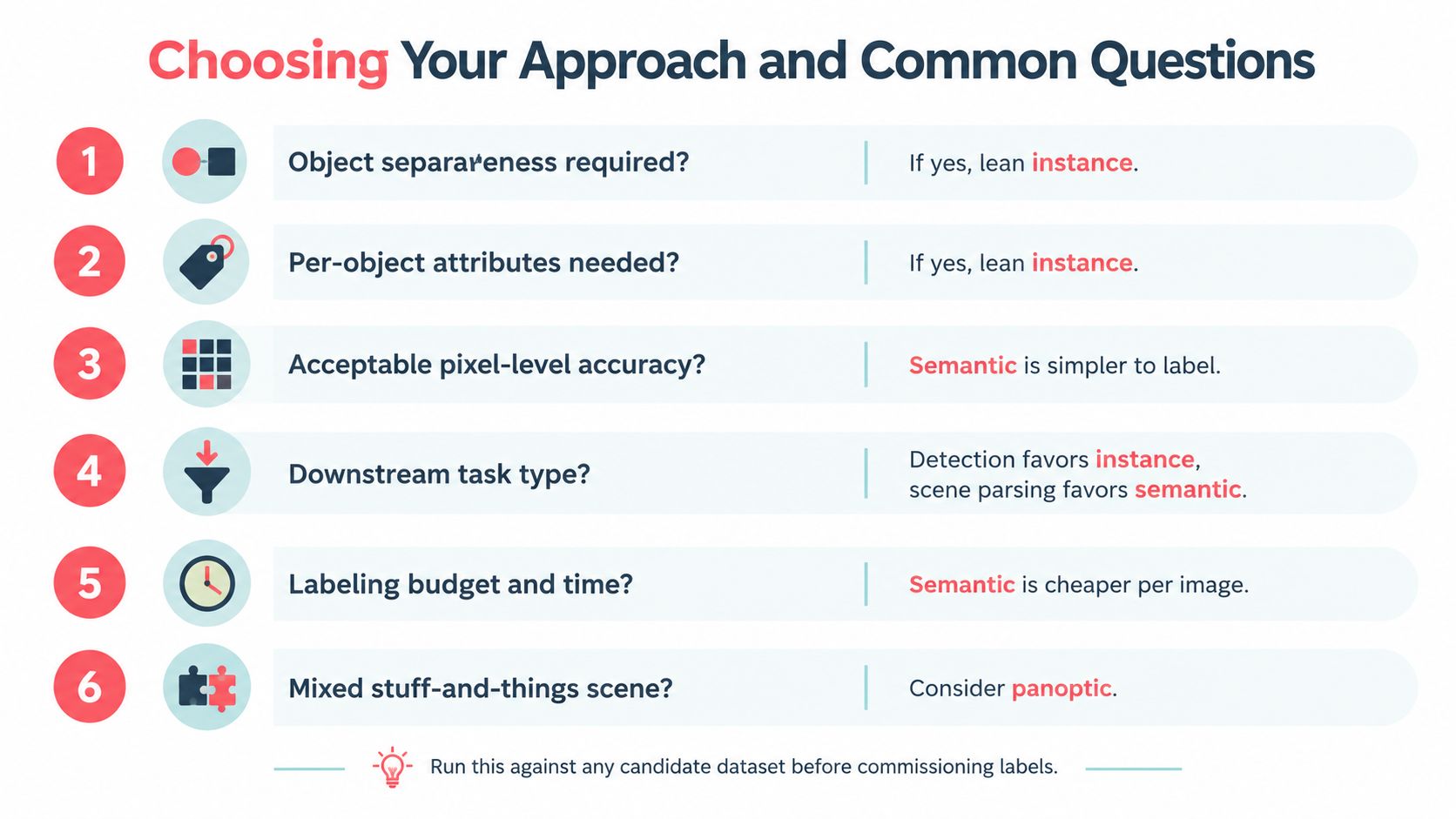
- If touching objects must stay separate, use instance labels for those classes.
- If each object needs attributes like defect, SKU, or track ID, use instance labels.
- If the decision depends on continuous regions, semantic labels are usually easier to specify and review.
- If the scene contains both broad regions and countable objects, consider a panoptic or staged pipeline.
- If annotation cost is a concern, test a small batch first and compare image time, QA disagreement, and export complexity across both approaches.
- If the end user cares about counts, object history, or object-level actions, do not assume a semantic mask will be enough just because it looks visually correct.
In our small-batch pilots, the surprise is usually in QA, not annotation. These were small pilots on specific datasets, not a controlled study, and results will vary with image type, class definitions, and reviewer training. Run your own comparison before committing.
Instance labeling looks harder on paper, but on both street and medical imaging projects, reviewers agreed with each other more often on instances than on semantic regions, because object boundaries were clearer than region boundaries. We would not have guessed that without running both.
The rule of thumb is simple: use semantic segmentation for regions, instance segmentation for objects, and a hybrid approach when your product needs both.
BUNCH has provided data labeling since 2017, building and managing human-in-the-loop teams for image, video, text, audio, and segmentation annotation. On segmentation projects, we run semantic, instance, and hybrid workflows. We start by agreeing on the rules before production (minimum object size, how occluded objects are masked, and where touching objects are split), then keep labels consistent with a written example gallery of ambiguous cases and reviewer QA. Our teams work from BGC, Manila and Cavite and have labeled data for healthcare, technology, infrastructure and etc. Coverage runs 24/7. If your team needs help defining the schema or running a semantic, instance, or hybrid labeling workflow, book a call with a BUNCH expert to start a conversation.
About the Author
Stay in the Loop!
Related Content

Scalable Data Labeling Solutions: Growing Teams Without Compromising Quality
Learn how to scale data labeling for ML without sacrificing quality through double-pass annotation, AI integration, dedicated teams, continuous training, and strong project management.

Data Labeling Company Guide for AI Teams
Learn what a data labeling company does, why quality matters, and how BUNCH helps AI teams with managed annotation, QA, and guideline ownership.

8 Managed Services Examples for Tech Operations
Explore 8 managed services examples across labeling, moderation, support, KYC and AI safety, with scope, SLAs, outcomes and practical lessons.