24/7 Customer Service: How to Actually Build It

At 2 a.m., a payment processor blocks a customer in Berlin. By the time someone in San Francisco sees the alert, the customer has disputed the charge and started looking elsewhere.
That is a coverage design problem. 24/7 customer service starts with deciding which problems need a human now, which can wait and who owns each case across shifts.
At BUNCH, we design and run that coverage for tech companies. Our dedicated support teams handle L1, L2 and technical support across chat, phone, email and social, working inside your existing tools. Team leads, workforce managers and QA specialists keep each shift accountable, so coverage holds through nights, weekends and holidays. We’ve been doing this since 2018 from our offices in Metro Manila and Cavite, and we pair AI-assisted workflows for routine questions with people who step in when a case is complex or sensitive. See how our customer support teams work. We sell this service, so test our advice against your own data and compare any provider on the same criteria.
What 24/7 Customer Service Actually Requires
Customers value round-the-clock access. In a November 2022 survey of 2,200 U.S. adults, 67% of chatbot users ranked 24/7 availability among chatbot support's top three advantages, according to Zoom's customer support expectations overview. But access does not mean staffing every inbox overnight. This figure comes from a survey of chatbot users, so it shows what those users value. Your own customers may weigh speed and human access differently, which is why we start with your data.
Classify requests by financial, safety and reputational impact, then account for customer context. A child-safety report should bypass the general queue; a routine profile change need not wake an agent.
If someone could lose money, access, safety or trust within an hour, plan for human coverage.
For more on routing and escalation, see these enterprise 24-hour support strategies. Apply them to your own failure modes rather than offering the same response target for every request.
Choose a Coverage Model
Customer expectations for speed are high, but the right coverage model depends on your risk, volume and team footprint, not on matching a headline figure.
Keep sensitive policy decisions close to the product team. Our teams work inside your policies. Decisions such as refund limits, policy exceptions, account closures stay with your team and we escalate those with the full case history attached so nobody repeats themselves. Outsource repeatable work only after documenting its boundaries. If you need external capacity, use customer support outsourcing for technology companies as a starting point for defining that scope.
Make Shift Handoffs Explicit
Schedule 30 to 60 minutes of overlap. The outgoing agent owns a case until the incoming agent accepts it; fresh tickets go to the new shift. Each handoff should identify:
- The named owner and next action
- The latest customer message and any promised deadline
- Active incidents, severity and incident lead
- Pending specialist decisions and next-shift triggers
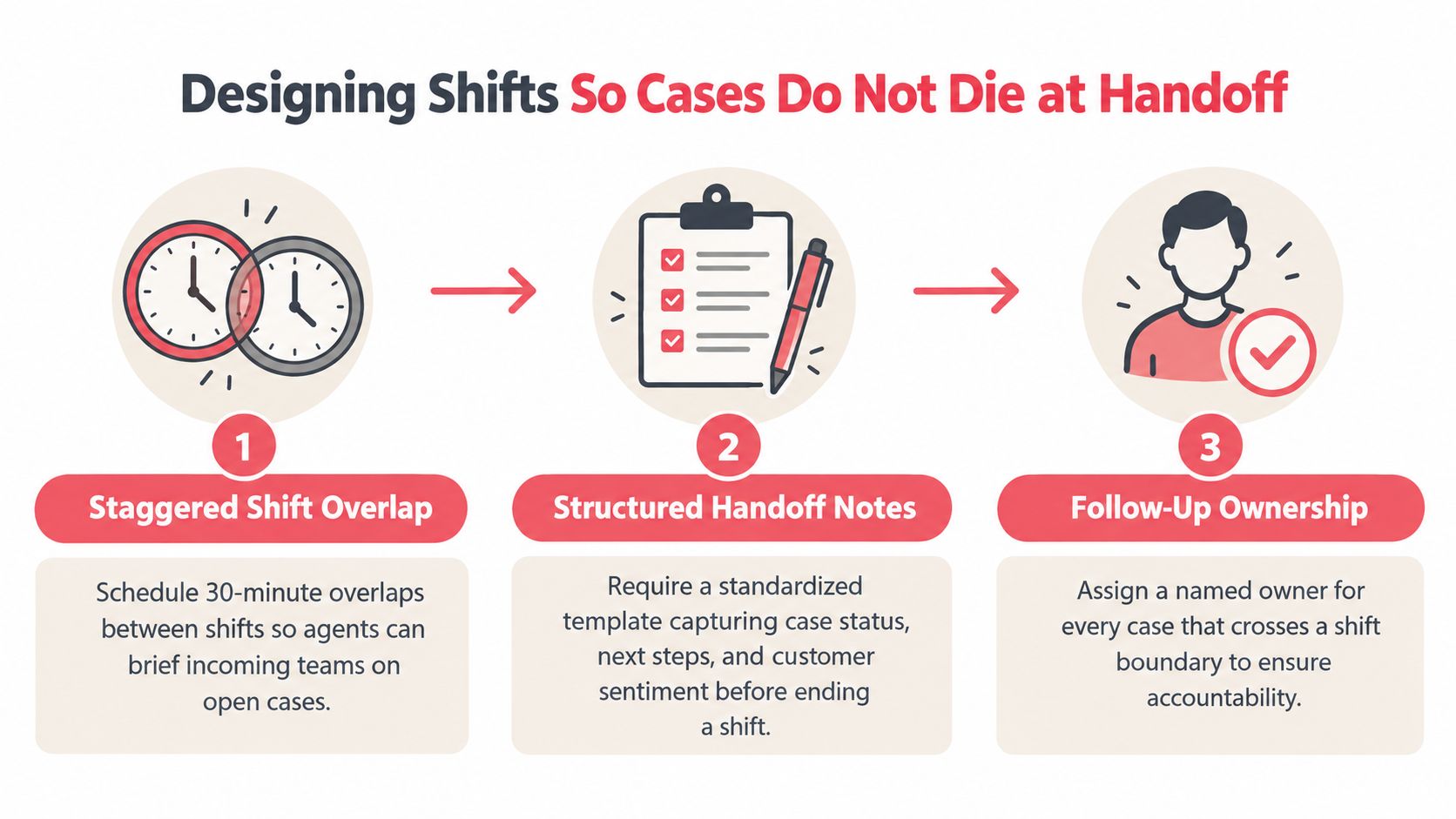
Those details keep a case from losing continuity while it appears covered. Document language coverage too: translation may help routine requests, but sensitive cases need a clear path to a qualified human.
Set SLAs for Response and Resolution
First response means a useful acknowledgment with an owner. Resolution means the issue is fixed, explained or assigned a documented next step. Set separate targets by tier, channel and customer segment.
Customers increasingly expect an immediate response, and many define “immediate” in minutes, not hours. Use that expectation to test your capacity, not as a promise to publish automatically. If you run live phone queues, set the answer-time target from your own risk tiers and staffing, not from a generic benchmark.
Track missed targets, queue age, abandonment and repeat contacts together. For measurement ideas, see this service-level agreement and KPI guide and customer service standards framework.
Use AI to Route, Not Block
Automate documented requests such as password resets and order status. Use AI to collect context and route complex work. Send fraud, safety reports, chargebacks, lockouts and outage impact to a human, preserving the conversation and actions already taken.
A 2025 analysis reported 88% satisfaction with human-led digital interactions, versus 60% with AI-only interactions; 72% were open to AI when human escalation was available, according to Customer Experience Dive's analysis of AI and human support.
Automate routine demand. Route complex demand. Escalate sensitive demand.
Review cases where customers contact support again after an automated answer. They expose failures in content, routing or escalation. Our team leads review cases where a customer came back after an automated reply, then update the answer or the routing so the next customer gets it right the first time.
Watch Coverage Quality After Launch
Review first response by tier, time to human, repeat contact rate and after-hours resolution quality every week. Also watch urgent queue age, abandonment, AI escalation and overtime. A team can hit response targets for a while by exhausting its agents. Our workforce managers plan shifts around the volume we see by hour, so overnight agents have the support and rest they need to stay sharp.
Give social support its own queue. Customers expect public replies quickly, and public complaints and safety reports may need faster triage than private tickets.
Track shift, channel, tier, owner, response time and reopen reason to spot weak handoffs.
Before You Commit
Should you outsource? Outsourcing isn’t right for every team. If your product changes weekly and your policies aren’t written down yet, start by documenting them, or run a small pilot first. We’d rather you launch with clear rules than discover the gaps after go-live. Keep high-risk decisions internal; outsource defined, repeatable processes you can monitor.
How should you evaluate a provider? When you evaluate any provider, ask four things: who owns each case across shifts, how escalation works for fraud and safety reports, what QA reporting you’ll receive and how often, and what a pilot will measure before you commit.
What should the first 30 days look like? Classify demand in week one. Set targets, channels and escalation rules in week two. Then run a 14-day pilot and measure response, time to human, repeat contact and after-hours quality before expanding. At the end of every pilot, we sit down with the client to review what the first two weeks showed, and adjust escalation rules and tier definitions before scaling up.
BUNCH builds and manages human-in-the-loop teams for customer support, content moderation, trust and safety, KYC and AI operations. If you need help designing shifts, escalation ownership or managed delivery, book a call with a BUNCH expert to start a conversation.
About the Author
Stay in the Loop!
Related Content
Call Center Outsourcing: How to Plan, Evaluate and Run It
Plan, evaluate, and run call center outsourcing with a clear framework for vendor selection, SLAs, 24/7 coverage, training, and quality assurance.

Customer Support Outsourcing How to Choose and Onboard
Learn customer support outsourcing step by step — evaluate partners, set SLAs, compare cost models and integrate 24/7 chat and voice without losing quality.

How AI Is Changing the Human Side of Customer Support
With AI and automation now part of everyday support structures, the role of humans, and the nature of the work they handle, has evolved dramatically.