AI Managed Services Explained for Growing Tech Teams

You know the problem. Volume rises, edge cases stack up, QA spills into roadmap time, and every vendor pitch sounds identical.
AI managed services are outsourced teams that run defined AI operations under clear scope, QA rules, and service expectations. They are not just software, a freelancer bench, or a labeling platform you still have to manage.
If you're weighing moderation, data work, AI validation, or support operations, the real question is simple: can a managed team take over the operating burden without hurting quality or control?
That's the question we work on every day at BUNCH. Our teams in Metro Manila and Cavite run labeling, moderation, support, KYC, and AI validation 24/7, so we've seen where managed delivery works and where it doesn't. This guide walks through both. We're BUNCH, a managed services firm in Metro Manila and Cavite, and we run data labeling, content moderation, customer support, KYC, and AI validation queues for high-growth tech companies, 24/7.
Introduction to AI Managed Services
The model is straightforward. You hand off a recurring workflow. The provider owns staffing, training, supervision, QA, and daily execution within agreed rules.
That matters once volume is real. A few hundred edge cases a week can stay in-house. A constant stream of tickets, labels, moderation decisions, or review queues usually cannot.
What the term actually means
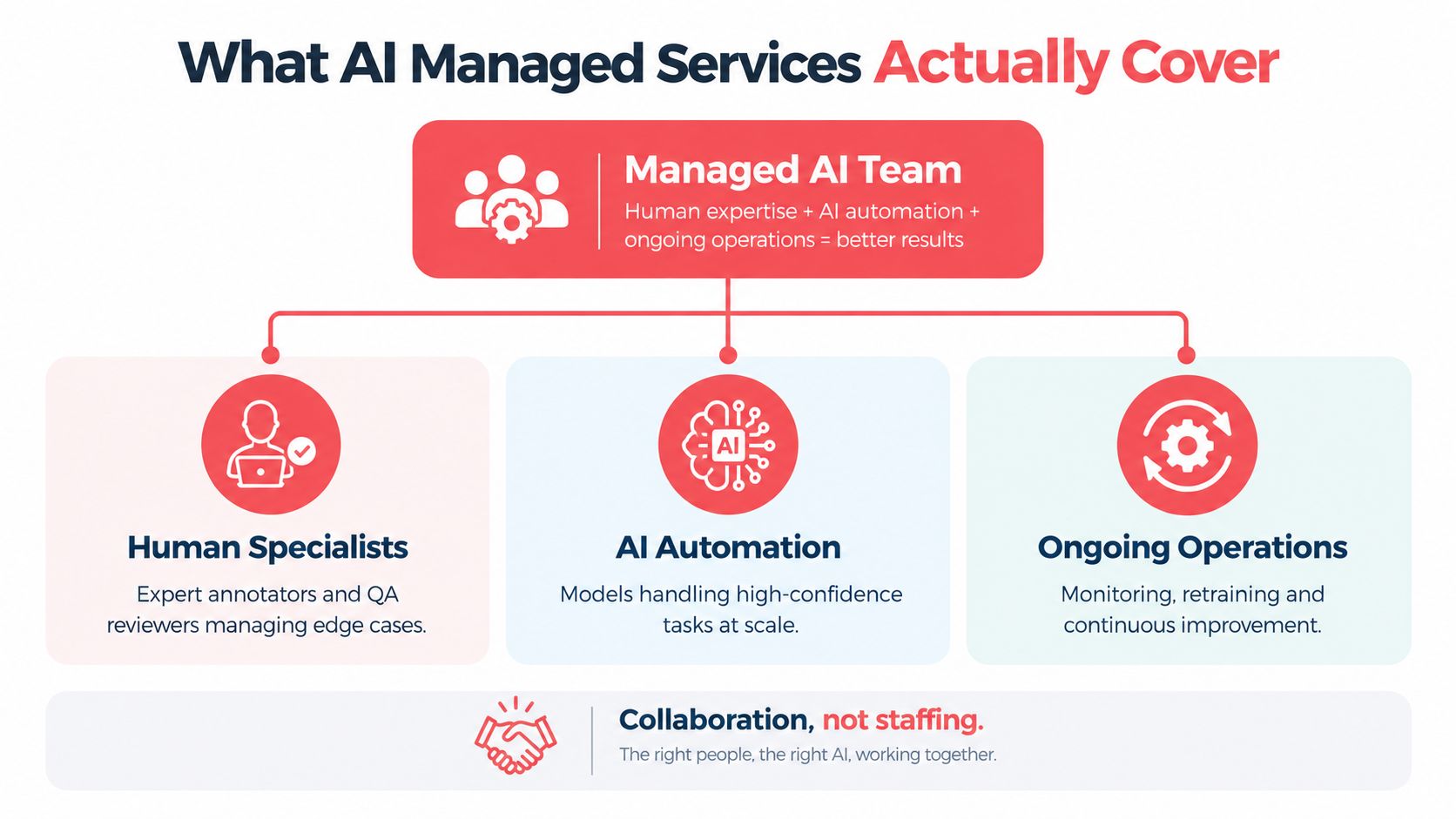
Most AI managed services are really a human-in-the-loop operating model. Models handle easy or high-confidence work. Humans handle review, exceptions, policy judgment, calibration, and feedback. The managed part is the operating layer around that system.
Practical rule: If the work needs staffing plans, QA checks, escalation paths, and coverage windows, you need a managed service, not just a tool.
Grand View Research projects the managed services artificial intelligence market at US$93.3 billion in 2025, reaching US$1.205 trillion by 2033, with a projected 36.5% CAGR from 2026 to 2033 according to its artificial intelligence managed services market forecast. The takeaway: teams are scaling AI through managed delivery, not just software licenses.
Who this is for
This model usually fits when:
- Volume is unstable and internal hiring cannot flex fast enough
- Quality matters because bad labels, moderation calls, or support responses create downstream risk
- Coverage matters because users submit content and tickets outside business hours
- Internal specialists are overloaded and spending too much time managing repetitive work
If your process changes every week, policies are still undefined, or the task is tied to product discovery, outsourcing is usually the wrong answer. Managed delivery works best when the work is repeatable, trainable, and measurable.
What AI Managed Services Actually Cover
Most buyers do not need another vague definition. They need to know what managed actually changes.
A managed team is closer to an operations function than a tool rental. You are not buying labor hours. You are buying execution with oversight.
Managed team versus marketplace versus platform
A staffing marketplace gives you people to manage. You still write SOPs, train them, monitor output, and fix drift.
A platform gives you workflow software, but your team still owns queue design, reviewer management, audit logic, and escalations.
A managed service owns the operation within an agreed scope. That usually includes:
- Workflow ownership of the queue, daily execution, and exception handling
- Training and calibration so reviewers apply the same standard
- Quality control through sampling, audits, dispute handling, and retraining
- Coverage planning so the queue is staffed when demand spikes
The difference is accountability. A tool processes tasks. A managed team owns how the work gets done.
Why this matters for fast-growing tech teams
ML leads and heads of trust and safety rarely fail because they picked the wrong interface. They fail because no one owns the operation end to end.
That is what companies like BUNCH are built around. BUNCH, founded in 2017, is a boutique managed services firm that builds custom outsourced teams for high-growth technology companies, with offices in Metro Manila and Cavite in the Philippines. Its model is managed human specialists working alongside AI across workflows like data labeling, content moderation, customer support, KYC, and AI validation.
A simple test: what happens when the queue gets weird on a Tuesday night? If the answer is "your internal lead jumps in and cleans it up," you do not have a managed service. You have extra capacity.
Core Managed Pipelines You Can Outsource
The easiest way to judge fit is to look at real pipelines.
Data and model support workflows
Data labeling and annotation
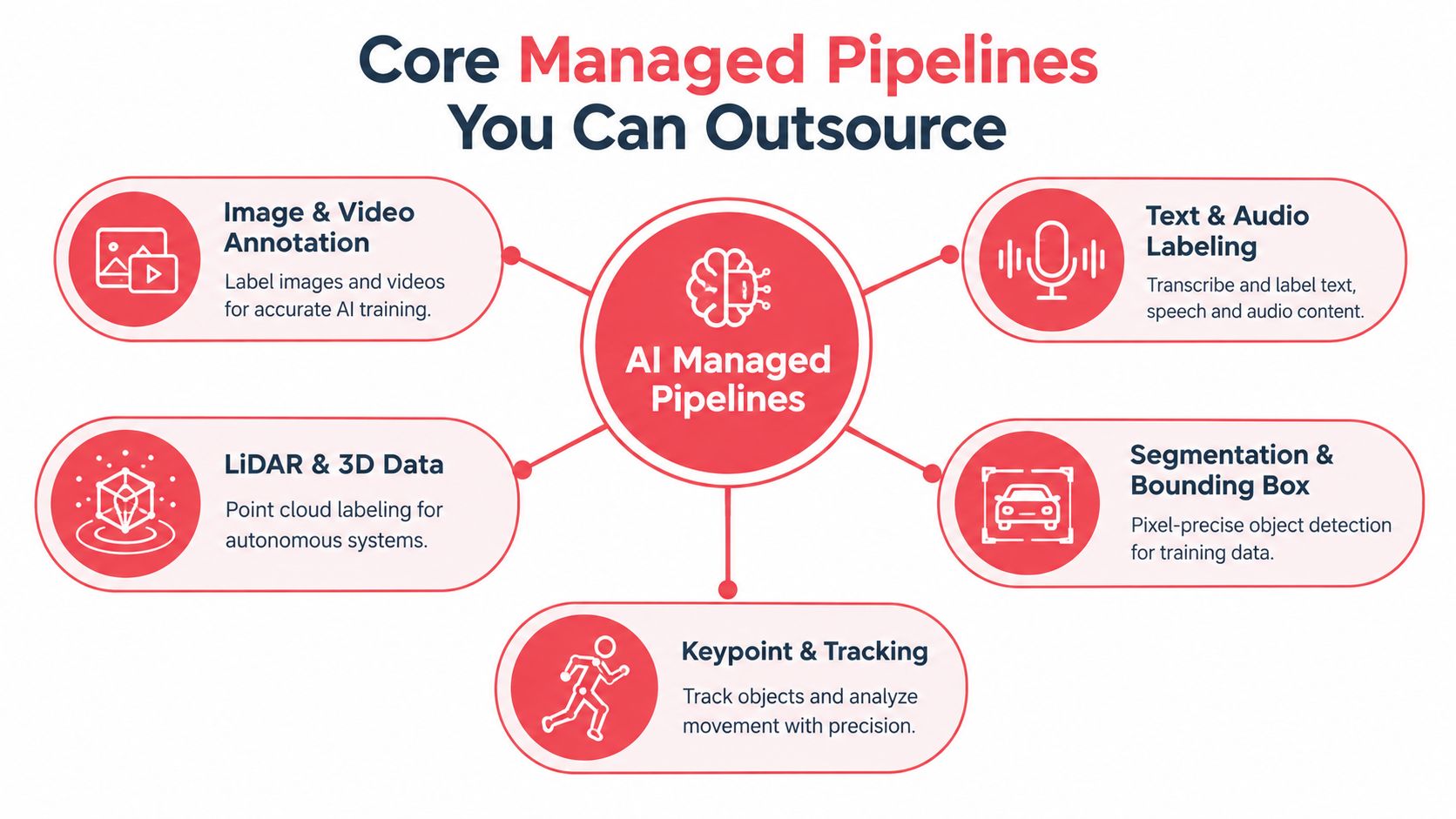
Input comes in as image, video, text, audio, or LiDAR data. Human specialists label, segment, tag, transcribe, or validate it. QA reviewers audit samples and resolve disputes before the dataset returns to your ML pipeline. If you're evaluating model training operations, this LLM model fine-tuning services page shows the kind of managed human review work that often sits around fine-tuning and validation.
Most disagreements between reviewers aren't about carelessness. They come from one vague line in the guidelines. On one project, two good reviewers kept labeling the same kind of image differently because the instructions never said what to do with partially hidden objects. Neither was wrong. The fix was a single paragraph and three annotated examples, not more training.
AI safety, model evaluation and validation
A model produces outputs, reviewers score them against guidelines, edge cases get escalated, and the results feed back into prompt tuning, policy updates, or evaluation sets. This matters when correctness depends on policy, risk tolerance, or nuanced judgment.
If you're tightening the handoff between ingestion, review, and downstream ML systems, it also helps to understand the broader workflow design behind a data pipeline automation guide.
User operations workflows
Content moderation and trust and safety
Automated systems filter obvious cases, human moderators review ambiguous or policy-sensitive material, and actions are logged for enforcement and appeals.
Customer support and CX
AI drafts responses or handles simple requests, then agents step in for account-specific, emotional, or high-risk interactions.
KYC verification
Customers submit identity documents or onboarding details. Reviewers verify completeness, flag mismatches, escalate suspicious cases, and produce a final outcome inside your compliance rules.
Community management
Teams monitor Discord, Telegram, in-app forums, or social channels, answer common questions, flag abuse, route product issues, and keep the tone stable during spikes.
What usually stays in-house
Keep these in-house, especially early on:
- Policy design when rules still change weekly
- Model strategy when the task affects core product differentiation
- Sensitive exception authority when only internal leaders can make the final call
- New workflow discovery when no one yet knows what good looks like
Outsource the repeatable operation. Keep unstable judgment close until it matures.
How Quality and Coverage Work in Production
The gap between a safe managed workflow and a messy one is usually not the model. It is the review design.
Human review should sit at decision thresholds
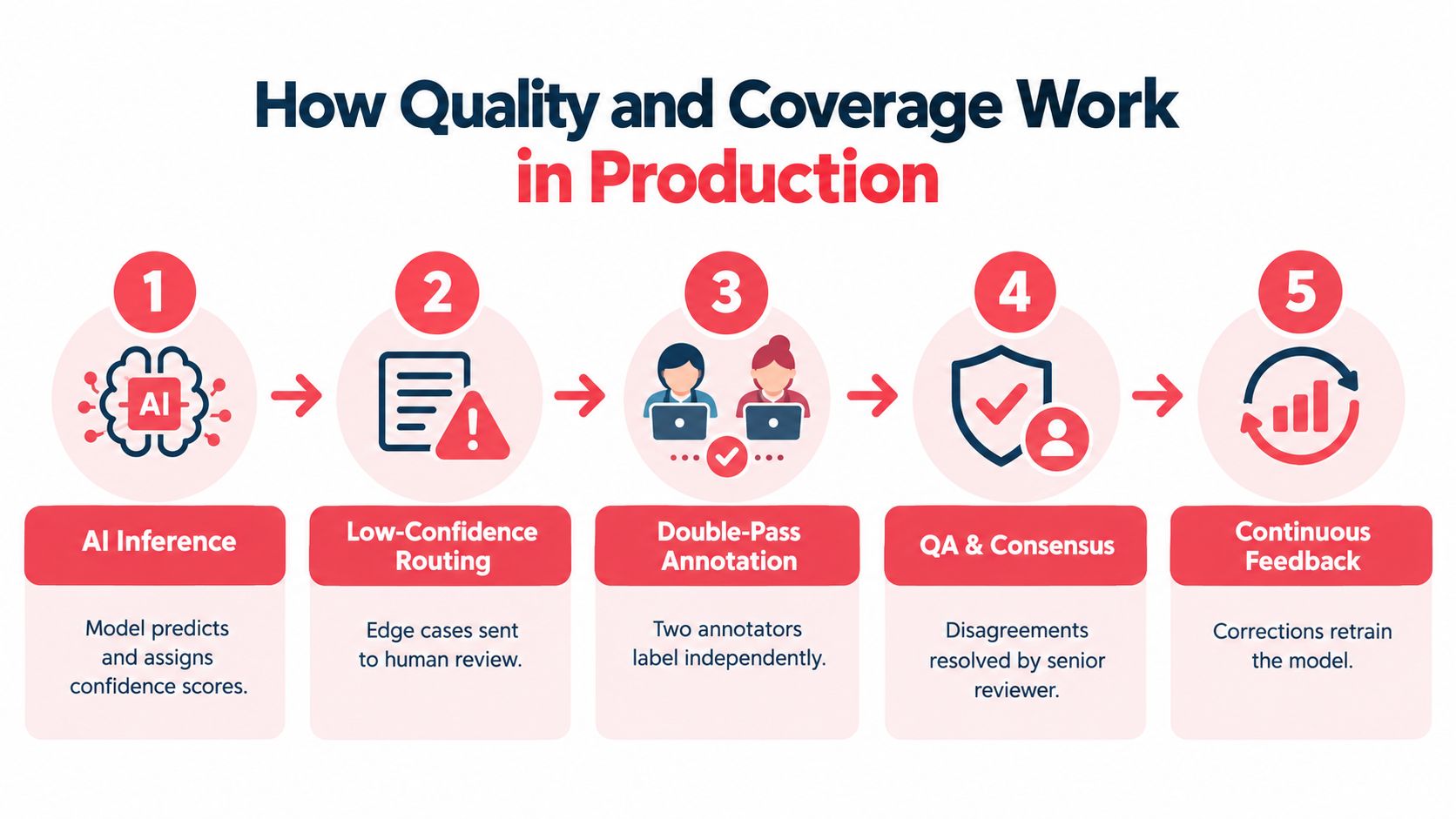
Low-confidence, disputed, or unusual items should route into a human queue by design. That keeps uncertain cases from contaminating training data or triggering bad production actions.
If reviewers only appear at the end as cleanup, the system usually breaks under volume.
What good production controls look like
Strong managed workflows usually include:
- Confidence-based routing so not every item gets the same treatment
- Double-pass review on a subset to detect drift and unclear instructions
- Senior adjudication for disputed or high-risk cases
- Weekly calibration so policy changes reach the queue
- Feedback capture so corrections improve prompts, policies, or models
xEarly in one moderation engagement, we treated calibration as a monthly meeting. Then the client changed a policy on a Thursday, and by the following week half the queue was still applying the old rule. Now policy changes go to the whole team the same day, and the next batch of decisions gets an extra review pass.
For CX and trust and safety work, Parloa's discussion of human-in-the-loop AI in customer operations is useful because it frames humans at decision thresholds, not as a last-resort manual fallback. It also points to production metrics like FCR, CSAT, cost per resolution, accuracy rate, attrition, and AI-QA coverage, which is how operators judge system health.
Coverage is an operating decision, not just a staffing one
Twenty-four hour coverage is not just about having people online. It is about queue handoffs, escalation rules, language coverage, and what happens when volume shifts.
The hardest hour for any queue is the handoff. On one support account, our evening lead started ending each shift with a short note listing open escalations and anything waiting on the client. The night team no longer had to guess what was urgent, and the client's morning started with answers instead of questions.
If your moderation backlog creates user harm overnight or your support queue affects retention across time zones, you need follow-the-sun operations with clear ownership at each handoff. If volume is low and mostly daytime, full-time coverage may be wasteful.
When you're trying to make your data platform more reliable, the same principle applies. Reliability comes from process controls around the data, not just from the model on top.
Choosing the Right Engagement Model
Not every outsourcing model solves the same problem. Some give you labor. Some give you software. Some give you an operation.
A quick way to compare them is to ask who owns quality and who gets called when output drifts.
Managed Teams Versus Other Ways to Scale AI Operations
How to decide
Use a managed team when the work is repetitive enough to document, risky enough to require QA, and large enough to justify a dedicated operating layer.
Use staff augmentation when your internal process already works and your managers can absorb more direct reports.
Use a platform when process control is your bottleneck and you already know how to run the operation.
If you're still deciding how a managed service model works in practice, this overview of the managed services model is a useful reference.
Decision shortcut: If your team spends more time managing the work than improving the system, a managed model starts to make sense.
When outsourcing is the wrong answer
Do not outsource if:
- Your policy is unsettled and changing faster than anyone can train against it
- The task is core product R&D and close coordination matters more than throughput
- You need direct founder-level judgment on most edge cases
- You do not have a stable owner internally to define scope and review results
A provider can run a workflow. It cannot invent your operating philosophy.
Pricing Governance and When to Use Managed AI Services
Two buying questions get skipped too often: how should this be priced, and when is it safe enough for serious workflows?
Pricing is changing faster than operations
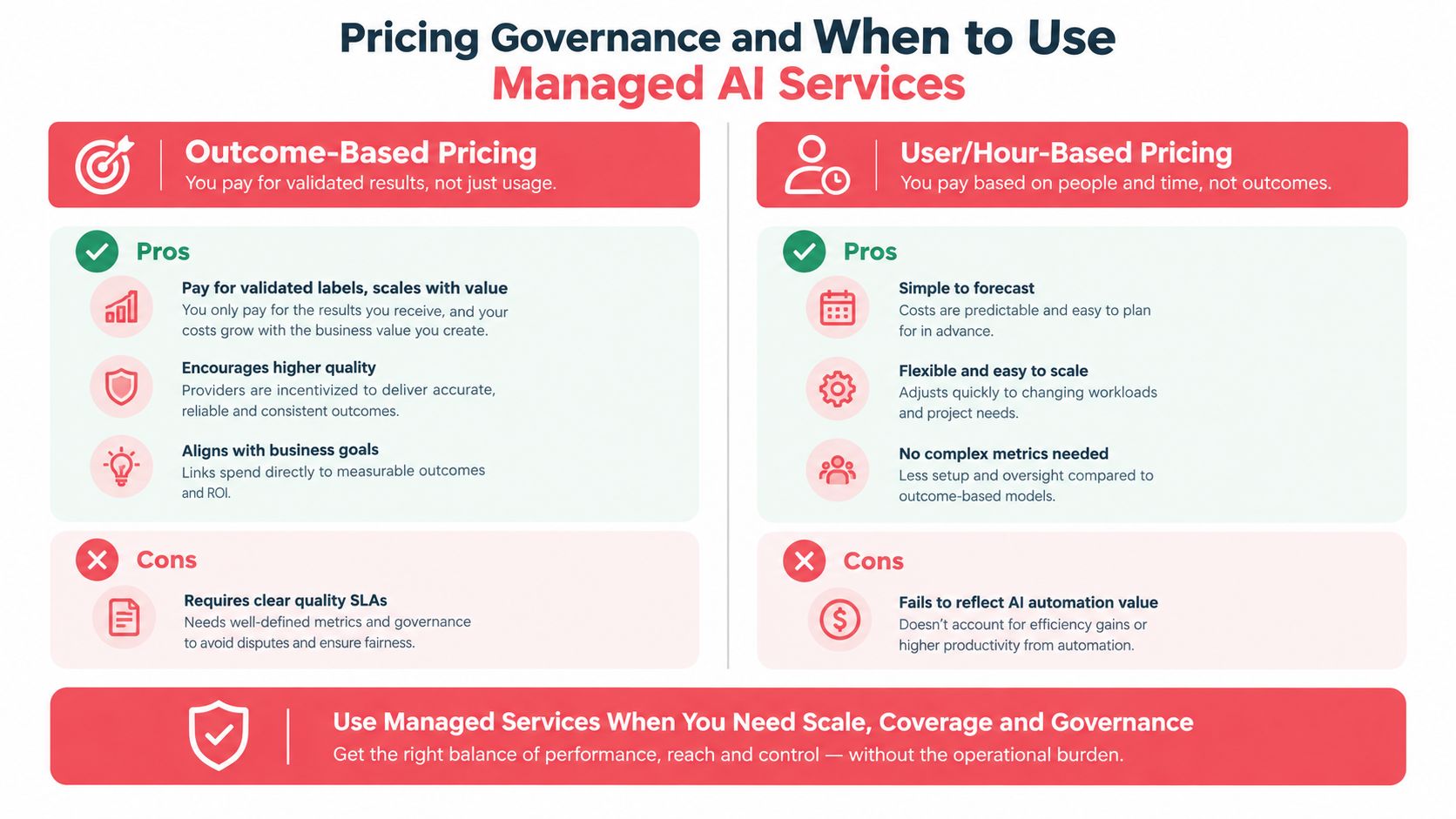
Traditional user-based, hour-based, or cost-plus pricing fits AI-heavy workflows poorly. If automation reduces manual effort, the old model can punish efficiency.
TSIA's 2026 research in its State of Managed Services 2026 says traditional pricing models fail to reflect the value AI creates. The same research says 48% of MSPs rank AI as the top client need for 2026, but only 13% are generating meaningful revenue from it, which shows a 35-point monetization gap. For buyers, that means asking what you are paying for: headcount, hours, validated outputs, review coverage, or business outcomes.
Governance decides whether the model is usable
For high-risk workflows, the blocker usually is not AI capability. It is messy data, uneven controls, and weak escalation design.
KPMG's 2025 and 2026 managed-services research in its piece on scaling enterprise AI with managed services says adoption is being held back by fragmented data, inconsistent integration patterns, tool sprawl, and gaps in governance and risk management. KPMG also reports that more than 90% of executives see managed services as essential for agentic AI delivery, and that 53% of MSPs are already using AI for ticketing, patching, and monitoring, though most have automated only about a quarter of their workload.
Use managed AI services when these conditions are true
- The workflow is defined enough to train and audit
- Human review thresholds are explicit for low-confidence or high-stakes decisions
- QA is visible and not buried inside black-box claims
- Escalation authority is clear for exceptions and appeals
- Your internal team can still govern policy even if they do not run the queue
Mordor Intelligence also projects the agentic AI managed services market at $4.12 billion in 2026 and $28.45 billion by 2031, a 47.18% CAGR, and values AI governance managed services at $1.7 billion in 2026 and $16.1 billion by 2036, growing 25.6% annually, according to its agentic AI managed services market report. The takeaway is not that every company should outsource agentic workflows. It is that governance and supervision are becoming their own managed category because buyers need real operating controls.
Making AI Managed Services Work for Your Team
The best buying process is boring. That is good.
Start with a narrow workflow. Define the input, the action, the exception path, and the output your team needs back. If a provider cannot explain the review path for ambiguous cases, stop there.
A short checklist that saves time
- Scope first so both sides know what is inside the service and what is not
- QA second because quality drift usually breaks the relationship
- Coverage third since 24/7 only matters if your queue really needs it
- Integration fourth because tool-agnostic matters only when handoffs are clean
A good provider should be able to show how reviewers are trained, how disagreements are handled, and how feedback gets back into your process or model.
Ask for the operating logic, not just the service menu.
Three common questions
Is this only for large enterprises
No. It is often a fit for Series A to Series C companies that have real volume but do not want to build a full operations layer in-house.
Will we lose control
You should not. A sound model keeps policy, escalation authority, and business rules with your team while the provider runs execution inside those boundaries.
How much oversight will we still need
Some. Managed does not mean unattended. You still need an internal owner who can review outputs, update guidelines, and decide what to do when the workflow changes.
The most common reason a pilot struggles isn't the team's quality. It's that nobody on the client side has been given authority to decide edge cases. Reviewers escalate, the escalation sits, and the queue backs up. We now ask in the first week: "Who makes the call when this is ambiguous?"
If the workflow is stable, the risk is operational, and the internal team is stretched, AI managed services can be the right answer. If the work is still undefined or experimental, keep it close.
BUNCH builds managed teams for data labeling, content moderation, customer support, KYC, and AI safety work for high-growth tech companies, with human specialists working alongside AI under structured QA and coverage models.
If you're trying to decide whether a managed team fits your workflow, you can book a call with a BUNCH expert and see whether the model matches the kind of operational burden you're carrying.
About the Author
Stay in the Loop!
Related Content

Operational Frameworks for AI Evaluation Beyond Benchmark Scores
When it comes to AI model evaluation, enterprise technology leaders are fast discovering that benchmark scores alone are insufficient in predicting real-world reliability.
Service Level Agreement KPI Guide for Operations Teams
Master every service level agreement KPI that matters for support, moderation, and data operations. Includes targets, formulas, and sample SLA clauses.

Our Managed Services Model
Learn how our managed services are designed to shoulder all operational responsibilities, offering clients streamlined, process-based operations under a flat monthly fee, allowing them to focus on growth.