E-commerce Customer Service That Protects Revenue


Your queue is not full because customers love asking where their order is. It's full because a carrier missed a scan, a refund is stuck or a return portal rejects an address. Routine questions clear quickly. Exceptions get reopened and consume the day. Strong e-commerce customer service starts by designing for those exceptions.
At BUNCH, we run managed e-commerce support teams. Our teams handle customer support, order management and catalog management for e-commerce brands and marketplaces, and we cover 24/7 across time zones, with custom shifts if you only need part of the day. We have operated from the Philippines since 2017. Our agents plug into your existing CRM and helpdesk, and we train them against your QA standards and audit their work as part of the service. Below is how we’d design e-commerce support around exceptions, and where outsourcing does and doesn’t make sense.
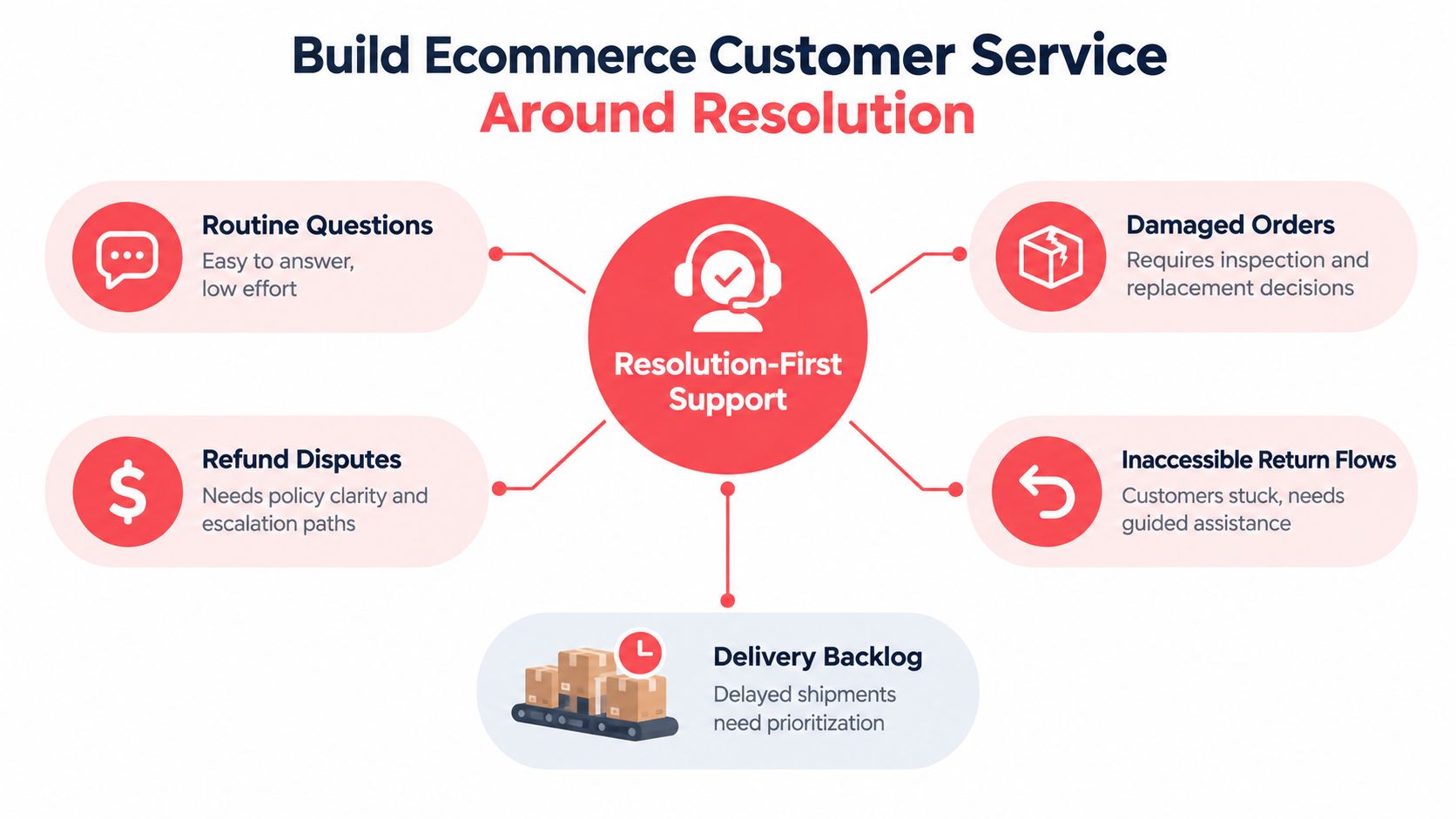
Build E-commerce Customer Service Around Resolution
Dependable support combines clear policy, order-level evidence, authority to resolve and a human route when automation cannot decide. If an agent can see the order but cannot approve a replacement, you have a message relay, not a resolution process.
During a peak week, macros may clear tracking questions while damaged items, partial deliveries and refund disputes pile up. Each case touches money, stock or a carrier claim. Without a named decision-maker, tickets bounce between teams and customers write again.
Ticket volume does not tell you whether anyone finished the work. An older e-commerce customer service benchmark report illustrates the cost of unanswered questions: shoppers can abandon a planned purchase when service falls short. Focus on whether each delivery or returns case reaches an outcome.
Practical rule: If the person replying cannot finish the case, the workflow is unfinished, however polished the reply sounds.
For every exception, define who decides, what evidence they need and where the case goes when the standard answer fails.
Route Customers to the Right Resolution Path
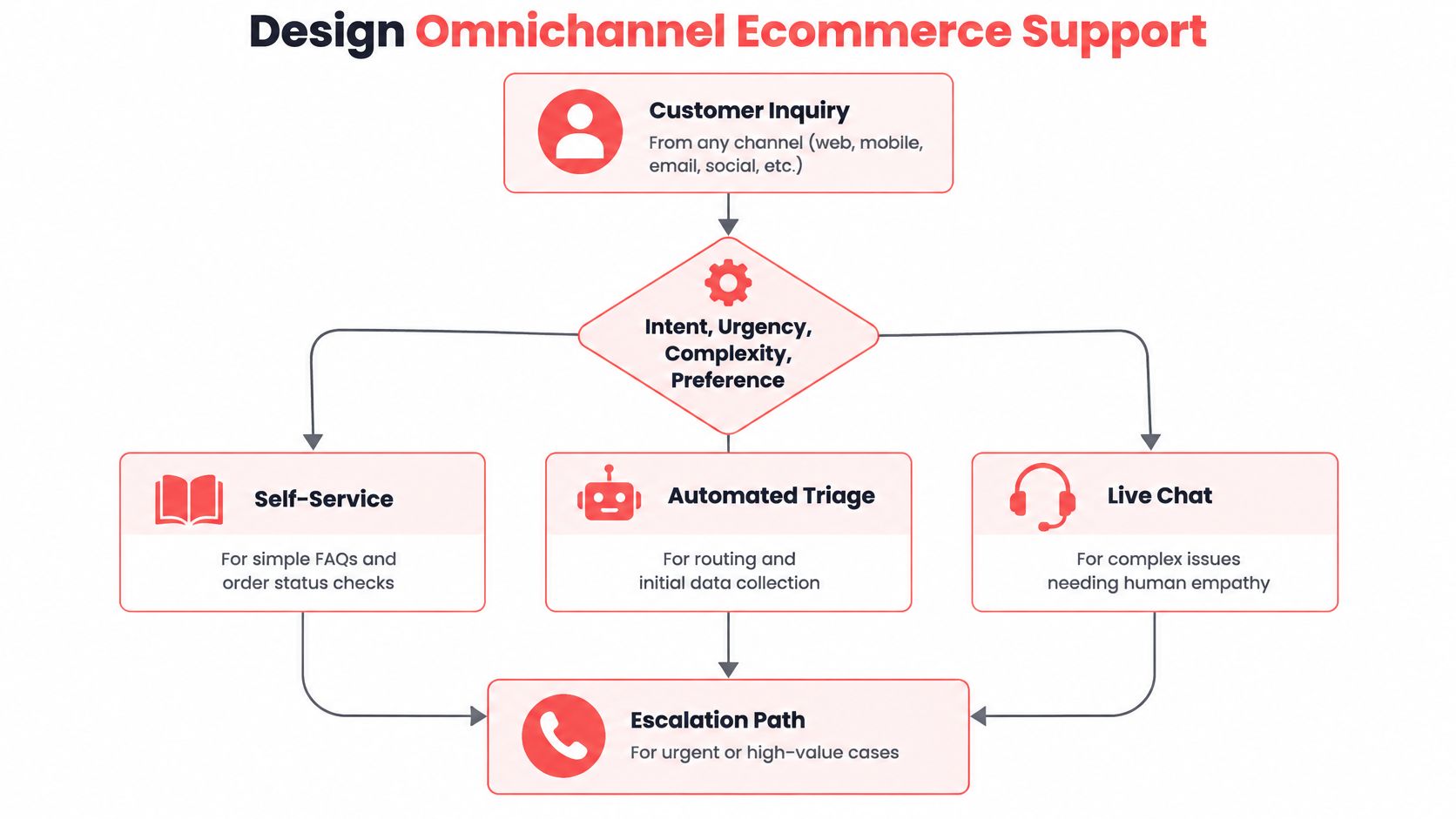
Organize support by intent, urgency and complexity, not just by channel. A returns-policy question may need self-service. A shopper choosing a size may need live chat before checkout. A damaged high-value order needs photos, identifiers and a written record.
Human help can matter before purchase. Digital Commerce 360's survey summary links access to chat, email and phone support with shoppers' willingness to buy. Keep a human route for questions that need an answer before checkout.
Measure waiting to connect separately from waiting for a useful answer. Routing addresses connection delay; knowledge and decision authority address answer delay.
At handoff, the next agent should see the order, prior messages, authentication state and what automation tried. Accessibility also needs an assisted path: AccessiWay's survey documents how digital barriers can interrupt customer processes. Let agents help with failed forms and explain policies in plain language. Escalate ambiguity, accessibility needs, suspected fraud and sensitive refunds to trained people.
A ticket marked “handled” doesn’t always mean the issue is resolved. Our team at BUNCH sees how incomplete notes can lead to reopened tickets, especially when customers have to repeat their story to a second agent. That’s why we make clear documentation a priority. Every note should explain what was tried, what the customer was told and what needs to happen next. The result? Smoother handoffs, fewer repeated conversations and a better customer experience.
Make Returns and Refunds Predictable
Returns deserve a production workflow. The NRF returns projection shows their scale, while a UPS summary of returns research links return policies and experiences to purchase decisions. Explain the policy before checkout, then make each refund or exchange traceable after purchase.
Use one sequence for every return
- Identify the order: Authenticate the customer and confirm items, prices and delivery records.
- Check eligibility: Apply the policy version in effect at purchase and record the deciding rule.
- Explain the outcome: State the refund or exchange, customer cost and expected timing.
- Issue the method: Provide a usable label or drop-off instruction.
- Capture evidence: Request photos or identifiers immediately for damaged and high-value items.
- Update the order: Make refund and exchange status visible to the next agent.
Separate straightforward returns from exceptions. A verified, policy-compliant return should move quickly. Damaged goods, partial deliveries and high-value disputes need evidence and a named approver. Give agents written refund limits, return-shipment waiver rules and escalation triggers.
Track refund cycle time, exchanges and repeat contacts alongside handle time. A faster ticket is not an improvement if the customer still has no refund.
Own Delivery Exceptions Beyond Tracking
A tracking link reports what the carrier claims happened. Support still needs to decide what to do when that record conflicts with the customer's experience. Eurostat's e-commerce statistics for individuals documents delivery problems and unsatisfactory complaint handling, but the operating question is who owns the next step.

For a parcel marked delivered but missing, check the promised date, scan location, delivery photo and confirmed address. If evidence supports a misdelivery, reship or refund under your policy. Open a carrier claim in parallel rather than making the customer wait for the carrier's investigation.
- Late with no recent scan: Send a revised date and state what happens if it slips.
- Misdelivered: Review scan evidence, then reship or refund under policy.
- Damaged or incomplete: Collect photos or item-level pick records; replace or refund the affected item.
- Porch theft claim: Review delivery evidence and account history before deciding.
Support owns the customer outcome and evidence log; operations owns the carrier relationship; payments executes refunds. Outsourced e-commerce order management support can help with order-level follow-up when those responsibilities and decision rules are clear. Proactively contact customers when carrier data shows a stall. Silence creates another ticket.
Choose a Support Model You Can Govern
In-house support keeps policy control and product feedback close, but makes hiring, overnight coverage and seasonal demand your responsibility. Hybrid support retains sensitive work internally while assigning defined queues or overflow to a partner; its weak point is handoff quality. A managed partner can run a bounded workflow with supervision and QA. At BUNCH, our e-commerce teams are full-time dedicated agents; shifts can be set to cover a set window or run 24/7, with QA audits included but only once the client’s policy, evidence standards and escalation limits are written down.
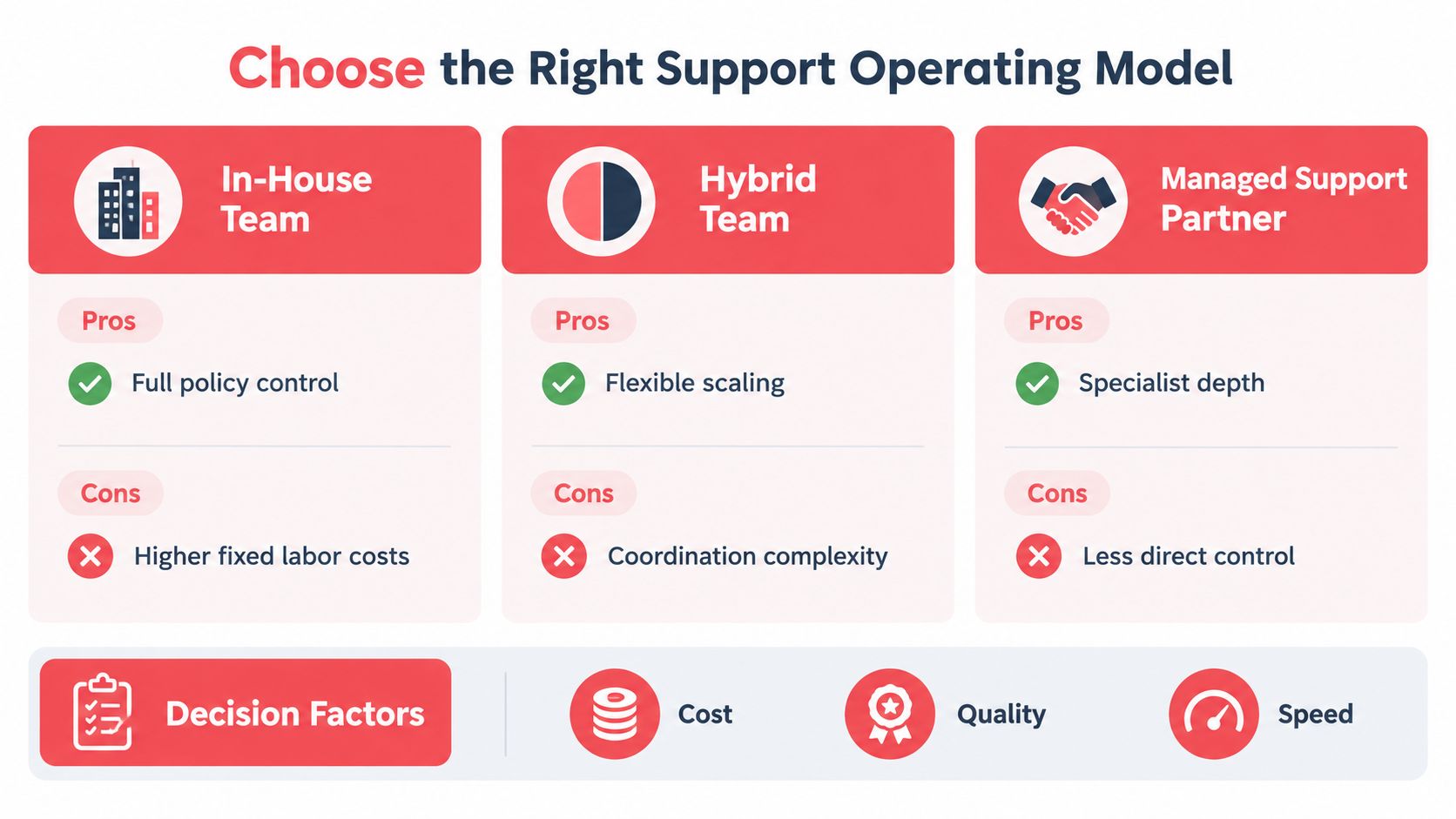
Outsourcing is a poor fit when refund policy changes constantly, documentation is weak or savings disappear after oversight and QA. A managed team amplifies operating clarity; it cannot supply rules you have not defined.
Language coverage also needs testing against real disputes, not just a feature list. Tools offering fast multilingual help for e-commerce may assist routine questions, while returns disputes and fraud-sensitive cases still need judgment about evidence and tone.
Start with one stable queue and written acceptance criteria. In the first week of a new returns queue, we have agents shadow the client’s own approver on live cases instead of working from the policy document. The policy says what the rules are; shadowing shows where people actually bend them. Sample cases weekly, fix guidance and expand only when quality holds without constant internal rescue. This overview of how customer support outsourcing works in practice provides a framework for evaluating the arrangement.
Prepare for Peak Demand Before It Arrives
Forecast by intent, time zone, handling time and escalation risk. A blended average hides the difference between a tracking lookup and a disputed refund. Subtract breaks, training, absences and QA from agent availability, then leave headroom for notes and evidence review.
At BUNCH, we assumed tracking questions would dominate a peak week. In practice, the queue that grew fastest was partial deliveries, where one box arrives and the second doesn’t, because customers think the order is lost.
Cover four functions: triage, back-office processing, exception specialists and a named decision-maker on each shift. Before peak, version the policy, check knowledge articles, test each agent's tool access and decide which queues stay protected if demand exceeds forecast.
Fraud controls should be proportionate. The NRF 2025 Retail Returns Landscape reported 9% of returns were fraudulent and 45% of shoppers considered it acceptable to bend return rules. Move low-risk cases quickly; review mismatched identifiers and repeated claims with documented evidence. Blanket checks punish legitimate customers and create more work.
Peak readiness checklist
- Policy dated, versioned and reflected in macros
- Helpdesk, order, payment and carrier access tested per agent
- Escalation owner and approval limits assigned per shift
- Carrier delay messages approved for proactive use
- Failed and reopened cases reviewed daily during peak
Measure Outcomes, Not Just Replies
Response speed matters, but a fast wrong answer generates another contact. Give each metric an owner and a next action:
- Time to connect and first substantive response: Diagnose routing separately from answer quality.
- First-contact and full resolution: Count reopens within a defined window.
- Refund cycle time and exchange conversion: Check whether returns actually reach an outcome.
- Repeat contact and escalation rates: Expose missing authority or order visibility.
- Accessibility completion: Track assisted cases finished, not just started.
Segment by issue type, channel and resolution path. SigOS's guide to impactful support metrics offers a useful distinction between operational measures and vanity metrics. Review failed and reopened cases against the current policy, and include support, operations and payments in the weekly discussion. If a metric improves while customers still write twice about the same order, investigate the repeat contact.
Common E-commerce Support Questions
Should AI handle e-commerce customer service?
Use automation for intent capture, policy retrieval, order status and summaries. Hand ambiguous cases, accessibility needs, suspected fraud and sensitive refunds to people who can examine evidence and decide.
When does outsourcing make sense?
When volume warrants it, rules are stable enough to document, coverage is difficult internally and you can review quality every week. Keep rapidly changing or poorly defined decisions in-house until the workflow is clear.
Where should a team start?
Choose returns authorization or delivery exceptions. Define evidence, approval limits and escalation triggers; run one queue, sample failures and revise the guidance before expanding.
If your team needs managed e-commerce support for a clearly defined workflow, talk to us at BUNCH. Dedicated full-time agents start at $1,100 per month, and we can send a proposal within 24 hours. Before we take on a single ticket, we will work with you on the scope, escalation rules and quality review your operation requires.
About the Author
Stay in the Loop!
Related Content

E-Commerce Support Operations Guide
Scale ecommerce support with BUNCH using automation for routine work and real people for difficult tickets, with 24/7 coverage and order ops.

Customer Support Outsourcing How to Choose and Onboard
Learn customer support outsourcing step by step — evaluate partners, set SLAs, compare cost models and integrate 24/7 chat and voice without losing quality.

Chat Support Outsourcing That Actually Works
A practical guide to chat support outsourcing for tech teams. Covers staffing, training, tooling, SLAs, and how to avoid the mistakes most buyers make.