Customer Support Operations: What It Is and How to Run It


Adding agents or an AI bot won’t fix a broken queue. When billing questions, bug reports and locked accounts land in the same line, with no clear routing, stale answers and no owner for escalations, extra capacity just moves the confusion faster. Fix the operation first, then scale it.
BUNCH is a managed outsourcing provider for high-growth tech companies. Its Community and Support line covers customer support, community management and KYC. We source, train, QA and manage full-time specialists under a defined scope of work, SLA and flat monthly fee. Our support and community teams work 24/7 alongside AI models. Most of our specialists are based in the Philippines and Indonesia, with offices in BGC (Metro Manila) and Bacoor (Cavite). We work with SaaS, e-commerce, fintech and crypto companies and we help clients design the processes behind the queue, including routing, escalation rules and QA, in the areas where we have expertise.
This guide covers what customer support operations includes, which metrics to track, how to staff the work and where AI should hand off to a person.
What Customer Support Operations Includes
Customer support operations is the system for receiving contacts, assigning owners, resolving issues and improving how that work gets done. It covers channels, routing, a searchable knowledge base, schedules, QA, escalations and reporting.
The easiest way to see it work is to follow three different contacts into the same SaaS queue. Each needs a different owner and a different clock:
The targets above are illustrative. Baseline your own queue before setting yours.
When rules like these are written down, any agent on any shift can route a contact correctly. When they aren’t, the queue depends on whoever happens to know the answer. That is why a team needs clear rules, not just more seats, and it is the first thing a managed team like BUNCH’s has to get right before it takes on volume.
For a broader view of channel design, see this overview from SnapDial, a contact-center provider.
Measure Resolution, Not Just Speed
First-contact resolution (FCR) is the share of cases solved without the customer having to contact you again. The Freshworks 2024 benchmark puts it at 53.89% for standard performance and 69.70% for top performance. Treat that as a reference range, not a target to copy.
A blended FCR figure can look healthy while one queue fails. Segment it by issue type and channel, then pair it with reopen rate. A case marked resolved that comes back a week later still counted as a first-contact win. Password resets may resolve on the first touch almost every time, while KYC cases that need a document resubmission rarely do. Averaged together, the two can hide the KYC problem.
We once reviewed a queue that looked healthy on first-contact resolution. When we read the reopened cases, most were refund requests that had been closed as soon as the refund was submitted, before the customer actually received it. When the money didn’t arrive, customers wrote back, and each of those contacts counted as a new case. Once we measured resolution at the point the customer had their refund, the real problem showed up.
Set first-response and resolution targets separately, because they measure different things. A fast acknowledgment says nothing about whether the problem was solved. In its 2024 State of Service report, HubSpot found that more than half of CRM leaders say customers expect resolution within three hours or less. That is a measure of expectations, not of what teams deliver, so use it to pressure-test your targets, not as one. Baseline your own queue first. Measure current first-response and resolution times by issue type, then set targets you can staff. Our guide to service level agreement KPIs shows how.
Staff the Work and Improve the Workflow
Each staffing model solves a different problem. In-house teams bring product depth. Outsourced teams add capacity and extended coverage. Hybrid teams keep policy decisions in-house and hand the daily queue to a partner. None of them works well without a volume forecast and written escalation rules, because the forecast says how many people you need and the rules say what each of them can decide.
Build the forecast around two numbers that are easy to underestimate. Shrinkage is paid time when agents can’t take contacts: breaks, training, meetings, leave and absence. Occupancy is the share of logged-in time spent handling contacts.
In practice, if your forecast says 10 agents must be on the floor, 30% to 35% shrinkage means scheduling 14 to 15 people. Staff to the raw forecast and you promise coverage you can’t deliver.
If outsourcing fits, here is how BUNCH runs it. We source, train, QA-check and manage full-time specialists day to day under a defined scope of work, SLA and flat monthly fee, with 24/7 coverage. Your company still owns policy and escalation decisions.
How a Ticket Becomes a Better Process
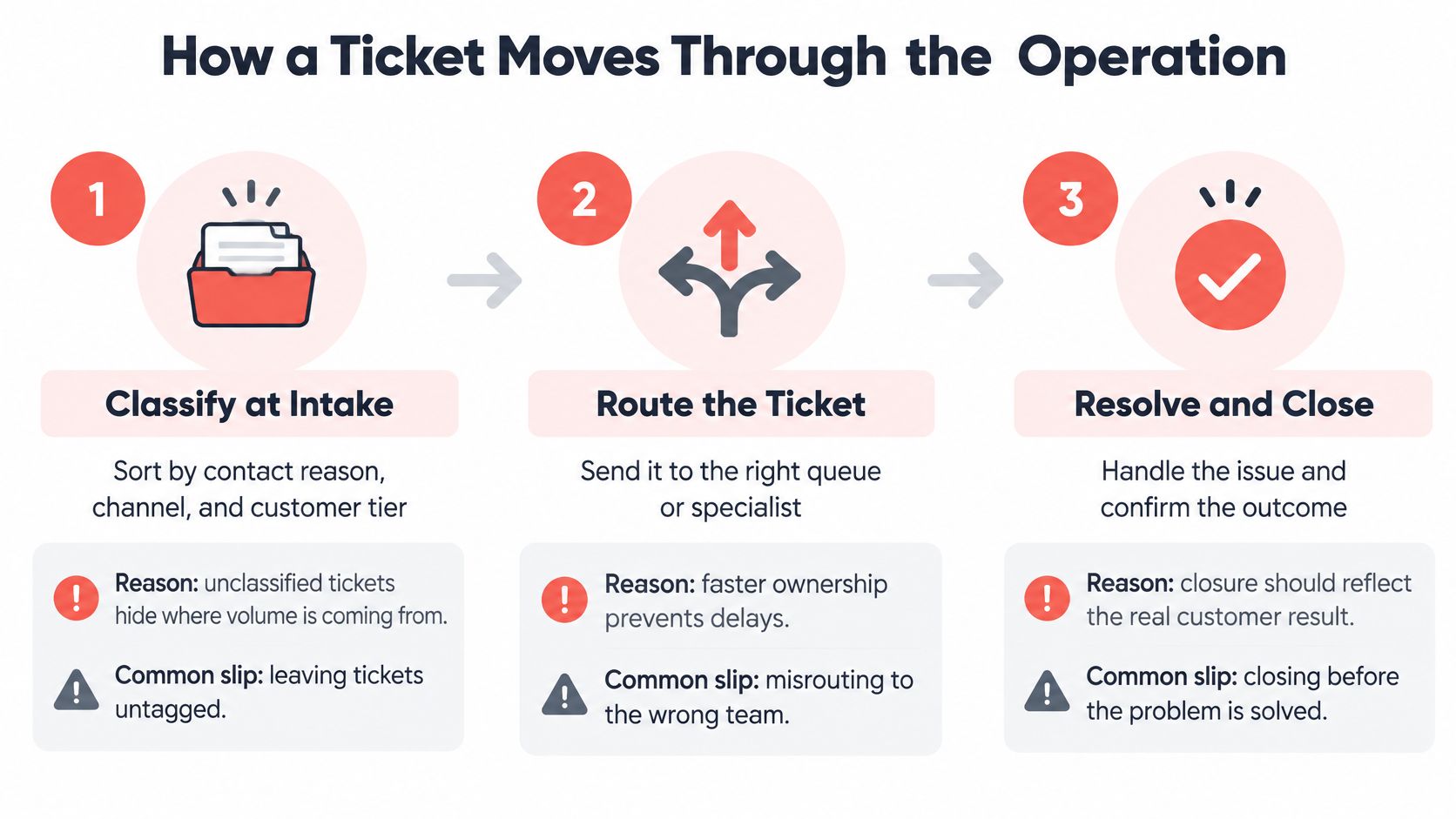
- Classify the contact by reason, channel and customer tier.
- Route it to an owner with the right authority and response target.
- Resolve or escalate using current guidance and a summary of the case history.
- Close with a reason code, then review resolved and escalated cases in QA.
- Update the process when QA finds a recurring routing error, missing answer or weak handoff.
That last step is where support operations compounds. Fixing one ticket helps one customer. Fixing a routing rule, adding a missing answer or tightening a handoff helps every customer who contacts you afterward.
This is the work our managed model is built around. We QA-check resolved and escalated cases and manage the team day to day, so recurring problems stay visible to us: the same misrouted contact, the same unanswered question, the same weak handoff. We also help clients redesign the processes behind the queue, so those problems get fixed instead of worked around.
Your company should still own policy and escalation decisions. We can flag that a refund limit is too low or an exception keeps coming up, but only you can change the rule.
Keep Coverage and AI Handoffs Honest

Coverage only counts if every shift has current answers and clear authority. A night shift that can’t approve a refund, verify an identity or reach an escalation owner is a message-taking service, not coverage. Three habits keep shifts equal: a written handoff at every shift change (open cases, known incidents, policy changes), the same QA standard on every shift and schedules people can sustain. The last one matters beyond morale. In Eagle Hill Consulting’s 2025 U.S. workforce survey, which covered employees across industries, 65% of burned-out respondents said burnout weakened their ability to serve customers. Our teams work 24/7, and our guide to operating 24/7 customer service covers what that takes. Harry Hunt, Head of Support at Cyclr, told us it was a relief to see every ticket answered since setup.
AI needs an exit rule, too. In Five9’s 2026 Consumer CX Report, a Hanover Research survey of 3,000 consumers in the U.S., U.K. and Germany that Five9 commissioned, 92% said they give an AI agent less than ten minutes before escalating to a human. The most common reason was the AI misunderstanding them (46%). Trust in AI resolution rose from 26% to 55% when a human option was clearly visible.
Set your own exit triggers, and have AI chat tools hand off when any of these occur:
- The AI fails to understand the customer repeatedly, for example after two or three attempts
- The customer asks for a person
- The issue involves financial or identity risk
- A time limit passes without resolution. Ten minutes is a reasonable starting point, but tune it to your own data
We’ve watched a customer repeat the same question to a chatbot three or four times before typing ‘agent.’ The bot had no rule for repeated misunderstanding, only for the keyword. Adding a trigger on failed attempts, not just the request for a person, moved those customers to a human sooner.
At BUNCH, our human specialists work alongside AI models. Whichever tool you use, name one person or team who owns escalations. An exit rule with no owner just moves customers into a queue nobody watches.
Before you outsource, write down your channels, hours, case owners, targets and volume forecast. That means which contact types you’re handing over, your coverage windows and time zones, who decides on refunds, exceptions and escalations, your first-response and resolution targets by issue type and your expected contacts by channel, including peaks.
If you can’t describe good work clearly, an outside team will scale the confusion. If you can, compare providers on three things: day-to-day delivery, what they do about recurring problems, and how they protect your data. Ask each one how they sample for QA, how shifts hand off, how they report repeated routing errors or missing answers back to you, and which agreements are in place, such as an NDA and a data processing agreement (DPA), and who owns the customer data.
At BUNCH, we build managed customer support teams. We source, train, QA-check and manage the specialists, and you keep ownership of policy and escalations. We have NDAs and DPAs in place with our clients, and your customer data stays yours. If you’ve written down the items above, we can scope a team around them. Talk to a BUNCH expert.
About the Author
Stay in the Loop!
Related Content

24/7 Customer Service: How to Actually Build It
A practical guide to building 24/7 customer service, covering staffing, follow-the-sun shifts, escalation, automation, and SLAs without burning the team.

Chat Support Outsourcing That Actually Works
A practical guide to chat support outsourcing for tech teams. Covers staffing, training, tooling, SLAs, and how to avoid the mistakes most buyers make.

Call Center Outsourcing: How to Plan, Evaluate and Run It
Plan, evaluate, and run call center outsourcing with a clear framework for vendor selection, SLAs, 24/7 coverage, training, and quality assurance.