Human-Centered AI: What It Is and How Teams Apply It


Human-centered AI keeps people in meaningful control of decisions while automation handles routine volume.
At BUNCH, we build and manage teams of human specialists who work hand in hand with AI models. We are an outsourcing house for high-growth tech companies, and our work sits in four areas: data labeling for AI, trust and safety (including content moderation), community and customer support (including KYC), and AI safety. We have been producing training data for ML models since 2017.
Our teams work 24/7, so we are ready when your data, your users or your content queues need us. We source, train, QA and manage each team day to day, under a defined scope of work, an SLA and a flat monthly fee. Our specialists are based in the Philippines, and we work from our offices in BGC (Metro Manila) and Bacoor (Cavite).
This article shows how we think about human oversight of AI, and where a managed team does and does not make sense.
What Human-Centered AI Means in Practice
Ben Shneiderman's 2020 framework on human-centered artificial intelligence pairs high human control with high automation. The question is not how much autonomy a system has, but where people need control and where automation helps.
In practice, a moderator reviews a contested decision, a KYC analyst clears a document mismatch, and an ML lead checks uncertain labels before they enter training data.
Benchmark accuracy alone is not enough. People must be able to understand, supervise, correct, and contest decisions. A named person should own each outcome, and reviewers should have access to the evidence behind it.
A human centered system is judged by what happens when the model is wrong.
Matching Human Oversight to Risk Level
Match the human role to the cost of an error and whether the decision can be reversed.
The NIST AI Risk Management Framework from January 2023 calls for oversight processes to be defined, assessed, and documented (MAP 3.5), with clear roles for each human-AI configuration (GOVERN 3.2). In practice, we assign owners for outputs, confidence scoring, escalation, overrides, appeals, and monitoring.
Low-risk work may need only sampled audits. High-risk work needs trained reviewers, escalation paths, and ongoing validation. Human review is not automatically safer: reviewers who see the model’s answer first may anchor on it. NIST also notes that human-AI teams can amplify bias under some conditions (Appendix C). For some decisions, show the raw evidence before the recommendation.
We noticed reviewers were agreeing with the model’s label without opening the full case, so we hid the label until the reviewer had recorded a first read. It slowed down easy cases, so we reserved it for decisions that are hard to reverse.
Automate routine tasks so people can focus on exceptions and process design. For agent-level controls in finance, see Loopfour’s post, ‘AI Agent Security in Finance: Risks and Fixes.’ Loopfour is an independent vendor of finance workflow automation software. Start with one row per decision type: configuration, owner, and escalation trigger.
How Human Reviewers Work Inside the Loop
In our moderation work, we filter user-generated content with ML foundational models and route edge cases to our human moderation teams. Our reviewers apply your community guidelines, and our QA analysts and subject matter experts audit their decisions.
Our review workflow runs in this order:
- ML filters routine volume
- Confidence and policy category route edge cases to reviewers
- A reviewer decides using written guidelines
- A second reviewer checks sampled or contested cases.
- QA audits decisions against the guidelines
- Ambiguous cases go to a subject matter expert
- Disagreements are logged
New reviewers start by shadowing, then label a shared sample alongside a team lead, and we review their disagreements with them before they take live queues.
We don’t keep second review at a fixed level. We raise the share of cases that get a second review in three situations:
- After a policy change, because reviewers are still interpreting the new wording
- When a reviewer is new, until their decisions consistently match the team lead’s on shared cases
- When a new abuse pattern appears, because the guidelines may not cover it yet and reviewers may handle it differently
We relax it one category at a time, once the second reviewer is mostly confirming the first decision and the disagreements that remain point to unclear policy rather than reviewer error. A new policy change or abuse pattern raises it again for that category.
Track agreement. A 2024 review in Artificial Intelligence and Law of 29 publications reported average agreement of 0.76 for Cohen’s kappa and 0.677 for Krippendorff’s alpha. Even trained annotators using the same scheme disagree. We treat low agreement on one category as a policy problem to fix before adding reviewers.
Treat disagreement as a signal to examine the policy, not just the reviewer.
On one moderation queue we run, two trained reviewers kept splitting on posts that quoted abusive language in order to criticize it. The guideline said “remove hate speech” and never addressed quotation. We added a borderline example, showing a post that quotes a slur to condemn it, marked ‘keep,’ with the reason written beside it, and the splits stopped.
The same principle matters when keeping client-facing AI accurate and safe. Can two reviewers reach the same decision on the same case?
When Managed Teams Help and When They Do Not
Keep review in house when policy changes constantly, decisions require deep product context, or liability cannot be transferred. Managed teams also add a handoff: if every ruling needs your product team’s input, the queue waits on you and the benefit disappears.
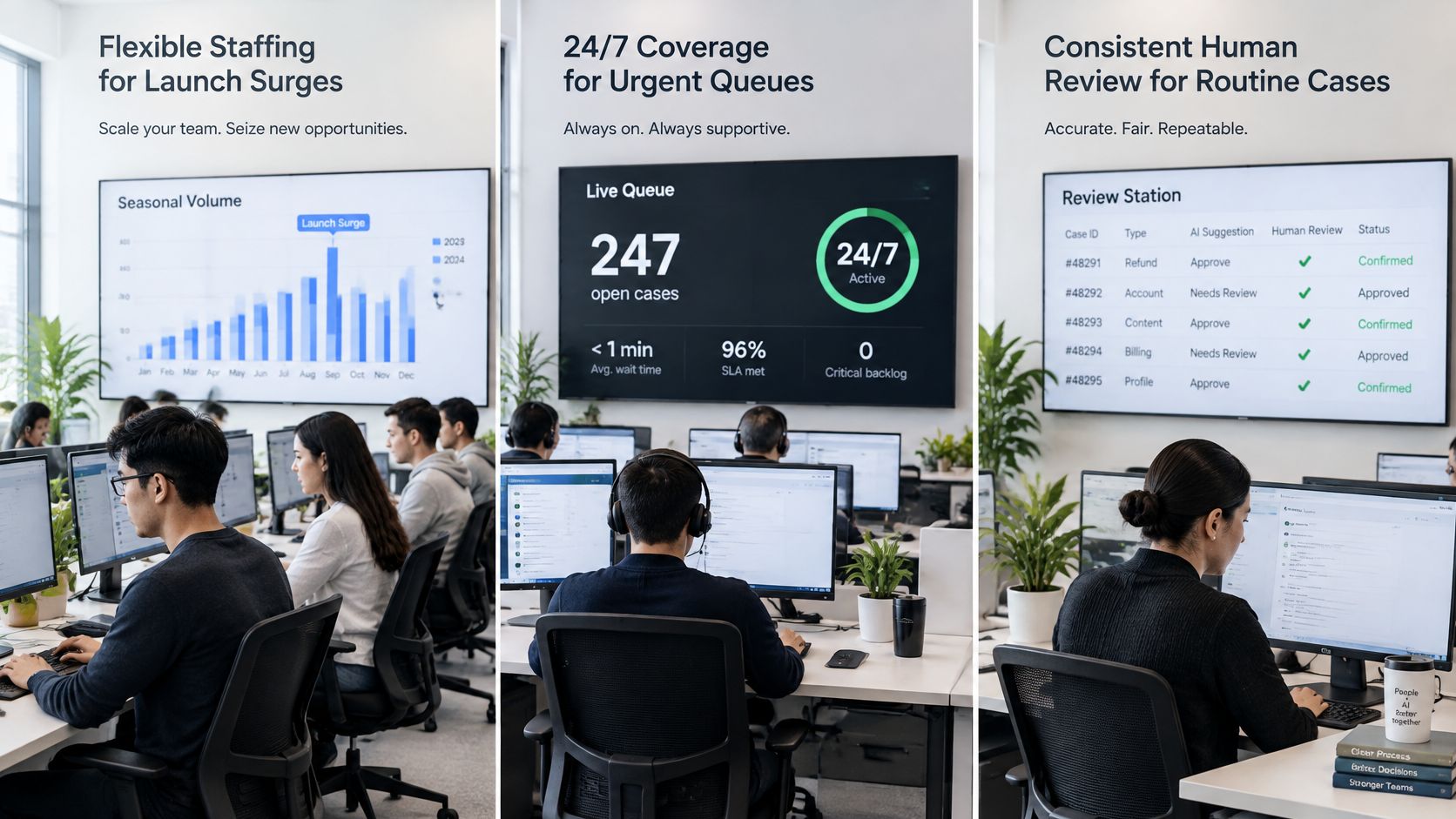
Our managed review teams fit work that follows a written policy, has volume that rises and falls, or needs coverage around the clock. Our teams work 24/7, and our specialists work alongside your AI models. You keep ownership of the policy, the escalation thresholds, and the appeals.
Managed review only helps if the review is real. Poorly designed review turns into rubber-stamping: reviewers agree with the model because the queue is long, or because disagreeing is slow and penalized. Whether you work with us, another provider, or your own team, ask:
- Challenge path: Can reviewers dispute model decisions without a productivity penalty?
- Training: Do reviewers learn to recognize automation bias, and are they calibrated on shared cases?
- Sustainability: How are fatigue, turnover, and exposure to harmful content tracked, and who acts on what the tracking shows?
For more on how we set up these teams, read our guide to AI managed services.
Measuring Whether Oversight Works
Appeals reveal errors that removal counts miss. Since 2024, EU users have appealed more than 165 million moderation decisions by very large online platforms through the platforms’ own complaint systems, and almost 30% were reversed (European Commission, updated 19 May 2026). A reversal can reflect new context or a policy change, not only an initial error.
Use the results. High disagreement may call for clearer policy; rising reversals may call for new thresholds; falling gold set accuracy calls for calibration. Log which rule applied and why decisions were upheld or reversed. Our AI evaluation framework covers how to structure that review.
Steps Product Teams Take to Adopt It
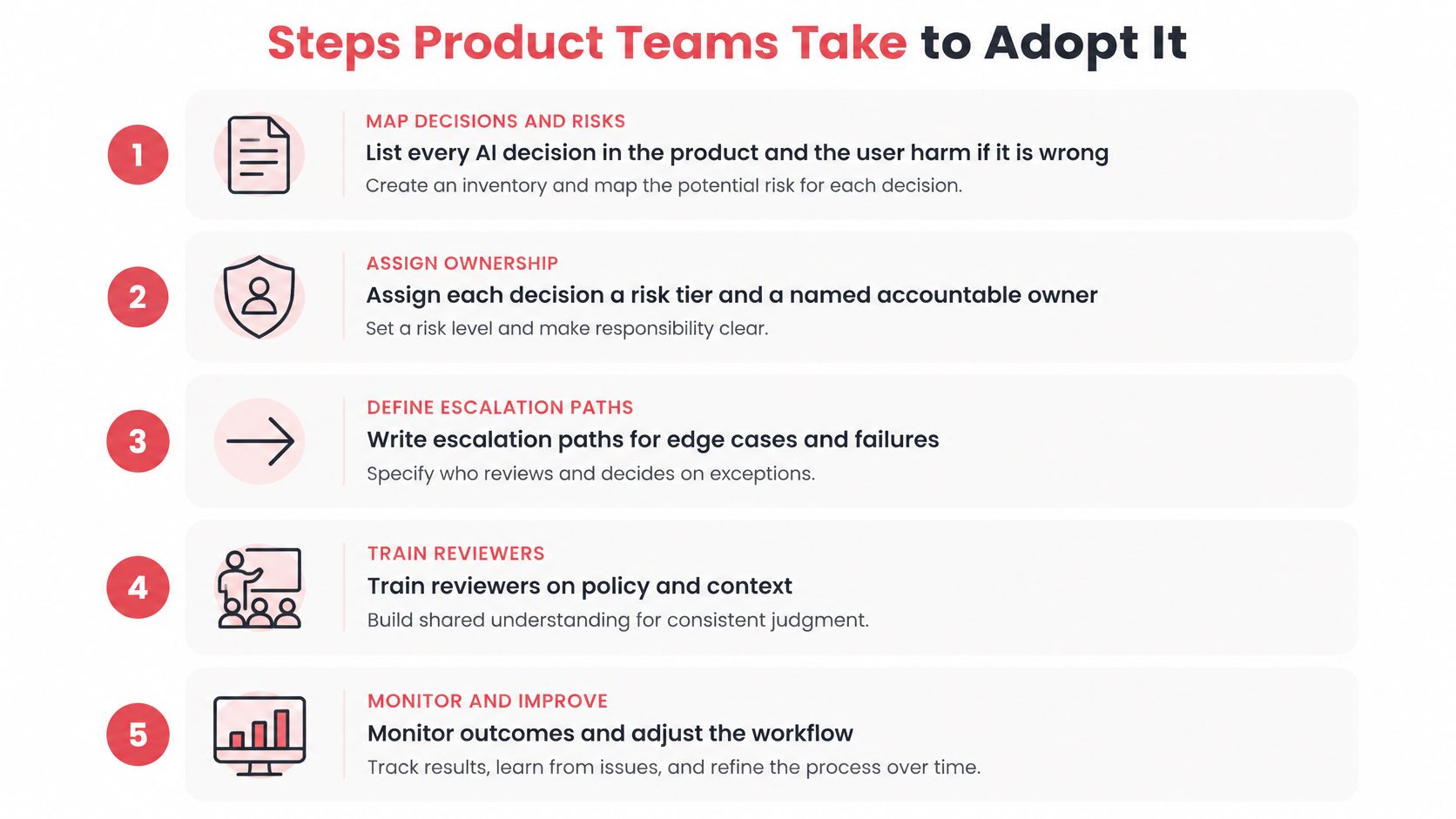
- List AI decisions and the harm each error could cause
- Assign risk tiers and a named owner for each decision
- Set escalation thresholds and an appeal path before launch
- Write guidelines with clear and borderline examples
- Calibrate reviewers on shared samples and track agreement
- Set sampling and double-review rates by risk tier
- Feed corrections back into policy and model updates
- Revisit tiers quarterly as the product changes
The result is a decision map with owners, thresholds, and a feedback loop.
Questions to Answer Before You Choose an Oversight Model
Does every AI output need human review?
No. Low-risk, reversible outputs can be sampled if escalation triggers are clear. A KYC exception that blocks a customer needs a person. Confidence alone should not determine the review rate. Set it by the harm if the decision is wrong, whether it can be reversed, how new the content is, and whether the model’s confidence is reliable on that kind of content.
How many reviewers do we need?
Pilot through a full policy cycle. Measure volume and review time by risk tier, then staff for the resulting queue, not total AI output.
Can we outsource and still be human-centered?
Yes. Keep policy ownership, escalation thresholds, and appeals in house. Our review team reports decisions and oversight metrics back to you.
At BUNCH, we build managed human review teams for data labeling, content moderation, KYC verification, customer support and AI safety work. Our specialists work alongside your models, under your policies. If you want a second view on your oversight tiers, talk to a BUNCH expert.
About the Author
Stay in the Loop!
Related Content

8 Managed Services Examples for Tech Operations
Explore 8 managed services examples across labeling, moderation, support, KYC and AI safety, with scope, SLAs, outcomes and practical lessons.

How to Build an AI Evaluation Framework
Build an AI evaluation framework with practical metrics, test datasets, human review protocols, red-teaming methods, scoring rubrics and production checks.

AI Summit Barcelona: Why AI Systems Need People to Succeed
AI works behind the scenes to filter spam, answer tickets, and moderate content. But the best companies still rely on people to catch mistakes and improve AI.